
Introduction
There is something truly magical about taking a single strand of yarn and a hook and transforming it into a cozy blanket, a stylish cardigan, or a sweet, handcrafted gift. If you have ever felt drawn to the rhythmic, meditative art of fiber crafts, you have likely found yourself wondering about the differences between the two most popular methods: crochet and knitting. Choosing between them—or, as many of us do, deciding to learn both—is a wonderful journey into creativity.
Choosing to learn what a crochet stitch is, and how it differs from traditional knitting, is the perfect starting point for your handmade adventure. Whether you are a total beginner who has never held a hook, or an intermediate crafter looking to truly understand the mechanics of your hobby, this guide is designed to act as your friendly companion. We will peel back the mystery behind these two crafts, help you understand the unique vocabulary of our community, and give you the confidence to pick up your hook and start creating with joy and purpose. Let’s dive into the cozy world of loops, hooks, and rhythmic stitches!
Quick Overview: What You Will Learn
This guide is for anyone who appreciates the beauty of fiber arts and wants to gain a deeper understanding of the “how” and “why” behind their projects. We will walk through the core conceptual differences between crochet and knitting to clarify why each technique produces such unique textures, drape, and structures.
Specifically, you will learn:
- The primary functional difference between a crochet stitch and a knit stitch.
- Why these two crafts require different tools and movements.
- How to identify the “live stitches” characteristic of knitting versus the “finished loops” of crochet.
- Practical tips for deciding which craft is better for specific projects like clothing, home decor, or gifts.
- Common terminology used in the United States to keep your work consistent and professional.
The Core Concept: What Is a Crochet Stitch?
At its heart, a crochet stitch is a loop of yarn pulled through another loop. When you crochet, you usually work with one active loop at a time. You keep that loop on your hook, pull a new loop through it, and secure it. Because each stitch is essentially “locked” as you go, crochet is incredibly stable. If you drop your hook, your project generally isn’t going to unravel suddenly—unlike some other fiber arts.
This process of creating and securing individual loops creates a fabric that is often slightly thicker and has more structural integrity. Because you are using a single hook to manipulate the yarn, you have incredible versatility; you can easily change the shape of your fabric by increasing or decreasing stitches in a way that feels very intuitive, almost like sculpting with fiber.
Differences Between Crochet and Traditional Knitting
While both crafts use yarn to create fabric, they approach the construction of that fabric from completely different architectural standpoints. Understanding this will help you choose the right tool for your next creative goal.
The Tool and Technique
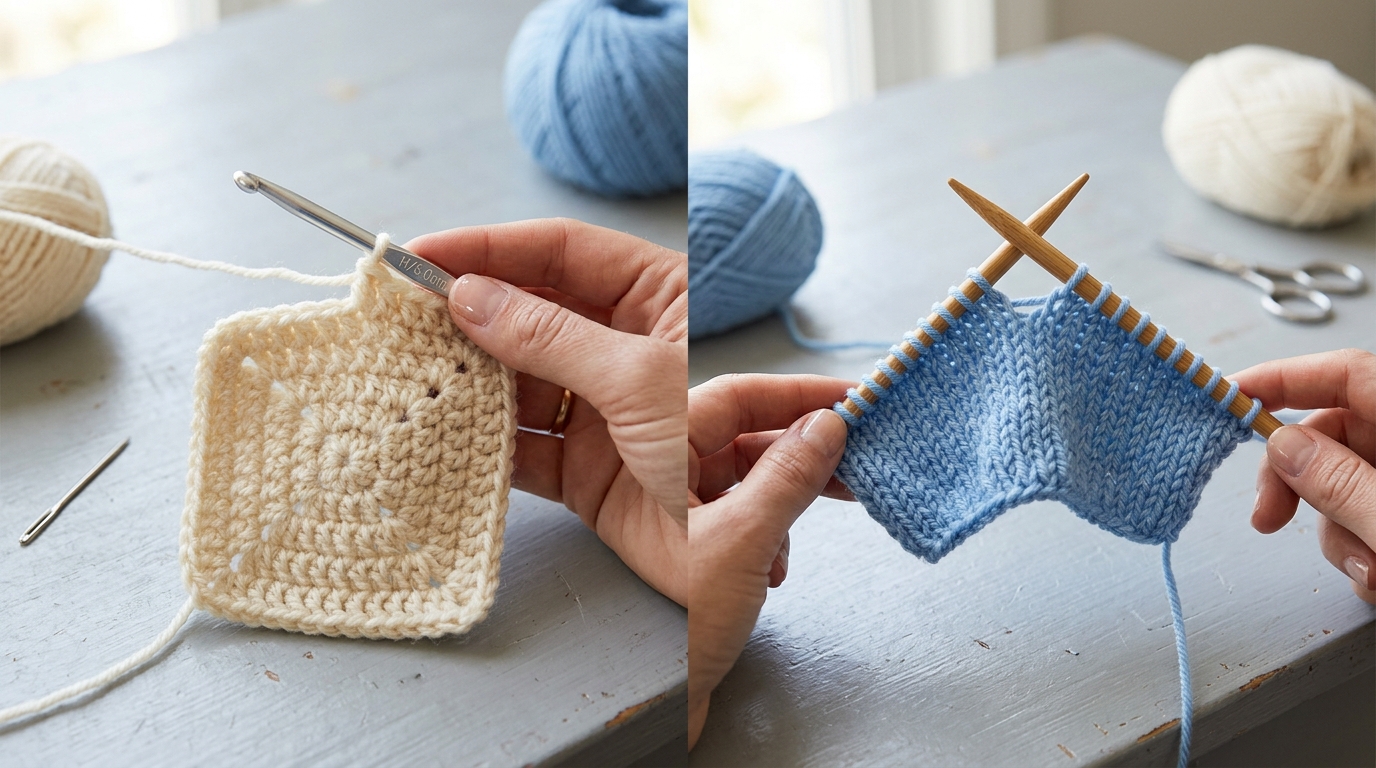
The most obvious difference is in the tools. Crochet is performed with a single hook, while knitting is performed with two needles (or a circular cord with two pointed ends).
In knitting, you hold a series of “live” stitches on your needles at one time. If you were to pull your needles out of a project before it was finished or bound off, the entire row would likely pull apart instantly. This is because knitting relies on a sequence of open loops held in a row, waiting for the next row to be worked through them.
In crochet, because you are only dealing with one active, finished loop at a time, the fabric has a “locked” nature. This makes it much easier to put your project down mid-row, as you only have to secure that single hook loop.
Texture and Drape
Generally speaking, crochet fabric tends to be denser and slightly more textured than knitted fabric. Because of the way loops are pulled through other loops in crochet, the resulting fabric has a higher degree of thickness. This makes crochet absolutely ideal for home decor items like heavy blankets, rugs, or structured baskets, as well as three-dimensional items like amigurumi (stuffed toys).
Knitting, on the other hand, creates a fabric that is usually thinner, more fluid, and possesses a beautiful, silky drape. This is why you will often see sweaters and delicate garments created with knitting; the fabric contours to the body in a way that is often lighter and more flexible than standard crochet.
Versatility in Shape and Structure
Crochet is arguably the most versatile craft when it comes to free-form shapes. Because it is simple to increase and decrease in a grid, you can create circular items, hexagonal motifs, or complex 3D shapes with very little stress. Knitting is also capable of these shapes, but it often requires more complex pattern reading and technical knowledge (like short rows or complex shaping) to achieve the same results that come quite naturally to a crocheter.
Crochet Terms Every Beginner Should Know
To get started with confidence, it helps to speak the local “language” of crochet. In the United States, our terminology is standardized to make patterns easy to read.
- Hook: Your primary tool. Sizes range from tiny steel hooks for lace to large wooden ones for chunky wool blankets.
- Chain (ch): The foundation of most projects. It involves pulling the yarn through a loop to start a new sequence.
- Single Crochet (sc): The most basic, sturdy stitch. It creates a tight, dense fabric.
- Half Double Crochet (hdc): A taller, slightly looser stitch that is often used for garments.
- Double Crochet (dc): A very popular, tall stitch that works up quickly and has lovely drape.
- Slip Stitch (sl st): Used to join rounds or move across a piece of fabric without adding height.
- Gauge: The number of stitches and rows that fit into a standard measurement (like four square inches). This determines if your finished piece will be the correct size.
- Fasten Off: The act of cutting the yarn and pulling it through the final loop to secure the project before weaving in the ends.
Helpful Tips for Your First Moves
If you are coming to crochet from a place of curiosity, remember that your tension is the most important thing you can master. When you first start, your stitches might be too tight, making it difficult to insert your hook into them on the next row. This is completely normal!
Try these practices to set yourself up for success:
- Use a light color: Don’t start with black or navy blue yarn; it is very hard to see the anatomy of the stitches in dark colors. Choose a soft, light-colored worsted weight yarn to start.
- Relax your hands: If you find your hands aching, you are likely gripping the hook too tightly. Take a breath and let your fingers move loosely.
- Count your stitches: Beginners often lose stitches at the ends of rows. Use a stitch marker to mark the first and last stitch of every row so you don’t accidentally skip one.
- Practice consistency: Don’t worry about making a perfect blanket right away. Just make rectangles, squares, or long strips to get the feel of the yarn sliding through your fingers.
Common Mistakes to Avoid
Even experienced crocheters make mistakes, but avoiding these common pitfalls will save you a lot of time and frustration.
- The Twisted Chain: When starting a project in the round, make sure your long starting chain isn’t twisted before you join it. It’s a classic mistake that ruins the shape of a hat or cowl.
- Ignoring the Turning Chain: Beginners often forget that the “turning chain” at the start of a row often counts as an actual stitch. Always check your pattern to see if the chain counts as a double crochet or just height.
- Wrong Hook Size: If your fabric feels like cardboard, your hook is too small. If it feels like a loose net, your hook might be too large. Adjusting your hook size is the fastest way to fix your gauge.
- Weaving in ends too quickly: Never trim your yarn tail until you are absolutely sure you won’t need it to fix a mistake or tighten a seam. Always weave in your ends securely on the back of the work to ensure your beautiful gift stays together for years.
Pro Tips for a Better Result
As you progress from being a beginner to an intermediate crocheter, focus on these three areas to polish your work:
Master Your Tension
Tension is the “secret sauce” of beautiful crochet. Use a tension gauge if you are making clothing, or practice “tensioning” the yarn by weaving it through your fingers in a way that provides consistent drag. The goal is even, uniform stitches that don’t look pulled or gapped.
Understand Fiber Content
Not all yarn is created equal. Cotton is beautiful for home decor and dishcloths because of its structure, while wool is warm and has “memory,” making it great for clothing. Acrylic is wonderful for beginners because it is durable and washable. Before choosing a skein, read the label—it tells you exactly which hook size the manufacturer suggests.
The Power of Blocking
If you have finished a piece and it looks a little wonky, do not be discouraged! Blocking is the process of gently misting or soaking your finished item and pinning it into the correct shape while it dries. It relaxes the fibers and makes your stitches look professional, crisp, and uniform.
Frequently Asked Questions
Which is easier to learn: crochet or knitting?
Most people find that because crochet only requires managing one live loop at a time, it is slightly more intuitive for beginners to learn than the two-handed, two-needle coordination required for knitting.
Can a crochet pattern be converted into a knitting pattern?
Not directly. Because the stitch structure, thickness, and yardage requirements of crochet and knitting are so fundamentally different, a pattern designed for one craft cannot simply be “swapped” for the other. You would essentially have to design the project again from scratch.
Do I need to buy expensive equipment to get started?
Absolutely not! All you truly need is one skein of yarn and the corresponding hook size recommended on the yarn label. There is no need for a fancy kit until you are sure you love the craft.
Can crochet projects be unraveled and reused?
Yes! That is one of the distinct joys of fiber arts. If you make a mistake or decide you no longer want a project, you can gently “frog” (pull out) the stitches and reuse the yarn for something new.
How do I know if the yarn is the right weight?
The yarn label will almost always have a little symbol with a number 1 through 7 inside it. This indicates the “weight.” For beginners, a “4” (Worsted/Medium) is the most comfortable and versatile to work with.
Conclusion
Starting your journey into crochet is more than just learning how to pull yarn through a loop. It is about beginning a tradition of creating something beautiful with your own two hands. Whether you are crafting a gift for a loved one, a new accessory for your home, or simply finding a quiet way to spend your evenings, you are joining a vibrant community of makers.
Remember that there is no rush. Every stitch you make is an improvement on the last. If you make a mistake, you can simply pull it out and try again—that is the beauty of this medium. Keep your hook close, your yarn stash cozy, and most importantly, enjoy the process of turning a simple string into something uniquely yours. You have everything you need to start right now. Happy crocheting!