
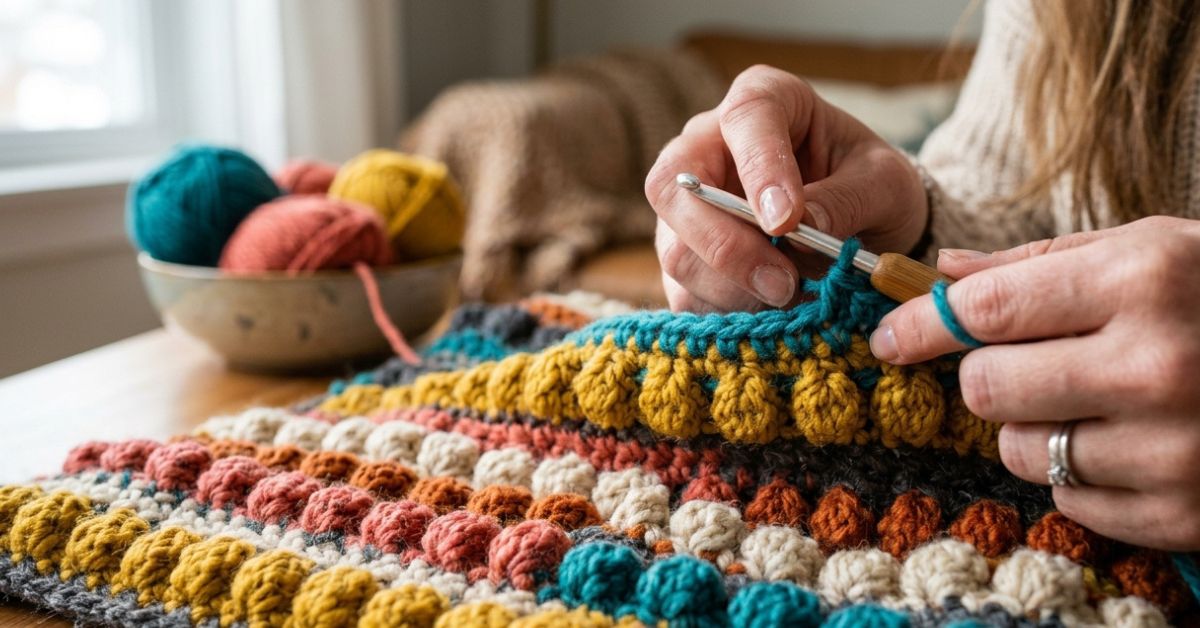
There is something truly magical about the way a simple length of yarn transforms under your fingertips. If you have been looking for a way to add a bit of personality, depth, and professional flair to your handmade blankets, you have come to the right place. The bobble stitch is a classic technique that creates a wonderful, bumpy texture—the kind that begs to be touched and makes a throw blanket feel like a high-end boutique piece.
When you incorporate bobbles into your designs, you aren’t just making a blanket; you are creating a sensory experience. These little “pops” of yarn add weight and warmth, making them perfect for chilly autumn evenings or as a special heirloom piece for a nursery. While the bobble stitch might look intricate or intimidating to a beginner, it is actually quite simple to master once you understand the rhythm. This tutorial is designed to walk you through the process step-by-step, providing you with all the confidence you need to infuse your home with cozy, handcrafted luxury. Whether you are a brand-new crocheter or someone who has been hooking for years, you will find joy in watching these lovely little textures emerge as you work.
Quick Project Overview
- Skill Level: Beginner-Friendly Intermediate. If you can double crochet, you can master the bobble stitch!
- Estimated Time: 8–12 hours for a full-sized throw, depending on your speed and the complexity of your pattern.
- Finished Size: Approximately 40″ x 50,” though this is easily customizable.
- Best Use: This texture is perfect for living room throws, baby blankets, or even textured wall hangings.
- Why You Will Love It: It adds instant “wow” factor to a basic blanket without requiring complicated color changes or advanced lace techniques.
Materials Needed
To create your own bobble texture masterpiece, you will need a few simple supplies:
- Yarn: Worsted weight (4) yarn is ideal for beginners. A soft acrylic or a wool-blend works beautifully to ensure the bobbles hold their shape while remaining snuggly. You will need approximately 1,800 to 2,000 yards for an average throw.
- Crochet Hook: A size H/8 (5.0 mm) hook is standard for worsted weight. If you crochet loosely, consider going down to a G/7 (4.5 mm) to keep your bobbles firm.
- Tapestry Needle: Essential for weaving in those ends securely.
- Scissors: Any sharp pair will do.
- Measuring Tape: To keep your dimensions consistent.
Stitches and Abbreviations
- Chain (ch): Yarn over, pull through the loop on the hook.
- Single Crochet (sc): Insert hook, yarn over, pull up a loop, yarn over, pull through both loops.
- Double Crochet (dc): Yarn over, insert hook, yarn over, pull up a loop, yarn over, pull through two loops, yarn over, pull through remaining two loops.
- Bobble Stitch (BO): Yarn over, insert hook into next stitch, yarn over, pull up a loop, yarn over, pull through two loops (you will have two loops on your hook). Repeat the yarn over and pull through two loops process 4 more times in the same stitch. You will end up with 6 loops on your hook. Yarn over and pull through all 6 loops at once.
- Stitch (st/sts): The foundation of your work.
Pattern Notes Before You Start
The most important aspect of a beautiful bobble blanket is maintaining consistent tension. Because the bobble stitch pulls a lot of yarn, it is natural for the fabric to tighten up slightly. Keep your tension relaxed on the single crochet rows that sit between your bobble rows. If the blanket feels like it is shrinking, try going up a half-size hook for the rows between the bobbles, then return to your normal hook size for the bobble row itself.
Full Crochet Pattern
This pattern is worked back and forth in rows. We will use a “Bobble Row” followed by three rows of “Plain Single Crochet” to ensure the texture really pops.
Part 1: The Foundation
Foundation: Ch 120 (or any multiple of 4, plus 2 for turning).
Part 2: Working the Rows
Row 1: 1 sc in the second ch from hook and in every ch across. Ch 1, turn.
Row 2: 1 sc in each st across. Ch 1, turn.
Row 3: 1 sc in the first 3 sts. Work 1 Bobble (BO) in the next st, 1 sc in the following 3 sts. Repeat from to across until you reach the end of the row. Ch 1, turn.
Row 4, 5, and 6: 1 sc in every st across. Ch 1, turn (at the end of Row 6).
Part 3: Establishing the Rhythm
Repeat Rows 3 through 6 until your blanket reaches your desired length. By alternating the bobble row with three rows of single crochet, you give the bobbles “room to breathe,” which makes them stand out much more clearly against the flat background.
Part 4: The Finishing Border
Once the main body is complete, do not fasten off immediately. Crochet one round of single crochet around the entire perimeter of the blanket, placing 3 sc into each corner to ensure the edges lie flat. This creates a clean, polished frame for your textured work.
Step-by-Step Tutorial Explanation
When you perform the BOBBLE (BO) stitch, you are effectively creating a cluster of double crochets that are joined at the top. When you pull that final loop through all six loops on your hook, the cluster is pushed forward, creating the raised sphere.
If you are a beginner, watch the “gap” in your stitches. In the row immediately after the bobble row, the single crochets will sit right on top of the bobble you just created. Make sure you don’t skip the stitch directly behind the bobble. If you find you have too few stitches at the end of the row, it is almost always because you accidentally skipped the stitch that holds the bobble!
Common Mistakes to Avoid
- Over-tightening: Beginners often pull their yarn too tight when finishing the bobble, causing the bobble to collapse inward rather than puffing outward. Practice keeping the yarn loose until the very final pull-through.
- Skipping the “Anchor” Stitch: Always count your stitches at the end of every row. If you started with 120 stitches, ensure you have 120 stitches when you turn. If you have 119, you likely skipped the stitch “behind” a bobble.
- Using uneven yarn: While variegated yarn is beautiful, it can sometimes hide the texture of the bobbles. For your first project, stick to solid colors so you can see your stitch construction clearly.
Pro Tips for a More Beautiful Result
- Blocking: This is non-negotiable for high-end textures. Once the blanket is finished, gently mist it with water and pin it to a flat surface. This “sets” the bobbles and makes them uniform across the entire surface.
- Yarn Choice: Look for a yarn that has a slight “bounce” or “spring.” Avoid very silky, thin yarns, as they tend to let the bobble sag. A nice, tightly spun wool or a premium acrylic with a soft twist is perfect.
- The “Pop” Technique: If your bobbles feel a bit flat, gently push them from the back side with your thumb. This physically encourages the “popped” look on the front side of the blanket.
Variations and Personalization Ideas
- The Checkerboard Pop: Instead of doing a full row of bobbles, place a single bobble every 10 stitches, then stagger them in the next bobble row so they form a diamond pattern.
- Color Blocking: Use one color for the plain rows and a secondary, contrasting color for the bobble rows. This makes the texture pop even more dramatically.
- Seasonal Touches: For a winter gift, use a snowy white yarn for the bobbles against a deep forest green background to replicate a textured, cozy look.
Care Instructions
Hand-knitted or crocheted items last longest when treated with a little extra care. For a bobble blanket, we highly recommend hand washing in cool water with a gentle wool wash. Avoid wringing the blanket; instead, lay it flat on a clean towel and roll it up like a sleeping bag to squeeze out the excess moisture. Lay it flat to dry away from direct sunlight to keep the colors vibrant and the bobbles springy. While most acrylic yarns are machine washable, placing the blanket inside a laundry mesh bag will prevent the bobbles from snagging on other items in the wash.
FAQ
Why do my bobbles look flat?
Flat bobbles usually happen due to tension issues. If your yarn is too thin or your stitches are too tight, the bobble won’t have enough room to puff forward. Try using a slightly larger hook for the bobble row only, or ensure you aren’t pulling your yarn too tightly when closing the stitch.
Can I do this stitch with a cotton yarn?
Yes, but be aware that cotton has very little “stretch.” It will make for a beautiful, heavy, and very defined bobble, but it will be physically harder on your hands to work with, as cotton doesn’t offer the same elasticity as wool or acrylic.
How do I join a new skein of yarn during a bobble row?
Try to avoid joining yarn in the middle of a bobble. If you run out of yarn, finish the row, fasten off, and join your new skein at the beginning of the next single crochet row. This ensures the bobbles remain uniform and free of complicated knots.
Are bobble stitches hard to wash?
Not at all, as long as you are careful. The biggest risk is snagging. Always turn your work inside out if possible, or use a laundry bag to ensure that the raised texture of the bobble doesn’t catch on your washing machine agitator.
Is this stitch suitable for a baby blanket?
Absolutely! The texture is excellent for sensory development. Just ensure that the bobbles are tightly crocheted so that there is no risk of little fingers pulling loops loose. Using a soft, high-quality baby-safe acrylic is the best choice for these projects.
Conclusion
The bobble stitch is truly a gift to the crochet world. It adds depth, warmth, and a professional level of detail that makes any simple blanket look like a designer piece. By taking your time, keeping your tension steady, and following the pattern rhythm, you will create a blanket that not only keeps its user warm but also brings a smile to their face every time they touch it.
Crochet is a journey of growth, and every new stitch you learn is another tool in your creative belt. Don’t be afraid to experiment with your color choices or to try this stitch on smaller projects, like a decorative pillow cover, before committing to a large blanket. We hope this tutorial inspires you to pick up your hook today. There is no feeling quite like the final stitch of a new project, and we can’t wait to see the beautiful texture you bring into your home. Happy crocheting!