
Introduction
Welcome to the wonderful, rhythmic world of crochet! If you have been admiring cozy handmade blankets on Instagram, seeing adorable plushies at markets, or simply looking for a peaceful creative outlet, you have come to the right place. There is something truly magical about taking a single strand of yarn and a hook and transforming it into something tangible, beautiful, and uniquely yours.
Many beginners feel intimidated by the sheer variety of tools available in the craft aisle, but the truth is that you need far less than you might imagine to get started. My goal with this guide is to demystify the essential tools of the trade so you can approach your first project with confidence rather than confusion. Whether you are picking up a hook for the very first time or you are a hobbyist looking to refine your kit, understanding your materials is the absolute best way to set yourself up for success. We will walk through the basics together, keeping things simple, practical, and, most importantly, fun. You are about to unlock a lifelong hobby that provides comfort, warmth, and a deep sense of accomplishment. Let’s get your craft room ready for your very first stitches.
Quick Overview
This guide is designed for the absolute beginner who wants to invest wisely in quality tools. You will learn how to identify the right yarn weight for your first project, why specific hook materials feel different in the hand, and which small accessories will make your experience smoother and more professional. This is for the woman who values quality over clutter and wants to start her crochet journey feeling prepared and organized. By the end of this guide, you will know exactly what to put in your “starter kit” and why each piece is essential for building your skills.
Essential Materials for Your First Project
The beauty of crochet is its simplicity: you really only need yarn and a hook. However, once you start, you will find that a few extra “helper” tools make a world of difference. Here is what you should focus on gathering first.
Choosing Your First Yarn
For your first project, avoid dark colors—they make it nearly impossible to see your stitches! Reach for a medium-weight yarn, often labeled as “worsted weight” or “Category 4” on the label. Acrylic blends are wonderful for beginners because they are durable, affordable, and easy to wash. Look for a yarn with a smooth twist, meaning the strands aren’t too fuzzy. A fuzzy texture (like mohair) hides your mistakes and makes it incredibly difficult to undo your work if you need to “frog” (unravel) a row.
Selecting the Right Crochet Hook
Crochet hooks come in various materials, including wood, bamboo, plastic, and metal. Metal hooks are generally the standard for beginners because they allow the yarn to glide easily. Bamboo or wooden hooks are fantastic if you find that your hands get tired quickly, as they provide a slightly warmer, grippy feel. For your first purchase, look for a size H/8 (5.0 mm) hook. This size is the “goldilocks” of the crochet world—it is large enough to be easy to hold but small enough to work with the versatile worsted weight yarn we mentioned.
The Must-Have Notions
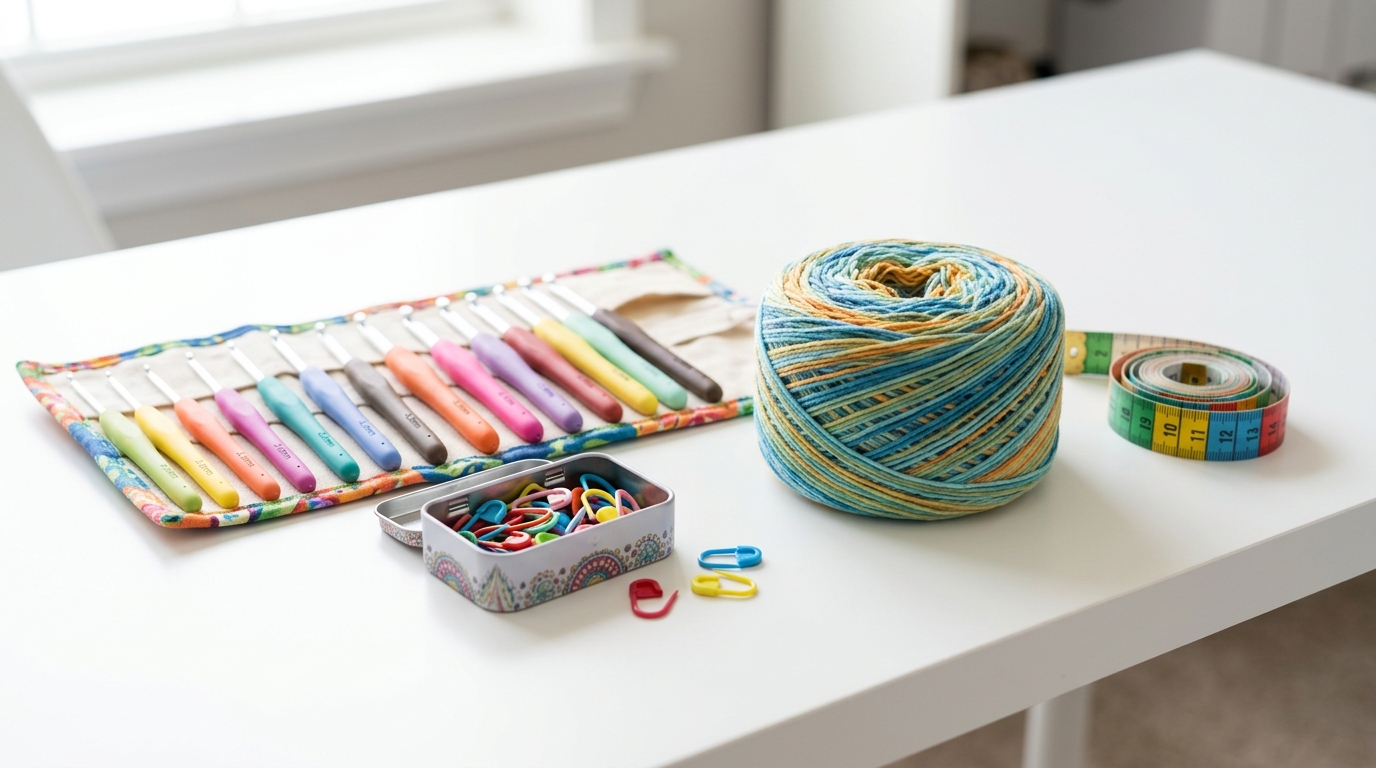
While you could technically finish a project with just a hook and yarn, your life will be much easier with these three extras:
- A Yarn Needle: These are blunt, large-eyed needles used to weave in your ends. Never try to weave in yarn with a sharp sewing needle!
- Stitch Markers: These little clips act as your “bookmarks.” They help you keep track of where a row begins or ends, and they are lifesavers when you lose count of your stitches.
- Small Scissors: Any sharp pair will do, but keep them in your project bag so you aren’t hunting for them when it’s time to fasten off.
Understanding Key Crochet Concepts
Before you buy your first skein, it helps to know a few terms that will appear on almost every project you choose to make.
What is Gauge?
You will see the word “gauge” on every pattern. It essentially refers to how many stitches you fit into an inch. It is important because if your stitches are tighter or looser than the pattern designer’s, your finished item might end up a different size. As a beginner, don’t stress about matching gauge perfectly, but do be aware that your “tension” (how tightly you pull the yarn) will naturally evolve as your hands get comfortable.
Yarn Weight Basics
Yarn is categorized by weight, which isn’t how much it weighs on a scale, but how thick the actual strand is. Category 1 is very thin (like sewing thread), while Category 6 or 7 is thick and chunky. Sticking to Category 4 (worsted) is the standard for 90% of beginner projects. It’s the “home base” of yarn thicknesses.
The Role of Stitches
Everything you make will be a combination of basic stitches:
- Chain: The foundation of almost every piece.
- Single Crochet: A short, sturdy stitch perfect for amigurumi or dense accessories.
- Double Crochet: A taller stitch that works up quickly, ideal for blankets and scarves.
- Slip Stitch: Used to join rounds or create invisible seams.
Helpful Tips for Beginners
Even with the best tools, you might hit a few bumps in the road. Here is how to keep your spirit high.
Tension Matters
You might find your first few rows look a bit uneven. That is perfectly normal! Tension is essentially “muscle memory.” Some of your stitches might be tight, and some might be loose. The best practice is to stop after 10 rows and look back. Does it look consistent? If yes, you are doing great. If not, don’t be afraid to take it apart and try again. It’s part of the process.
Comfort in Your Hands
Pay attention to how you hold your hook. Some people hold it like a pencil, others like a dinner knife. There is no “right” way—only the way that prevents your hand from cramping. If you notice your knuckles aching, take a break. Stretch your fingers and shake out your wrists. Crochet should be a relaxing therapy, not a workout.
Organizing Your Workspace
Keep your supplies in a designated basket or bag. When your yarn is rolling under the couch or your hook is lost in the couch cushions, you are far less likely to pick up your project during a spare fifteen minutes. A small, dedicated “crochet corner” where your materials stay organized is a great way to invite more creativity into your day.
How to Get Started with Your First Toolset
If you feel ready to head to the store or browse online, here is your shopping list for a successful start.
Prioritize Quality Over Quantity
It is tempting to buy the cheapest yarn you find, but cheap, scratchy yarn can actually make your hands hurt and ruin the joy of the craft. Look for a “soft” acrylic or a cotton-acrylic blend. Touch the yarn. If it feels nice against your cheek, it will feel nice to work with for hours.
The “Stitch Marker” Trick
Even for simple scarves, use stitch markers! Place one at the very first stitch of your row. When you come back around, you will know exactly where to put your needle. This simple act prevents the most common beginner frustration: accidentally adding or losing stitches at the end of a row, which causes your rectangular project to turn into a wonky triangle.
Don’t Panic Over Terminology
You will see “U.S. Terms” versus “U.K. Terms.” This can be confusing because the names of the stitches are the same, but the meanings are different! Since you are likely looking at American patterns, just remember that the “Single Crochet” is the gold standard for U.S. patterns. If you see a pattern and follow these U.S. terms, your work will turn out exactly as the designer intended.
Common Mistakes to Avoid
We have all been there—the “too-tight” chain or the “missing stitch.” Here is how to navigate the common pitfalls.
The “Death Grip”
Many beginners hold their yarn and hook with a white-knuckled “death grip.” This makes it impossible to pull the hook through the loops. Try to consciously relax your hands. If you are struggling to pull the yarn through a loop, your tension is likely too tight. Practice holding the yarn loosely, letting it glide through your fingers.
The Twisted Starting Chain
When joining a foundation chain to work in the round, it is incredibly easy to twist the chain. Always lay your chain flat on a table before joining it to ensure the bottom edge is perfectly straight. If it looks like a Mobius strip, undo it and lay it flat again. It is better to spend thirty seconds fixing it now than to finish a whole hat that is permanently twisted.
Choosing Dark or Black Yarn
I cannot stress this enough: stay away from black, navy, or deep purple yarn until you have a few projects under your belt. You need to see the “anatomy” of the stitch (the V-shaped loops) to understand where to put your hook next. Stick to light, bright, or neutral colors (like sage green, cream, or soft pink) to make your life easier.
Pro Tips for a Smoother Routine
Once you have mastered your first few small projects, keep these tips in your back pocket to level up your work.
Mastering Your “Ends”
Weaving in ends is the part of crochet that everyone dislikes, but it is the secret to a professional-looking project. Leave a tail of at least 6 inches when you finish a yarn color. Instead of just snipping it off, use your yarn needle to weave it back and forth through the stitches on the back side of your work in at least three different directions. This ensures your project won’t unravel in the wash.
Blocking Your Projects
If you make a lace scarf or a delicate granny square, it might look a little “wonky” when it comes off the hook. Blocking involves gently washing your piece and pinning it into the correct shape while it dries. It transforms a rustic-looking item into a polished, professional piece of art.
The Value of Practice Swatches
If you want to try a new, fancy stitch pattern, don’t start it on a blanket! Make a small 4×4 inch “swatch” first. It gives you a chance to learn the stitch rhythm without committing to a massive project. Plus, you get a cozy little coaster as a bonus!
FAQ
Is it hard to learn crochet?
Not at all. It is a series of simple, repetitive motions. If you have the patience to practice for a few hours, you will have the basic stitches down in no time. The most important skill is patience with yourself!
Why is my crochet project triangle-shaped instead of square?
This usually means you are accidentally dropping stitches at the ends of your rows. Use a stitch marker in the first and last stitch of every row to ensure you are consistently working into the final stitch every single time.
Does it matter which crochet hook brand I use?
At the beginner level, the most important thing is that the hook is smooth. Metal or polished wood hooks are excellent. Avoid super cheap plastic hooks if they have a “seam” or a rough edge, as this will catch on your yarn and make it frustrating to pull through.
How do I know which yarn to buy for a pattern?
Every pattern has a “Requirements” section. It will tell you the weight (e.g., Worsted/Medium/Category 4) and often the material. Try to stick to the recommended weight for your first few projects until you feel comfortable enough to “break the rules.”
Should I learn to knit or crochet first?
Crochet is often considered more forgiving for beginners. With knitting, you have many live stitches on your needle at once; if you drop one, it can unravel your whole row. With crochet, there is usually only one live loop at a time, making it much easier to put down and pick up your work without worry.
Conclusion
You now have a solid foundation for beginning your crochet journey. Remember that every master was once a beginner who refused to put down their hook. The materials you choose today—your favorite color of worsted yarn, that comfortable hook, and a few simple but effective tools—are the building blocks for years of creative joy.
Don’t worry about being perfect. Worry about enjoying the process. There is a cozy chair, a cup of tea, and a whole world of yarn waiting for you. Take it one stitch at a time, embrace the learning curve, and know that every loop you create is a tiny victory. You are creating something from nothing, and that is a truly beautiful thing. Happy crocheting!