
Welcome to the wonderful world of crochet! There is something truly magical about taking a single hook and a simple ball of yarn and transforming them into something tangible, cozy, and handmade. If you have been admiring those beautiful textured blankets, adorable plush toys, or stylish handmade accessories and feeling a little nervous about getting started, take a deep breath. You are in exactly the right place.
Crocheting is a rhythmic, meditative, and deeply rewarding craft that is far easier to pick up than many people realize. The best part? You actually need very few tools to begin your journey. Many beginners fall into the trap of buying elaborate craft store kits filled with items they won’t use for years, only to feel overwhelmed by the clutter. By focusing on just a few high-quality, essential supplies, you can set yourself up for success and actually enjoy the process of making your first stitches. This guide is designed to walk you through the must-have items that will help you gain confidence, develop great habits, and fall in love with the hook. Let’s get your craft room ready for creativity!
What You Need to Know Before You Buy
This journey is for those who are brand new to the craft or perhaps those who started years ago and want a “refresher” on basic quality gear. You do not need professional-grade equipment to learn; however, you do need tools that are comfortable and easy to work with. Some materials can actually make learning harder—like yarn that splits or hooks that snag—so being intentional with your first few purchases is an investment in your own enjoyment.
In this guide, we are looking at the foundational kit. These are the items you will reach for no matter how advanced your skills eventually become. Think of these as your “forever tools.” We will cover how to select the right yarn, why hook material matters for your hands, and the small notions that will save you from major headaches as you learn to read patterns and count your stitches.
The Essential Crochet Supplies Checklist
Before you head to the store or browse online, keep this list handy. It covers the bare essentials: a single hook, the right type of yarn, and a few small helper tools.
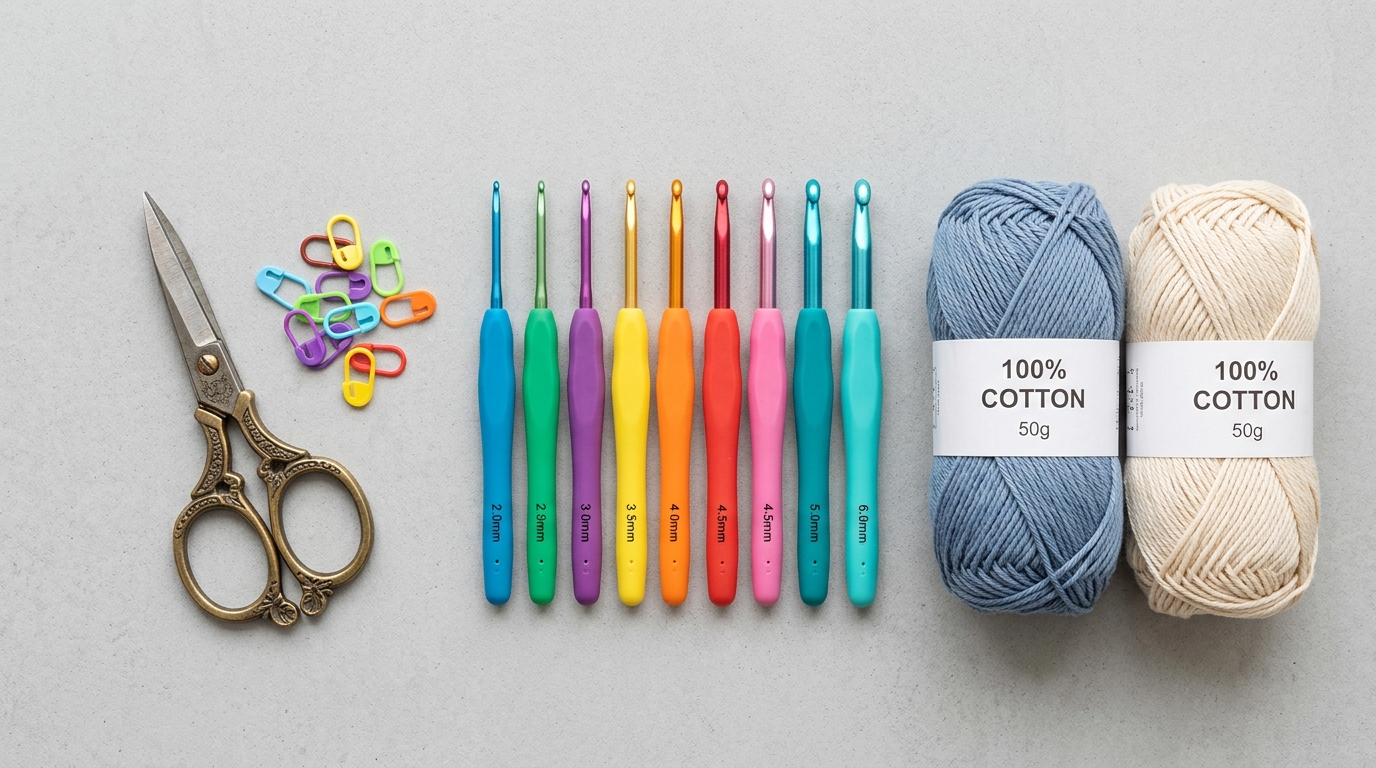
- A “Starter” Crochet Hook: Start with a size H/8 (5.0 mm). It is the “Goldilocks” of hooks—not too small, not too big—and it is perfect for learning how to hold your yarn.
- Worsted Weight Yarn: Look for a label that says “Medium 4” or “Worsted.” Choosing a light, solid color makes it so much easier to see your stitches as you are learning to place your hook.
- Yarn Needles: These are blunt, large-eyed needles used to weave in your yarn ends. You will need these to finish every single project.
- Stitch Markers: These little plastic clips are lifesavers for beginners. They help you keep track of where a round begins or end, or mark a stitch you need to come back to.
- Small Scissors: Any sharp pair of scissors will do, but having a designated pair for your yarn bag keeps them handy for quick snips.
- A Flexible Measuring Tape: You will need this for checking gauge and ensuring your projects are the correct size.
Choosing Your First Hook
Your crochet hook is an extension of your hand. When you are just starting, you might notice your hands feeling tired. This is usually due to “tight tension,” which is common for beginners. To mitigate this, look for a hook that feels good in your grip. Some crocheters prefer aluminum hooks because they are smooth and allow the yarn to glide easily. Others prefer ergonomic hooks with rubberized handles, which can be much more comfortable if you have sensitive joints or plan to crochet for more than a few minutes at a time. The most important thing is that the hook has a smooth, polished surface so the yarn doesn’t catch on any rough spots.
Selecting the Right Yarn
If you walk into a yarn aisle, it can be dazzling. There are fuzzy yarns, sparkly yarns, and ultra-thick yarns. As a beginner, steer clear of these! Textured, novelty, or dark-colored yarns make it nearly impossible to see your stitches.
Instead, look for a smooth, plied yarn (the strands are twisted together) in a bright or pastel solid color—a soft cream, light blue, or sunny yellow are lovely choices. A smooth texture makes it easy to slide your hook in and out, and a lighter color allows you to see exactly where your stitch was placed. Your future self will thank you for choosing a solid color for your first dozen projects!
The Importance of Stitch Markers
If there is one tool that separates a frustrated beginner from a confident one, it is the stitch marker. Beginners often find themselves wondering, “Where is the first stitch of this row?” or “Did I accidentally drop a stitch?” Stitch markers act as your anchors. By clipping them into your first and last stitches, you create a visual guide that tells you exactly where you are in your row or round. When you are starting out, never be afraid to use too many of them while you are counting!
Understanding Essential Crochet Terms
As you dive into your first tutorials, you will encounter standard U.S. terminology. Learning these terms early will help you read any pattern you come across in the future.
- Chain (ch): The foundation of almost every project. It is the basic loop-through-loop stitch.
- Single Crochet (sc): The most fundamental decorative stitch. It is short, dense, and perfect for toys or sturdy bags.
- Slip Stitch (sl st): Used to join rounds or move across a piece of fabric without adding height.
- Half Double/Double Crochet (hdc/dc): These add more height to your work and create a drape that is lovely for scarves or clothing.
- Gauge: This refers to the number of stitches and rows per inch. It is how you ensure that your project matches the dimensions in the pattern.
- Fasten Off: The process of cutting your yarn and pulling the tail through the last loop to “lock” it in place.
- Weave in Ends: Using a yarn needle to hide your yarn tails back into the fabric so they don’t unravel.
Common Mistakes to Avoid as a Beginner
Every crocheter has been exactly where you are! Here are a few traps to keep an eye out for.
The “Death Grip”
Hold your hook comfortably, like you are writing with a pen. If you are gripping your hook or your yarn with a white-knuckle hold, your stitches will be too tight, and you will have a very difficult time getting your hook into the next stitch. Try to relax your shoulders; your crochet will get more even the more you relax.
The Twisted Starting Chain
It is very common for a long starting chain to twist before you join it to start a round. Always lay your chain flat on a table to ensure it is perfectly straight before you make your first connection.
Ignoring the “Turning Chain”
In many patterns, you will “chain one” or “chain two” at the beginning of a row to give you the height you need to start the next row. These chains count as stitches in some patterns and not in others. Always read the “Pattern Notes” section carefully so you don’t accidentally skip the very first or last stitch of a row.
Miscounting Stitches
This is the number one reason beginners feel like their projects are “warping” or changing shape. Count your stitches at the end of every single row. If your row started with 20 stitches, make sure you ended with 20. It feels tedious at first, but it is the fastest way to learn how to keep your edges straight.
Pro Tips for Better Results
Once you have your supplies and have practiced a few rows, keep these tips in mind to take your craft to the next level.
- Block Your Work: Blocking involves gently wetting or steaming your finished piece and pinning it into the correct shape while it dries. It works wonders for evening out wobbly stitches and making your projects look professional.
- Practice Tension: Create a few small “swatches” (little squares) until your stitches look consistent—not too loose, not too tight.
- Invest in Good Lighting: Crochet is very visual. Working in low light can strain your eyes. Use a bright lamp and, if possible, work during the day by a window.
- Save Your Yarn Labels: The labels tell you the fiber content and the recommended hook size. They are like a recipe card; holding onto them will help you know how to wash and care for your finished projects.
- Be Kind to Yourself: Your first attempt won’t be perfect, and that is okay! Every messy stitch is proof that you are learning something new.
FAQ
What is the easiest thing to crochet first?
A simple rectangular washcloth or a cozy chunky-weight scarf are the best first projects. They allow you to practice working in rows and keeping your tension consistent without worrying about complex shaping or counting.
Does it matter which crochet hook brand I choose?
Not at all. While some brands are more expensive, what matters most is the size and the smoothness of the hook. If you find a hook that feels smooth in your hand and doesn’t snag your yarn, stick with it!
How do I stop my crochet from getting wider as I work?
This is usually caused by accidentally adding an extra stitch at the end of every row. Make sure to count your stitches religiously! Using a stitch marker in the first and last stitch of every row is the best way to keep your piece perfectly rectangular.
Is crochet expensive to start?
One of the best things about crochet is that it is quite affordable. For under twenty dollars, you can buy a hook, a skein of high-quality, beginner-friendly yarn, and a tapestry needle.
What should I look for when buying yarn?
Look for “medium” or “worsted” weight (a number 4 on most labels). Choose a light, solid color like cream, sage, or light blue. Avoid dark colors, black, or novelty textures until you have more experience.
Conclusion
Embarking on your crochet journey is such an exciting step. By choosing the right essential supplies—a smooth hook, a comfortable weight of yarn, and a few handy stitch markers—you are already ahead of the curve. Remember that crochet is a practice, not a race. There will be days when the rhythm flows beautifully, and days when you might have to “frog” (rip out) a row to fix a mistake, and that is just part of the process.
Keep your supplies organized, stay patient with your hands, and most importantly, enjoy the time you set aside for yourself. Whether you are creating a gift for a loved one or simply enjoying the quiet focus of the work, you are becoming part of a centuries-old tradition of makers. Pick up your hook, take that first loop, and enjoy the journey one stitch at a time!