
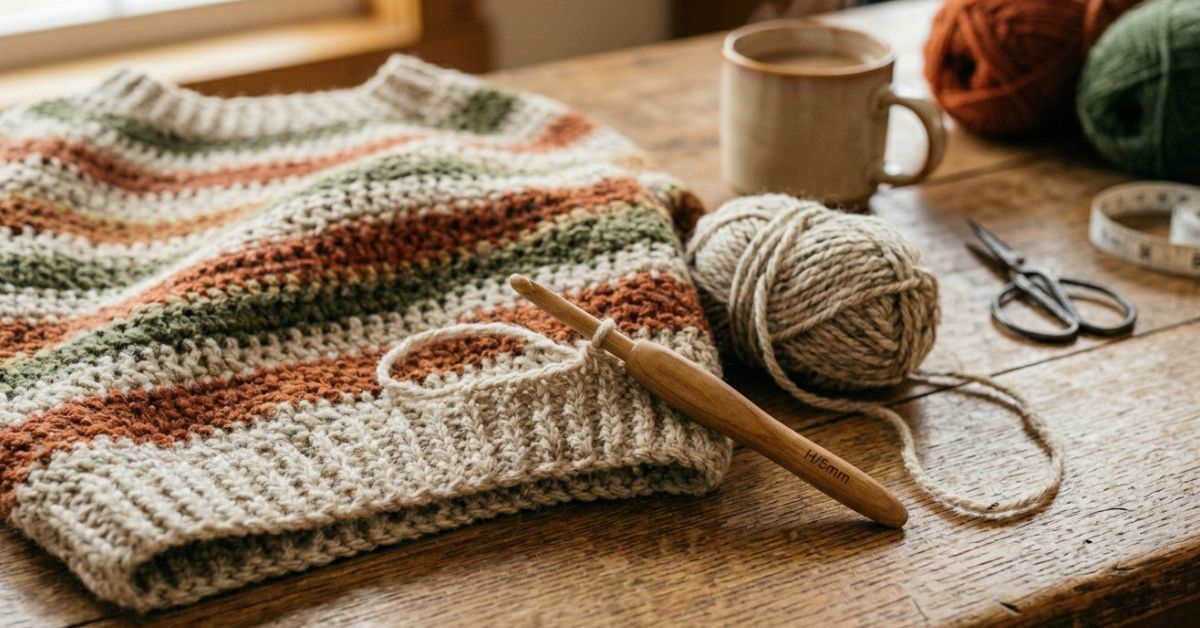
There is something truly magical about the moment a cozy, handmade sweater begins to take shape under your crochet hook. As the weather turns crisp and the days grow shorter, our thoughts naturally turn to soft wools and comforting textures. If you are looking for the absolute “goldilocks” stitch—one that isn’t too lacy, isn’t too stiff, and holds just enough warmth for the perfect winter garment—you have arrived at the right place. The half double crochet stitch is the unsung hero of the crochet world. It sits beautifully between the height of a double crochet and the dense, sturdy nature of a single crochet, making it the ideal choice for sweaters, hats, and scarves that need to drape well while keeping the chill away.
Whether you are picking up a crochet hook for the very first time or you are an experienced maker looking to refine your technique for a more professional finish, this guide is designed to walk you through everything you need to know. We will break down the mechanics of the half double crochet, explore why it is a staple in garment construction, and provide you with actionable steps to master this versatile stitch once and for all.
Quick Overview
This guide is designed as an educational deep-dive into the half double crochet stitch. It is perfect for beginners who have mastered the basic chain and single crochet and are ready to expand their repertoire, as well as intermediate crocheters who want to understand the mechanics of stitch height and tension for garment making. You will learn:
- The anatomy of a half double crochet stitch.
- How to execute the stitch cleanly for flat, even fabric.
- Why this stitch is superior for cold-weather clothing.
- Troubleshooting tips for common tension issues.
- The secrets to creating professional, garment-ready edges.
Tools and Concepts You Should Know
Before we dive into the stitches, let’s talk about what makes the half double crochet (abbreviated as HDC in most U.S. patterns) so special. You don’t need much to practice—just a medium-weight yarn (often called “worsted” or “category 4”) and a hook that corresponds to your yarn’s label. A size H/8 (5.0 mm) hook is a wonderful starting point for most beginners.
It is important to understand the concept of “stitch height.” In crochet, the taller the stitch, the more flexible the fabric. The shorter the stitch, the denser and warmer it is. The HDC effectively combines these strengths—it is taller than a single crochet, meaning it builds fabric faster, but it creates a tighter “knit-look” fabric than a double crochet does. This makes it sturdy enough to hold its shape in a sweater while maintaining that feminine, soft flow we all love in our winter wardrobe.
Crochet Terms and Key Concepts
To follow any modern American pattern, you need to be comfortable with a few specific terms. The half double crochet is essentially a two-step process disguised as one. Unlike a single crochet, where you insert and pull through, or a double crochet, where you yarn over once and pull through in two distinct phases, the half double is an “all-in-one” movement.
- Yarn Over (YO): This is where you wrap the yarn over your hook from back to front.
- Insert Hook: Pushing the hook into the designated stitch or space.
- Working Loop: The loop currently on your hook.
- Turning Chain: The stitches worked at the end of a row to bring your yarn height up to the level of the next row. For HDC, this is usually 2 chains.
Helpful Notes Before You Start
Tension is the most frequent challenge for beginners, and the half double crochet can be a little tricky because it involves three loops on your hook at once. Do not feel discouraged if your first few rows look a bit uneven. This is entirely normal!
A great tip for sweater making is to pay attention to your “starting chain.” If your foundation chain is too tight, the bottom of your work will look pinched while the rest of the sweater stays loose. Practice making your chains slightly looser than you think they need to be, or consider using a hook a half-size larger just for the foundation row to ensure your sweater has a natural, comfortable fit.
Understanding the Half Double Crochet Stitch
The beauty of the HDC lies in its efficiency. When you master pulling through all three loops at once, you will find you can finish a project in nearly half the time it takes to crochet a garment in single crochet.
The Standard Execution
- Start with a Foundation: Create a slip knot and chain a small length, perhaps 15 or 20 stitches, just for practice.
- Yarn Over: Bring the yarn over the hook. This is your setup.
- Insert: Push your hook into the next stitch.
- Pull Up a Loop: Grab the yarn and draw it back through the stitch. You should now have three loops on your hook.
- The “Half” Moment: Yarn over one more time. Now, instead of pulling through only half the loops (which would be a double crochet), pull the yarn through all three loops on your hook in one smooth motion.
Why It Feels Different
If you find your hook catching on the yarn, it is usually because you are pulling the loops too tightly. Because you have three loops on your hook, you need a slightly larger area to slide through. Keep your loops relaxed. Visualize the hook sliding through those three loops like a needle through silk—don’t force it, just guide it.
Step-by-Step Learning Stages
To truly master this stitch for sweater making, follow these three stages. Don’t rush; treat this as a meditative, creative process.
Stage 1: Building Consistency
Begin by crocheting a small swatch. Aim for accuracy rather than speed. Practice finding the “V” shape at the top of each stitch from the previous row. That “V” is where you will insert your hook for the next row. By working into both legs of the “V,” you create a strong, durable fabric that will stand up to the wear and tear of a winter sweater.
Stage 2: Managing the Edges
The biggest secret to professional-looking crochet is the edge. In HDC, the turning chain can sometimes leave a small gap. To avoid this, consider placing your first stitch of the row into the very same space where your turning chain originated. This “closes” the gap and keeps your sweater edges straight and clean, which makes seaming your pieces together much easier later on.
Stage 3: The “Camel Stitch” Variation
Once you feel comfortable with the standard HDC, try this: look at the three loops on your stitch. There is a top “V,” and then there is a “third loop” tucked behind it. If you work your HDC only into that third loop, it pushes the front two loops forward, creating a texture that looks exactly like knitted ribbing. This is a game-changer for winter sweaters—you can use the standard HDC for the body and the “third loop” technique for the cuffs and hem to create a professional, store-bought look.
Common Mistakes to Avoid
Even seasoned crocheters occasionally trip over these common issues. By staying mindful, you can avoid them entirely.
- The “Twisted” Chain: If your foundation chain is twisted, your entire sweater will be crooked. Take a moment to lay it flat on a table before you make your first stitch.
- The Missing Middle Loop: Because the HDC has that unique third loop, beginners often accidentally work into the wrong spot, causing the row count to increase or decrease. Always recount your stitches at the end of every row for your first few practice pieces.
- Stiff Fabric: If your sweater feels like a board rather than a soft garment, try moving up a hook size. The half double crochet naturally creates a dense fabric; if your tension is naturally tight, a larger hook is your best friend.
- Inconsistent Turning: Always be consistent with your turning chains. If the pattern says to turn and chain two, do exactly that. Changing your turning method halfway through a project will result in wavy edges.
Pro Tips for a Better Result
The difference between a “handmade” look and a “hand-crafted” luxury look often comes down to the finishing.
- Blocking is Essential: Never underestimate the power of blocking. Once you finish your sweater panels, pin them to a foam mat, lightly mist them with water, and let them dry. This relaxes the fibers, makes your HDC stitches look uniform, and helps the drape of the fabric.
- Color Swapping: HDC is a great stitch for color changes because it doesn’t leave huge gaps between rows. When switching colors, perform your last “pull through” with the new color to keep the transition invisible.
- Weaving Ends: Because sweaters get heavy, weave your ends in tightly and in different directions. This ensures your hard work doesn’t unravel after a few washes.
Variations and Personalization
Once you are comfortable with the half double crochet, you have the keys to thousands of patterns.
- The Texture Shift: Try alternating a row of HDC with a row of single crochet. This creates a refined, subtle texture that looks incredible in solid neutrals like cream, charcoal, or forest green.
- Yarn Choices: For winter, look for wool blends or alpaca. These fibers have a bit of “halo”—a slight fuzziness—that loves the HDC stitch. The weight of the wool complements the density of the stitch, creating a sweater that feels like a warm hug.
- The “Everyday” Accessory: If you aren’t ready for a full sweater, use these techniques to crochet a matching scarf. It is the perfect project to practice your tension without the pressure of needing a specific fit.
Care and Next Steps
Once your project is complete, handle it with love. Hand-wash your crochet garments in cool water with a gentle wool wash and lay them flat to dry. Avoid hanging them, as the weight of the water can cause the stitches to stretch out of shape.
Your next steps should be to find a simple sweater pattern that uses the half double crochet. Now that you understand how to keep your edges straight and your tension consistent, you will find that following a pattern feels much less intimidating. You aren’t just making a project; you are building a skill set that will last a lifetime.
FAQ
Why is the half double crochet good for sweaters?
The half double crochet is perfect because it is denser than a double crochet but faster than a single crochet. It provides enough thickness to keep you warm in the winter while retaining a beautiful, fabric-like drape that isn’t too bulky.
How do I stop my edges from getting wavy?
Wavy edges are often caused by inconsistent tension or not counting correctly. Ensure you are working into the correct stitch at the end of every row and consider placing your first stitch of the row into the base of your turning chain to keep the side straight.
Do I always need to count stitches in HDC?
Especially when you are learning, yes. It is very easy to accidentally skip the final stitch of a row or work two stitches into the same space. Counting your stitches at the end of each row ensures your sweater panels stay rectangular and consistent.
What hook size should I use for HDC?
While you should always follow the size recommended on your yarn label, a 5.0 mm (H/8) hook is the standard for worsted-weight yarn. If your fabric feels too stiff, move up to a 5.5 mm (I/9) hook to add more drape.
Can I use the third loop technique for the whole project?
You certainly can! Working exclusively into the third loop of the half double crochet creates a beautiful, stretchy fabric that mimics the appearance of knitted ribbing. It is slightly more time-consuming but results in a stunning, high-end texture.
Conclusion
Mastering the half double crochet is truly a milestone in any crocheter’s journey. By embracing this versatile, cozy stitch, you have unlocked the potential to create pieces that are not only beautiful but also functional and warm. Whether you are crafting a gift for a loved one or an heirloom-quality sweater for your own winter wardrobe, the skills you have practiced here will serve as the foundation for endless creativity.
Take your time with your next project, remember to breathe, and don’t be afraid to experiment with your tension and yarn choices. Crochet is meant to be a joyful, soothing practice. Each loop you pull through is a moment of care, and eventually, those loops become a tangible representation of your talent and patience. Happy hooking, and may your winter be filled with the warmth of your own beautiful creations.