
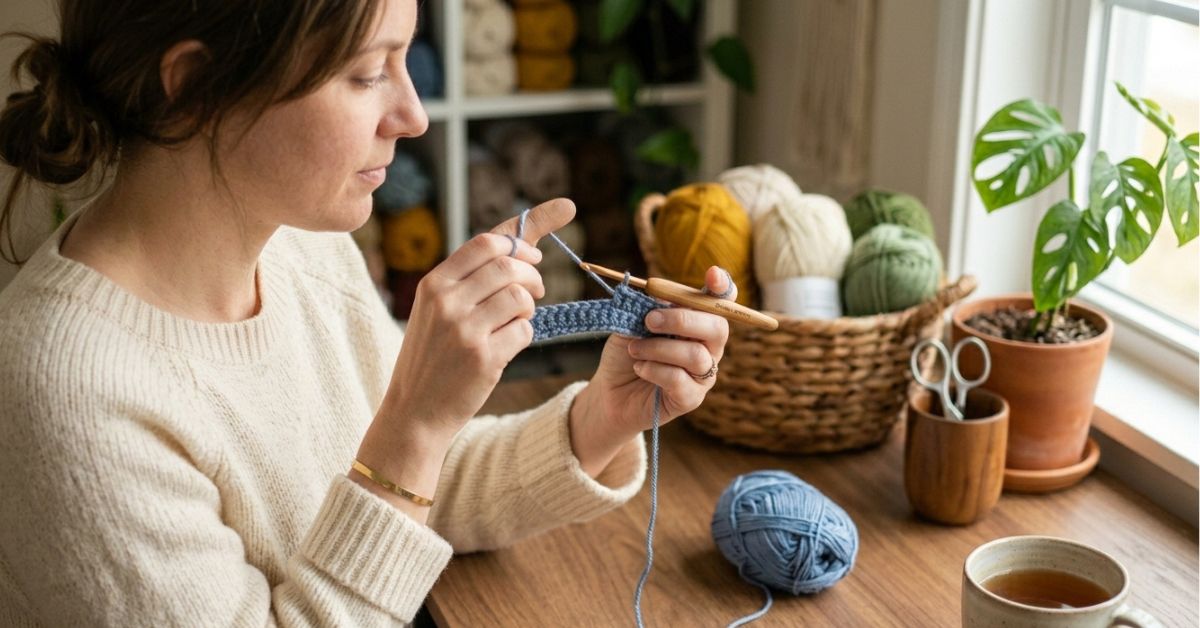
Have you ever sat down with your favorite skein of yarn, hook in hand, ready to start a brand-new project, only to find yourself struggling with the dreaded foundation chain? We have all been there. You spend minutes—sometimes hours—carefully counting those little loops, only to find that your chain is either too tight, pulling on the bottom of your work like an invisible corset, or so loose that your piece starts with a sloppy, uneven edge. It can be incredibly frustrating to feel like your project is compromised before you’ve even finished the first row.
The foundation single crochet (FSC) is a total game-changer, and today, I am so excited to walk you through it. This technique allows you to create the foundation row and your first row of actual stitches simultaneously. Not only does this save time, but it also creates a gorgeous, stretchy, and professional-looking edge that mirrors the top of your crochet stitches perfectly. Whether you are crafting a cozy baby blanket, a structured sweater, or a simple scarf, mastering this skill will instantly elevate your work. Take a deep breath, grab your favorite hook, and let’s dive into this essential skill together.
Quick Project Overview
- Skill Level: Intermediate (Great for ambitious beginners)
- Estimated Time: 15–20 minutes to master the technique
- Finished Size: Customizable (you decide as you go!)
- Best Use: Use this for any project that starts with a row of single crochet—think hat brims, waistbands, or the base of a blanket.
- Why you will love it: It eliminates the struggle of counting chains, provides better stretch for clothing, and creates a clean, elegant foundation that looks intentional and polished.
Materials Needed
- Yarn: Any weight will work, but I recommend a smooth, light-colored worsted weight yarn for your first practice run so you can clearly see the stitch anatomy.
- Crochet Hook: Use the size recommended on your yarn label. An ergonomic handle can make practicing new stitches much easier on your hands.
- Scissors: For trimming your ends.
- Tapestry Needle: For weaving in your finished tails.
- Stitch Markers: Useful for beginners to mark the end of the round if you are turning this into a repetitive practice drill.
Stitches and Abbreviations
- Ch (Chain): Yarn over hook and pull through the loop on your hook.
- Sc (Single Crochet): Insert hook into stitch, yarn over, pull up a loop, yarn over, pull through both loops on the hook.
- Fsc (Foundation Single Crochet): The star of our show. This replaces both the starting chain and the first row of single crochet.
Pattern Notes Before You Start
Tension is the secret ingredient here. Because you are working the chain and the stitch at the same time, it is easy to accidentally pull the “chain” portion too tight. If you find your foundation row bowing or curving, try loosening your yarn tension just a fraction of an inch as you pull through the first loop. If you are a naturally tight crocheter, don’t be afraid to go up a full hook size for just this foundation row; it can make the transition much smoother. Remember, this is a skill—give yourself the grace to unpick and restart a few times.
Full Crochet Pattern
We are going to practice this technique by creating a simple “Foundation Practice Swatch.” This will give you a beautiful, sturdy square to keep in your project bag as a reference.
Part 1: The First Foundation Single Crochet
- Start with a slip knot on your hook.
- Chain 2.
- Insert your hook into the second chain from the hook.
- Yarn over and pull up a loop (you now have 2 loops on your hook).
- Yarn over and pull through ONLY the first loop (this creates your “chain”).
- Yarn over and pull through both loops on your hook (this completes your “single crochet”). You have now completed your very first Fsc stitch.
Part 2: Continuing the Row
- To make the next stitch, look for the “chain” you just created at the base of the stitch you just finished; it looks like a little “V” right at the bottom.
- Insert your hook into that “V” (the chain).
- Yarn over and pull up a loop (you have 2 loops on your hook).
- Yarn over and pull through the first loop only (the chain part).
- Yarn over and pull through both loops on your hook (the single crochet part).
- Repeat steps 7 through 11 for as many stitches as your pattern calls for.
Finishing
Once you reach your desired width, chain 1 and turn your work. You can now continue with your standard pattern, working into the tops of the single crochet stitches you just created. Weave in your initial yarn tail securely to prevent the foundation from unraveling, as this end can be slightly more delicate than a knotted chain.
Step-by-Step Tutorial Explanation
Think of the foundation single crochet as a two-step process disguised as one. When you make a traditional chain, it is essentially a separate piece of fabric. When you make the Fsc, you are essentially building a rope (the chain base) and building a stitch on top of it at exactly the same time.
As you look at your work, the bottom of the Fsc should look almost identical to the top of a standard row of single crochet. The “gap” where you insert your hook is that bottom V-shape. If you struggle to find the opening, tilt your work toward you. You will see a distinct horizontal loop and a vertical loop—inserting your hook under both of these creates a sturdy, consistent base that prevents your project from looking like a messy, twisted starting chain.
Common Mistakes to Avoid
- The Twisted Chain Look: If your foundation looks like it is spiraling, you are likely rotating your hook too much as you work. Try to keep your hook movement fluid and horizontal.
- Tight Tension: If the base is so tight you cannot get your hook into it on the following row, you are likely pulling the “chain” part of the Fsc way too snugly. Practice keeping that specific “chain” step loop a little longer.
- Skipping the First Loop: Always count your stitches every 10 stitches or so. It is easy to miss the very last stitch in a row if you are not careful about where you place your insert.
- Hook Size Mismatch: If you use a hook that is too small, your foundation will naturally be stiff. If you are making a project that requires drape, like a scarf, don’t be afraid of a slightly larger hook.
Pro Tips for a More Beautiful Result
- The “Double Loop” Method: Always ensure you are catching both legs of that bottom “V.” Inserting into only one of the strands will cause your foundation to stretch out over time, leading to a wavy edge that looks unfinished.
- Visual Check: After working a few stitches, lay your work flat. If it curls into a circle, your tension is likely too tight. If it ripples like a wave, your tension might be a bit too loose.
- Blocking: If you are making a garment, always block your Fsc row just like the rest of the piece. Because it is foundation-based, it can behave slightly differently regarding gauge than the rest of the project.
- Color Transitions: If you are working with multiple colors, start your foundation in the main color of your project to ensure the base edge is unobtrusive and clean.
Variations and Personalization Ideas
Once you master the foundation single crochet, you can easily adapt this to Foundation Half Double Crochet or Foundation Double Crochet. The logic is exactly the same: you build the base chain and the main part of the stitch in one go. Using this for a sweater neckband creates an incredibly professional, stretchy finish that won’t choke you when you pull the garment over your head. You can also use this technique to adjust a pattern on the fly; if your swatch suggests a width you don’t like, you can simply add more Fsc stitches without having to rip out your entire foundation chain and start over.
Care Instructions
Since a foundation edge is structurally sounder than a chain, your items will generally hold up better in the wash. However, crochet is still a textile. Always hand-wash your handmade items in cool water with a gentle wool wash. Lay them flat on a towel, reshaping them into their original dimensions while damp. Never hang a heavy crochet item to dry, as the gravity will stretch out that beautiful foundation edge you worked so hard on!
FAQ
Does the foundation single crochet count as the first row?
Yes! In almost every pattern that calls for a starting chain plus a row of base stitches, the Fsc serves as both. You can skip the setup chain entirely and move straight to your second row.
How do I know if the base is too tight?
If you have to force your hook into the stitches on the second row, your base is likely too tight. Try relaxing your grip or sizing up your hook for the foundation row exclusively.
Can I use this for any pattern?
Absolutely! If a pattern calls for “Chain 50, sc in 2nd ch from hook,” you can simply replace that with “Fsc 49.” Always calculate your stitch count carefully.
Is the foundation single crochet faster than chaining?
Once you get the hang of it, it is significantly faster. You aren’t chaining, turning, skipping, and then going back; you are doing everything in one fluid pass.
Can I do this starting with a different stitch?
Yes, the technique is essentially universal. You can create foundation half double or double crochet stitches using the same “chain-then-complete-the-stitch” method, just add extra yarn overs before you pull through the foundation loop.
Conclusion
Isn’t it wonderful when a simple technique makes the entire process of crocheting feel more fluid and professional? The foundation single crochet is truly one of the best tools to add to your repertoire. It saves time, creates a cleaner edge, and gives you so much more control over the final dimensions of your handmade treasures.
Don’t feel discouraged if your first few stitches look a little uneven; every master crocheter started with a few wobbly rows. Keep practicing, play with your tension, and soon, you will find yourself using this method for every single project you start. Save this tutorial for the next time you cast on a new blanket or scarf, and enjoy the added stretch and beauty it brings to your work. Happy crocheting!