
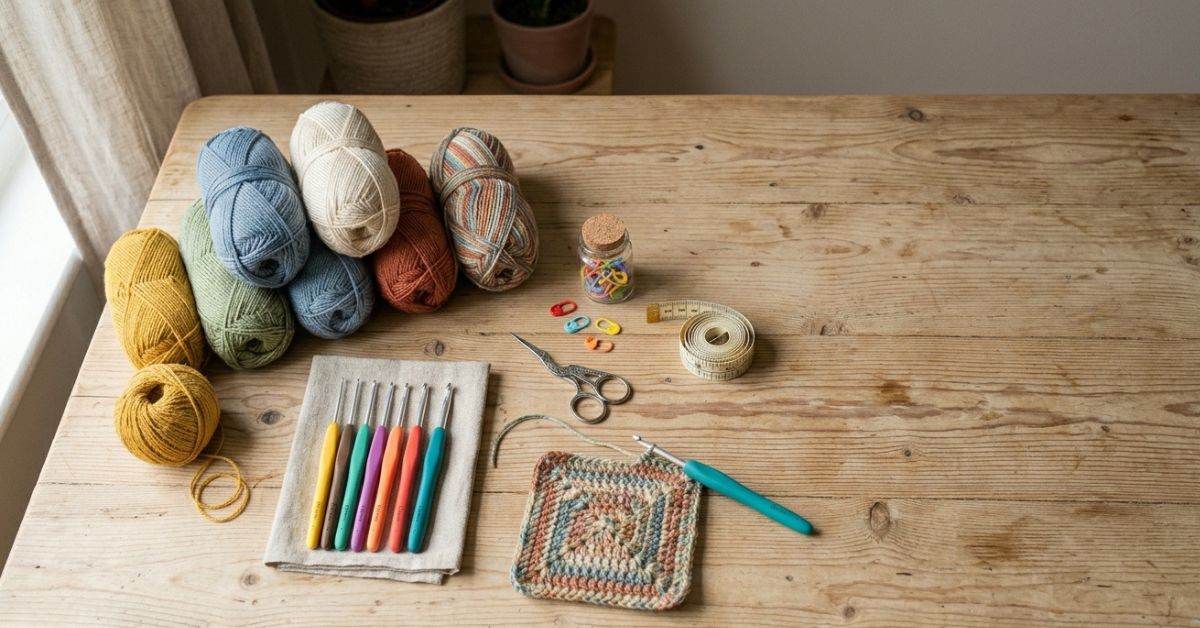
There is something undeniably magical about taking a single strand of yarn and, with nothing more than a small hook and your own two hands, transforming it into something useful, beautiful, and uniquely yours. If you have been admiring the cozy, handcrafted textures in shops or seeing the creative explosion of crochet projects online and thinking, “I wish I could do that,” you have come to the right place. Learning to crochet is a journey of patience and creativity, and the best part is that you don’t need an entire studio full of equipment to get started. In fact, you can begin your new favorite hobby today with just a few basic, affordable supplies.
This guide is designed to remove the intimidation factor, whether you are picking up a hook for the very first time or returning after a long hiatus. We are going to walk through the essential tools you truly need, dispel some common myths about starting, and dive into a simple, satisfying project that will help you master the fundamentals while creating a functional piece for your home. By the end of this article, you will feel confident, equipped, and ready to turn that first loop into a completed treasure.
Quick Project Overview
To put your new skills to the test, we are going to create a “Cozy Home Essentials” Textured Cotton Washcloth. This is the ultimate beginner project because it works up quickly, uses only the most foundational stitches, and is incredibly forgiving.
- Skill Level: Beginner.
- Estimated Time: 1 to 2 hours.
- Finished Size: Approximately 8 inches by 8 inches.
- Best Use: A perfect eco-friendly swap for paper towels, a gentle accessory for your bathroom, or a thoughtful handmade gift for a housewarming party.
You will love this project because it allows you to practice maintaining even tension—the secret to beautiful crochet—without the pressure of shaping a complex garment.
Materials Needed
You do not need to break the bank to start your crochet journey. Here is your essential checklist:
- Yarn: For beginners, I always recommend starting with a medium-weight (worsted/aran) 100% cotton yarn. Cotton is sturdy, easy to manage, and has little stretch, which helps you see your stitches clearly. Look for the “4” symbol on the yarn label.
- Crochet Hook: A size H/8 (5.0 mm) hook is the gold standard for beginners. It is comfortable to hold and works beautifully with worsted-weight yarn. Choose a hook with an ergonomic handle if you can; your hands will thank you later.
- Scissors: Any pair of sharp household scissors will do.
- Yarn Needle: Also known as a tapestry needle, you will need a large-eye blunt needle to weave in your ends.
- Measuring Tape: A flexible sewing tape measure is helpful for checking your gauge.
Stitches and Abbreviations
We will use standard U.S. crochet terminology. Here are the building blocks you need:
- Ch (Chain): The foundation of most projects. You create a loop and pull a new loop through it repeatedly.
- Sc (Single Crochet): The most common stitch. It creates a dense, sturdy fabric.
- Dc (Double Crochet): A slightly taller stitch that works up faster and has a lovely drape.
- Sl St (Slip Stitch): Used to join rounds or move across a row without adding height.
- St (Stitch): Referring to the individual loop or space where you insert your hook.
Pattern Notes Before You Start
- Tension: This is the “secret sauce” of crochet. Tension is how tightly or loosely you hold your yarn. If your stitches are too tight, your fabric will be stiff and it will be difficult to insert your hook into upcoming rows. If it is too loose, your work will be full of gaping holes. Try to hold the yarn with a light, steady grip, allowing it to glide through your fingers.
- Counting: If you are a beginner, counting your stitches at the end of every row is your best defense against crooked edges. It might seem tedious, but it builds the muscle memory you need to “see” the stitches later on.
- Foundation: Don’t stress if your first chain row isn’t perfectly consistent. It takes practice to keep the loops the same size.
Full Crochet Pattern
This textured washcloth is worked in flat rows, creating a repeating pattern that highlights the beauty of simple stitches.
Part 1: The Foundation
Start with a slip knot on your hook. Chain (ch) 30. This ensures a nice, square shape.
Part 2: Working the Rows
Row 1: In the second chain from the hook, work one single crochet (sc). Continue working one sc in every chain across the row. You should end with 29 stitches. Ch 1 and turn your work.
Row 2: Work one double crochet (dc) in the first stitch. Skip the next stitch, work one double crochet in the following stitch. Repeat from to until you reach the end of the row. Ch 1 and turn.
Row 3: Work one sc in every stitch across the row. You are essentially filling in the gaps from the previous row. Ch 1 and turn.
Row 4-25: Repeat Rows 2 and 3. This pattern creates a lovely, pebbled texture that is great for scrubbing.
Assembly and Finishing
Once you have reached your desired length, fasten off by cutting the yarn, leaving a 6-inch tail, and pulling the tail through the final loop on your hook. Use your yarn needle to weave the tail back and forth through the back of the stitches to secure it firmly. Trim any excess yarn.
Step-by-Step Tutorial Explanation
When you start that first row of sc, you might feel like your hands are a bit clumsy—that is completely normal. Think of your hook as a “grabber.” You are wrapping the yarn over the hook (yarn over) and pulling that new loop through. When you move to the dc row, the height increase is immediate. A dc stitch consists of a yarn over before you insert your hook into the stitch, then another yarn over to pull through, and two more yarn overs to complete the stitch. Once you finish the washcloth, you will notice that the edges stay straight because we used that “ch 1 and turn” method, which acts as a gentle border.
Common Mistakes to Avoid
- The “Vanishing” Stitch: Many beginners miss the very last stitch of a row, which causes the project to slowly shrink into a triangle. Always count your stitches at the end of each row to ensure you have the same number you started with.
- Tight Tension: If you find yourself having to force the hook into the stitch, you are working too tightly. Take a breath, loosen your grip on the yarn, and try again.
- Twisted Chains: When you start your very first row into your foundation chain, make sure the chain isn’t twisted like a curly fry. Lay it flat on your lap before you begin.
- Ignoring the Tail: If you don’t weave in your ends securely, your hard work will unravel in the washing machine. Always weave the yarn through at least three different directions for a secure finish.
Pro Tips for a More Beautiful Result
Block your work! Blocking is the process of soaking your finished item in cool water, gently squeezing it out (not wringing), and laying it flat on a towel while shaping it into a perfect square. This sets the stitches and gives the washcloth a professional, store-bought look. For color, consider using two colors of yarn and alternating them every two rows for a trendy striped effect. Finally, remember to rest your hands; crochet is a workout for your knuckles and wrists!
Variations and Personalization Ideas
- Make it a Set: Use the same pattern but change the color to create a set of three washcloths tied together with a bit of twine for a DIY housewarming gift.
- Border Power: Want to level up? After finishing the last row, chain 1 and work a round of single crochet all the way around the outer edge of your square. Work three single crochets into each corner to keep it laying flat.
- Textural Shift: If you want a more scrubby feel, look for “scrubby” style yarns that have a bit of polyester or nylon mixed in with the cotton.
Care Instructions
Since we used cotton yarn, your washcloth is incredibly easy to maintain. Toss it into the washing machine on a warm, gentle cycle and tumble dry on low. Avoid using fabric softener, as it can coat the cotton fibers and actually make your washcloth less absorbent over time. If the washcloth starts to look a bit “tired” after months of use, a quick, fresh wash will fluff up the stitches and bring it back to life.
FAQ
Does it matter which way I hold my hook?
Not at all! There are two main ways to hold a hook—the “pencil grip” and the “knife grip.” Try both and see which one feels natural for your hand. There is no right or wrong way, only the way that keeps your hands from tiring out.
How do I know if I’m using the right yarn weight?
Look at the yarn label. Most yarns in the U.S. have a “Yarn Weight” icon, which is a small skein of yarn with a number inside. For beginners, the number 4 (Worsted) is your best friend. It is not too thin, which makes the yarn hard to see, and not too thick, which can feel clunky.
Why does my project look like a trapezoid instead of a square?
This usually happens because you are either accidentally adding stitches (increasing) or missing stitches (decreasing). If your project is widening, you are likely working two stitches into one space. If it is narrowing, you are skipping the last stitch of a row.
Should I worry about crochet gauge?
For a washcloth, not really! Gauge only becomes critical when you are making clothing where fit is important. For home decor or accessories like bags and mats, you have more freedom.
Is crochet actually a relaxing hobby?
Absolutely. Many people find the rhythmic, repetitive motion of crochet to be a form of moving meditation. It helps shift your focus away from screens and stresses, allowing you to settle into a cozy, mindful groove.
Conclusion
You have just taken the first step toward a lifetime of creative possibilities. What started as the simple act of pulling a loop through a chain is the foundation for blankets, sweaters, delicate lace, and whimsical amigurumi figures. Don’t be discouraged if your first few rows aren’t perfect; every slight inconsistency is a sign of your progress and a reminder that you are learning a new, beautiful skill.
Keep your hook and a bit of yarn nearby, and don’t hesitate to pull out your work and start over if you feel like you’ve made a mistake—it is all part of the learning process. You are now part of a global community of makers who value the warmth, texture, and care that goes into every handmade item. We invite you to save this tutorial for whenever you need a quick refresh, and we hope you feel inspired to explore more patterns. Happy crocheting!