
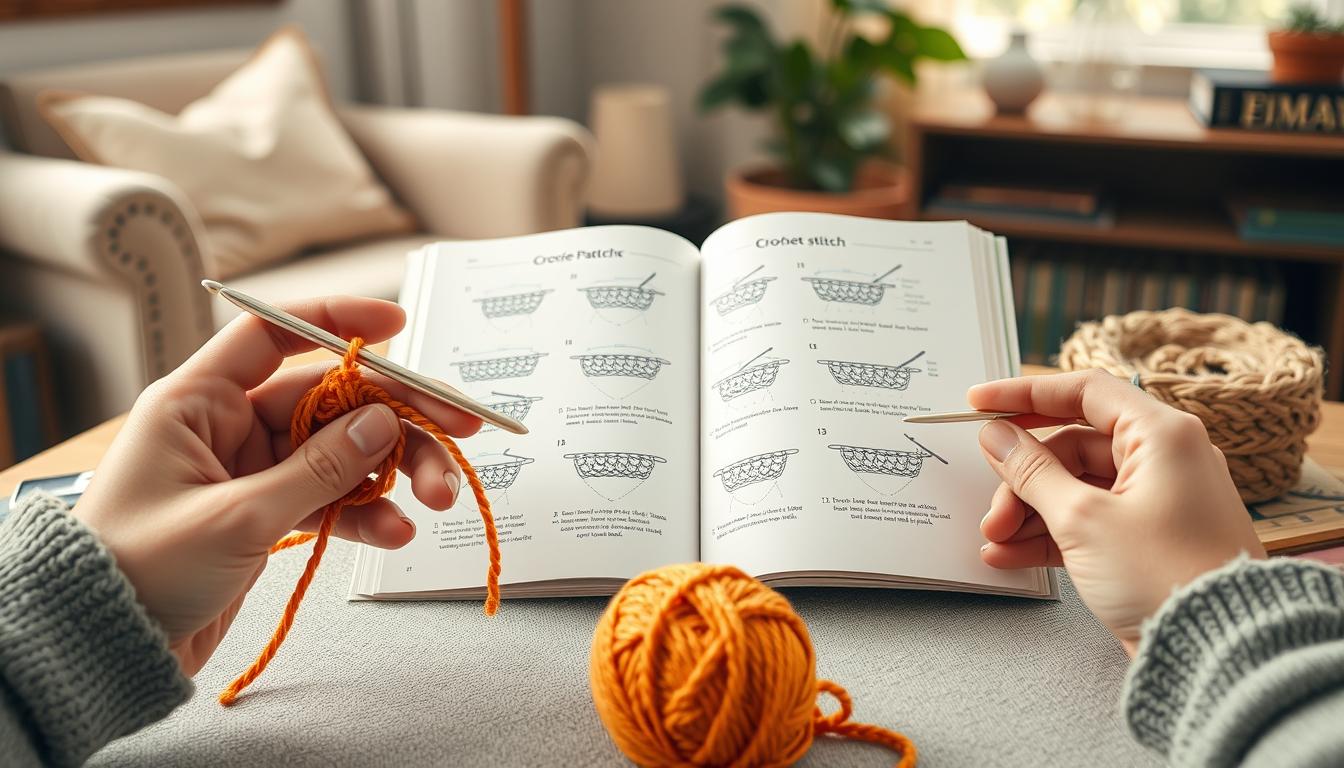
Every crochet project begins with a single stitch. If you want to learn crochet, this introduction will help you start. We will cover key techniques like the slip knot and chain stitch.
Also, we will explain main stitches: single crochet, half double crochet, double crochet, and treble crochet. Knowing one stitch well, often the double crochet, makes learning others easier. Stitch height affects how the fabric drapes and feels.
This basic crochet tutorial uses clear written steps along with diagrams and short videos to help you. Brands such as DMC and Lion Brand offer helpful diagrams. These work well with practice.
Photo tutorials and quick clips are useful when you repeat motions slowly. Checking your tension as you go is important.
In this crochet for beginners series, you’ll find a practical step-by-step method. We start with casting on and holding yarn. Then we cover foundation chains and core stitches.
Finally, we finish with notes on tension, gauge, and next steps. These include the magic ring or joining a new ball. The goal is to make learning clear and doable for readers across the United States.
Key Takeaways
- Start with a slip knot and foundation chain to begin any project.
- Master one basic stitch—like double crochet—to speed learning of others.
- Stitch height (Sc → Hdc → Dc → Tr) changes fabric drape and texture.
- Use diagrams, short videos, and photo steps to reinforce practice.
- Check tension and gauge early to match pattern size and feel.
Getting started with basics and supplies
Before you pick up a pattern, gather a small kit of beginner crochet tools. Learn a few core moves first. A tidy selection of supplies keeps practice focused and enjoyable.
Start simple. Use one medium-weight yarn and a hook size that the yarn label recommends. This helps you follow a yarn weight guide and build confidence.
https://www.youtube.com/watch?v=GcOzdAzmtNM
Essential tools and yarn for beginners
Choose crochet hook materials that feel comfortable in your hand. Metal, plastic, wood, and bamboo are common choices. Ergonomic handles or flattened sections make long sessions easier.
Bring a tapestry needle to weave ends, stitch markers to track rows, sharp scissors, and a measuring tape. This basic set covers most starter projects without feeling overwhelming.
How to cast on: slip knot and foundation chain
Begin casting on with a slip knot placed on the hook. Try both methods: make a loop and pull the yarn ball end through your hook. Or wrap yarn twice around your finger, lift the loops, and tighten.
Use whichever method feels smoother for you. Work the foundation chain by yarning over and pulling through the slip knot repeatedly.
Notice each chain has a top front loop, a top back loop, and a back loop underneath. Most patterns ask you to stitch into the top back loop. Practice making consistent chain sizes and count carefully. Do not count the loop on the hook as a chain. Never skip the final chain.
Grip and yarn-holding techniques for comfort and control
Experiment with pencil grip and knife grip to find a steady rhythm. The pencil grip holds the hook like a pencil with thumb and index near the flattened section. The knife grip looks like holding a butter knife with your forefinger along the shaft.
Hold yarn in your non-dominant hand for tension control. Loop yarn under the pinky, up in front of the ring and middle fingers, and behind the index finger.
Pinch the yarn near the hook if you need firmer control. Keep your hands an inch or two apart to reduce strain and build muscle memory.
how to crochet stitches
Start with the basic mechanics every stitch shares: yarn over and draw through loops. These simple actions form the backbone of a chain stitch tutorial. They set the pace for learning single crochet, half double crochet, double crochet, treble crochet, slip stitch finishing, and turning chains. A short warm-up chain helps you find rhythm and even tension before moving into rows.
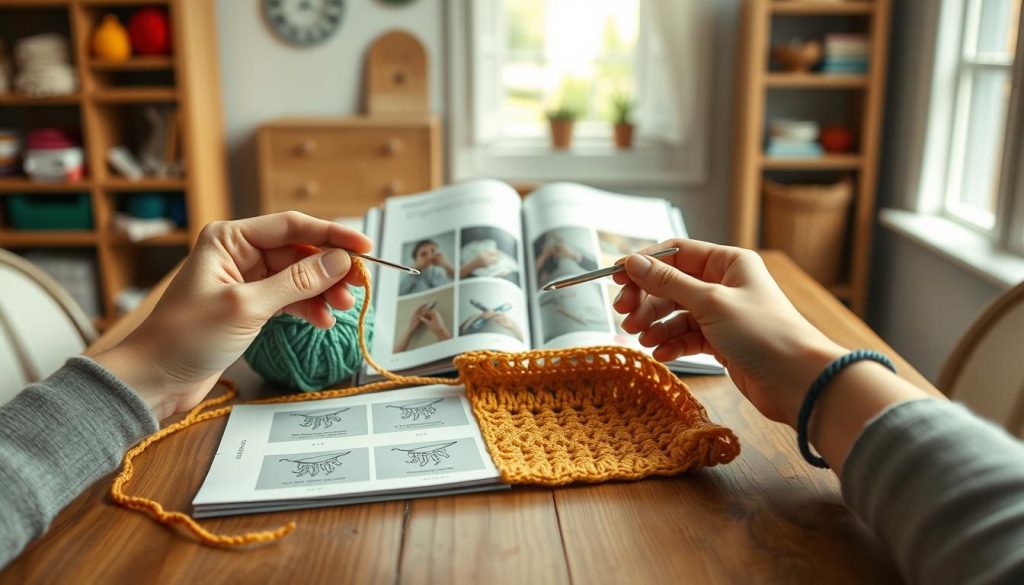
Chain stitch (Ch) step-by-step
Make a slip knot on the hook and hold it with thumb and forefinger. Yarn over from back to front and pull through the loop to form one chain. Repeat, keeping chains even and not counting the loop on the hook.
Notice chain anatomy: the top front loop, top back loop, and back loop underneath. Many patterns ask you to work into the top back loop on the first row to ease joining. Practicing a steady rhythm will make the chain stitch tutorial feel natural.
Single crochet (Sc) technique and uses
For single crochet steps, start with a foundation chain—eleven chains is a common sample. Skip the chain next to the hook and insert into the second chain from hook under the correct loop. Yarn over, pull up a loop so two loops sit on the hook, yarn over and pull through both loops to finish the stitch.
Single crochet creates dense fabric. Use it for amigurumi, dishcloths, and coasters. At each row start, make one turning chain and turn your work the same direction for tidy edges.
Half double crochet (Hdc) technique and sample swatch
Chain twelve to sample hdc across ten stitches with two turning chains. Yarn over, insert in the third chain from hook, yarn over and draw up a loop so three loops rest on the hook. Yarn over and draw through all three loops to complete the stitch.
Hdc sits between single and double crochet in height and softness. It works well for hats and sweaters. Keep the turning chains consistent at two to match row height and preserve neat sides.
Double crochet (Dc) and treble crochet (Tr) for speed and lacy fabric
For double crochet instructions, chain twelve or thirteen depending on whether you use two or three turning chains. Yarn over once, insert into the indicated chain, yarn over and draw through to make three loops on the hook. Then yarn over and draw through two loops twice to finish the stitch.
Dc moves quickly and creates open texture that suits blankets and granny squares. Test whether two or three turning chains give cleaner edges for your tension.
For a treble crochet tutorial, yarn over twice and insert into the appropriate chain—usually the fourth from hook when using three turning chains. Draw up a loop to get four loops on the hook. Then yarn over and draw through two loops repeatedly until only one loop remains.
Tr stitches make very open, airy fabric for lacy shawls and market bags. Use three or four turning chains based on pattern guidance and your edge preference.
Slip stitch and finishing techniques
Slip stitch finishing is simple. Insert the hook under both top loops of the target stitch. Yarn over and pull through stitch and loop on hook to create a neat, single-loop join. Use slip stitch to join rounds, create edges, or move across stitches without adding height.
To fasten off, cut the yarn leaving a 4–6 inch tail and pull the tail through the last loop to secure. Weave in ends with a tapestry needle on the wrong side. Travel under the vertical “v” stitches for a hidden, sturdy finish. For a decorative edge, try a crab stitch or reverse single crochet for a slightly twisted border.
| Stitch | Turning Chains | Height | Common Uses |
|---|---|---|---|
| Chain (Ch) | 0 (foundation) | Base | Cast-on, starting rows and rounds |
| Single Crochet (Sc) | 1 | Short | Amigurumi, dishcloths, dense fabric |
| Half Double Crochet (Hdc) | 2 | Medium | Hats, sweaters, balanced drape |
| Double Crochet (Dc) | 2 or 3 | Tall | Blankets, granny squares, textured stitches |
| Treble Crochet (Tr) | 3 or 4 | Very tall | Lacy shawls, openwork panels |
| Slip Stitch | 0 | None | Joining rounds, finishing edges, moving |
Advanced tips, stitch variations, and shaping
Move beyond basics with a few tricks that lift your projects. Check your crochet gauge by making a 4″ x 4″ swatch in the stitch pattern you will use.
A clear tension guide helps decide whether to change hook size. If the swatch is larger than 4″, drop a hook size.
If it’s smaller, go up one hook size. Gauge matters most for garments. For blankets and scarves, you can be more flexible.
Texture and stitch variety
Try back loop only (BLO) to get ribbing for cuffs and bands. Use shell, ripple, and linen stitch for decorative surfaces.
For raised motifs, follow a bobble stitch tutorial to learn bobble, puff, and popcorn techniques. These make soft, dimensional patterns for blankets and sweaters.
Shaping, increases and decreases, and circular starts
Shape pieces by working multiple stitches into one space to increase. For decreases, use tr2tog or tr3tog.
Leave the last loop of each stitch on your hook. Then yarn over and pull through all loops to close.
Start amigurumi and round motifs with a magic ring for a tight center. Join rounds with a slip stitch and pull the tail to close.
Color change in crochet and joining yarn
Switch colors mid-stitch by completing it until two loops stay on the hook. Then bring the new yarn over and finish with the new color.
To join a new ball, finish the current stitch with the new yarn. Continue without knots for a cleaner edge. This method keeps the join nearly invisible.
Weaving in ends
Fasten off and hide tails by weaving ends on the wrong side using a tapestry needle. Travel horizontally under vertical Vs, drop down a few rows, and travel back to lock the tail.
Leave 2–3″ woven before trimming for secure, neat finishes.
Practical pointers
Use BLO ribbing and slip-stitch ribbing for cuffs and edges. Try single crochet for dense, warm fabric.
Use double or treble crochet for speed and a lacy drape. Combine these techniques to control fabric density and shape garments with confidence.
Conclusion
Mastering casting on, the chain stitch, and one basic stitch builds a strong foundation. Once you perfect one stitch, like single crochet, the others get easier. Focus on turning chains, stitch anatomy, grip, and tension; these basics shape every project.
Practice rows and small swatches to build muscle memory. Check your gauge often. Combine basic stitches into patterns like linen, shell, or ripple. Then try beginner projects such as scarves, hats, granny squares, or small amigurumi.
Use step-by-step diagrams and short videos from trusted brands like DMC. These help reinforce instructions and finishing techniques for a polished result.
Explore new crochet techniques such as the magic ring, bobble, or crab stitch. Photo tutorials and quick videos work well for specialty stitches like Solomon’s knot or bullion. Adjust your hook size and yarn to try new textures and scales.
Keep projects small at first to make learning fun and rewarding. Start simple, practice often, and use visual aids when needed. Steady practice and good tools will help your skills grow fast.
This crochet tutorial conclusion offers a clear path: learn one stitch well, check your gauge, use diagrams or videos, and add variations slowly to build confidence.
FAQ
What tools and yarn should a beginner buy to start crocheting?
Start with a medium-weight (worsted/Aran) yarn and a matching hook—typically size H/8 (5 mm) or recommended on the yarn label. Choose a hook material you find comfortable: aluminum for smooth stitches, bamboo or wood for grip, or plastic for lightness.
Add a tapestry/darning needle for weaving in ends, a pair of sharp scissors, stitch markers, and a measuring tape. Consider an ergonomic hook or one with a flattened thumb grip if your hands tire easily.
How do I make a slip knot and a foundation chain?
Make a slip knot by forming a loop with the yarn, pulling the ball end through the loop, placing that loop on your hook, and tightening the tail. Another method uses two wraps on your finger, lifts the loops, and tightens.
To make a foundation chain, yarn over (wrap yarn over the hook) and pull through the slip knot; repeat until you have the desired number of chains. Don’t count the loop on the hook as a chain. Use diagrams or short videos from sources like DMC to see the motion clearly.
How should I hold the hook and yarn for best control and comfort?
Try two common grips: pencil grip (hold hook like a pencil) and knife grip (hold like a knife). Hold the yarn in your non-dominant hand, looping it under your pinky and up in front of your ring and middle fingers. Loop it over or behind your index finger to control tension.
Keep hands an inch or two apart and make small adjustments—pinching the yarn with your forefinger can stabilize tension. Stick with the grip that feels comfortable and produces consistent stitches.
What are the basic stitch mechanics I should learn first?
All stitches share yarn over and draw-through motions. Practice chain stitch, single crochet (Sc), half double crochet (Hdc), double crochet (Dc), and treble crochet (Tr).
Learn turning chains (Sc = 1, Hdc = 2, Dc = 2 or 3, Tr = 3 or 4) to achieve the correct row height. Mastering one stitch—like double crochet—makes picking up others much easier.
How do I work a chain stitch step-by-step?
Start with a slip knot on the hook and hold it steady with thumb and forefinger. Yarn over from back to front and pull through the loop on the hook to form one chain. Repeat for each chain.
Look for the top front loop, top back loop, and back loop underneath each chain—most patterns work into the top back loop for the first row.
How is single crochet (Sc) worked and what is it good for?
Make a foundation chain, then skip the turning chain and insert the hook into the correct chain (often the 2nd chain from hook). Yarn over, pull up a loop (2 loops on hook), yarn over and pull through both loops to finish the stitch.
Sc creates a dense fabric ideal for amigurumi, dishcloths, and coasters. Use a turning chain of 1 and turn your work consistently for neat edges.
How do I make a half double crochet (Hdc) and when should I use it?
Chain the required number plus turning chains (Hdc uses 2). Yarn over, insert into the stitch (often the 3rd chain from hook), yarn over and draw up a loop (3 loops on hook), then yarn over and draw through all three loops.
Hdc gives a taller, softer fabric than Sc—good for hats, sweaters, and projects needing some drape.
What’s the difference between double crochet (Dc) and treble crochet (Tr)?
Dc is taller than Hdc and works up quickly to create open, lacy fabric; it typically uses 2 or 3 turning chains. Tr is much taller, using two yarn overs before inserting into the stitch and more draw-through steps, producing very open, airy fabrics.
Choose Dc for blankets, granny squares, and textures. Choose Tr for lacy shawls and airy garments.
How do I use slip stitch and how do I finish off a project neatly?
For a slip stitch, insert the hook under the target loops, yarn over, and draw the yarn through the stitch and the loop on your hook. Use slip stitches to join rounds, move along edges, or create decorative finishes like the crab stitch.
To finish, cut the yarn leaving a 4–6″ tail, pull the tail through the last loop to fasten off, and weave the tail into the wrong side using a tapestry needle. Travel under vertical “v”s horizontally to lock it in place.
How can I check and fix my tension or gauge?
Make a swatch in the stitch and yarn you’ll use, measure stitches and rows over a 4″ x 4″ square, and compare to pattern gauge. If your swatch is larger than 4″, go down a hook size; if smaller, go up a hook size.
Tension depends on yarn thickness, hook size, and how you hold yarn—practice to build consistent muscle memory.
What are useful stitch variations and texture techniques to try next?
Try back loop only (BLO) for ribbing and texture, bobble/puff/popcorn stitches for raised motifs, shell and ripple patterns for decorative edges, and Solomon’s knot or bullion stitches for lacy effects.
Combine these with basic stitches to create interesting textures for blankets, garments, and accessories.
How do increases, decreases, and the magic ring work?
Increase by working multiple stitches into one space (e.g., 2 Dc in the same stitch). Decrease (like tr2tog) is made by partially completing stitches, leaving loops on the hook, then pulling through all loops to close.
The magic ring creates an adjustable center for circular starts—form a ring, work the first round of stitches into it, then pull the tail to close the hole. Magic rings are ideal for amigurumi and medallions.
What’s the best way to change colors or join a new ball?
Change colors at the end of a stitch: complete the final yarn-over and pull-through with the new color so it finishes the stitch. To join a new ball, finish a stitch with the new yarn the same way.
Fasten off unused yarns and weave in tails on the wrong side with a tapestry needle. Avoid excess knots for neater work.
Which small projects are best for practicing these techniques?
Start with a simple chain bracelet, dishcloth, scarf, or granny square to practice chains, Sc, Hdc, and Dc. Move to a magic-ring amigurumi head or a Solomon’s Knot scarf for next-step skills.
Small swatches help test gauge and tension before making garments.
Where can I find reliable visual tutorials and diagrams?
Use step-by-step photo tutorials and short videos from reputable brands like DMC, yarn manufacturers, and established crochet teachers on YouTube. Diagrams and close-up photos complement written steps and speed up learning.
This is especially useful for slip knots, chain anatomy, magic ring, bobble stitches, and finishing techniques.