
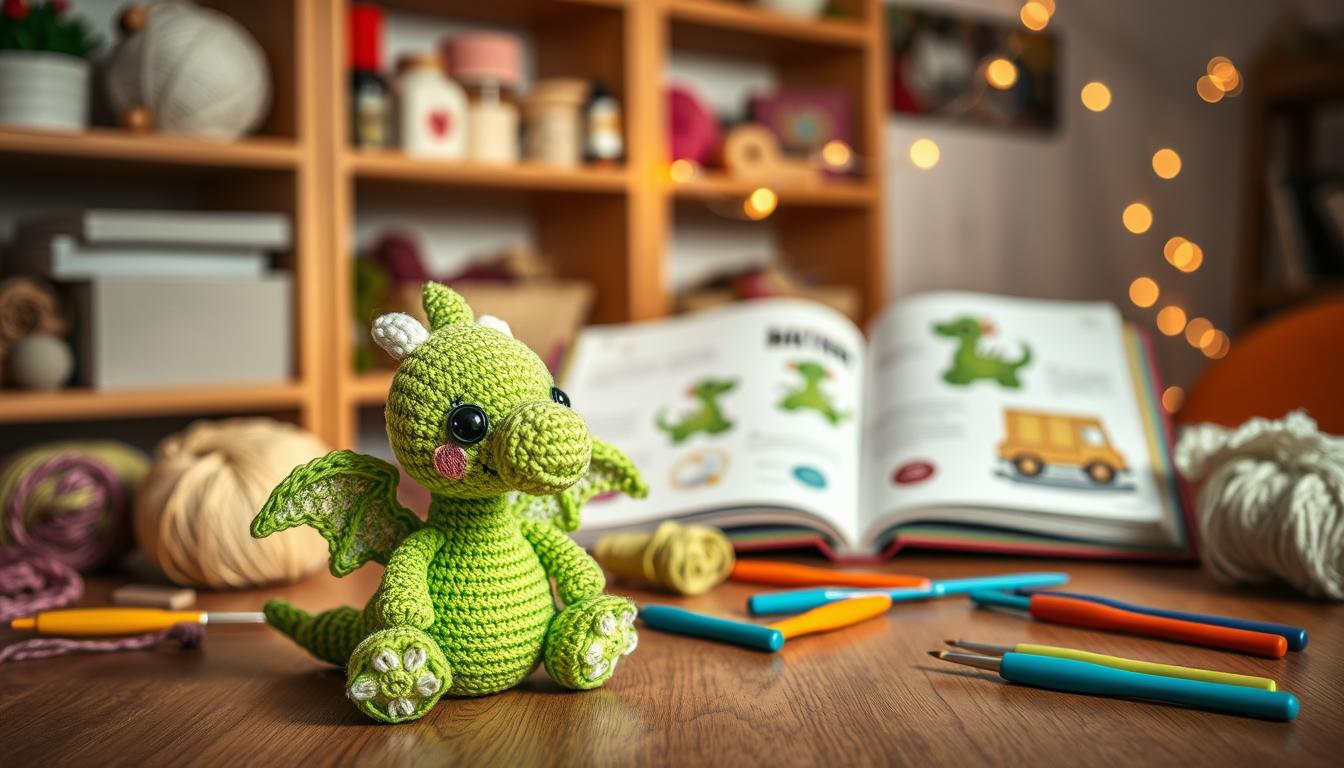
This crochet baby dragon tutorial guides you in making a 7.5-inch (about 19 cm) amigurumi dragon with an oval, egg-shaped body. It includes charming details that bring this tiny dragon to life.
The pattern is designed for Bernat #5 Bulky yarn, using a 4.5mm (G/7) hook and 12mm safety eyes. Yellow accent horns, ears, and wings add a warm, nursery-friendly touch.
Embroidered nostrils give the dragon a cozy look, perfect as a handmade gift or a shelf companion.
This pattern features integrated head-and-body construction for a smooth, seamless finish. The egg-shaped silhouette peaks around Rows 17–18 to increase cuddliness.
Graduated tail spikes add visual motion from base to tip, making the design lively. A stitch-count verification table helps catch mistakes early.
The tutorial suits crocheters comfortable with intermediate-to-advanced techniques like magic ring, FLO/BLO, bobbles, shaping, and color changes. It uses US terms and continuous rounds unless noted otherwise.
Advanced makers can expect to finish in 3–4 hours. Beginners might take 8–12 hours.
Count stitches carefully and use the stitch table to keep your bulky yarn dragon even and balanced.
Key Takeaways
- Finished size: ~7.5 inches (19 cm) with an oval/egg-shaped body.
- Pattern written for Bernat #5 Bulky yarn, 4.5mm (G/7) hook, and 12mm safety eyes.
- Integrated head-and-body construction and graduated tail spikes create a seamless, cuddly look.
- Intermediate-to-advanced techniques required; continuous rounds and US terms used.
- Stitch-count verification table included to prevent cumulative errors.
Materials, Skill Level, and Prep for the Crochet Baby Dragon Tutorial
This short guide lists supplies, time, and key notes to check before you begin. Gather all materials. Practice any new techniques so the project flows smoothly.
Essential supplies and recommended yarn
Start with a clear supplies list: Bernat #5 Bulky green yarn for the body and contrasting yellow or gold for accents. Get one full skein of each color. Also have a 4.5mm (G/7) crochet hook, fiberfill stuffing, 12mm plastic safety eyes, stitch markers, a yarn needle, and sharp scissors.
Different yarns change the feel and size. Cotton makes a firm shape. Acrylic feels soft and offers many colors. Velvet or chenille makes an ultra-plush toy. Blanket yarn adds extra squishiness. Changing yarn weight means adjusting hook size and stuffing amount.
Skill level and time estimates
This is an intermediate to advanced pattern. You should know the magic ring, continuous rounds, even increases and decreases, FLO and BLO work, and the 4-loop bobble stitch. Basic sewing for amigurumi assembly is also needed.
Time varies by skill. Beginners may take 8–12 hours. Intermediate crocheters usually finish in 5–7 hours. Advanced makers can finish in 3–4 hours.
Important pattern notes before you start
Read the pattern carefully for US terms and stitch counts. Decide if you will work in a spiral or finish rounds with a slip stitch and chain 1 as told. Keep a stitch marker at the round start. Count stitches after each row to avoid mistakes.
Stuff firmly at the body’s widest point (Rows 17–18) to keep an oval shape. Check safety eye placement before final stuffing. Fasten backs tightly. Safety eyes may not be safe for very young children. To care for the toy, hand-wash cold and let it air dry flat.
Try small swatches to practice bobble stitches and yarn sculpting for eye sockets. These tips make assembly neater and reduce fixing later during sewing and finishing.
crochet baby dragon tutorial: Head, Body, and Main Construction
Start shaping with one continuous piece for a neat head and body crochet dragon. Work Rows 1–13 for the head. Then continue through Rows 14–24 to form an oval amigurumi body.
Stuff progressively from Row 12 and add firm stuffing at the widest point. This keeps the egg shape stable.
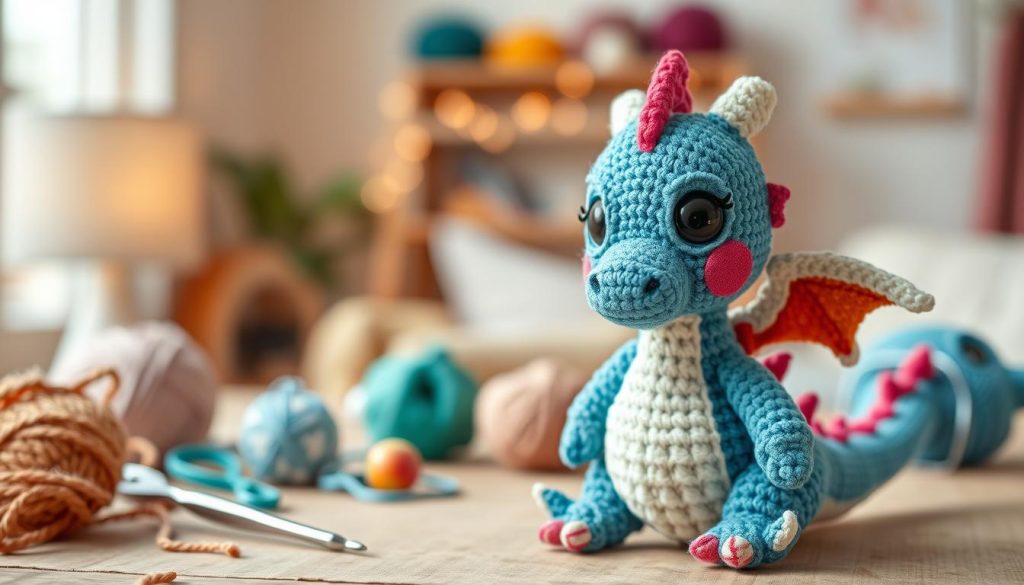
Head and integrated body overview
Begin with a magic ring. Follow the increase pattern to build a rounded head.
Early rows (R1–R8) set the dome: 6, 12, 18, 27, 27, 30, 30, 36 stitches. These rounds prepare the head for eye placement between Rows 8–9.
Keep stitch counts close to the verification table. This prevents shape drift and ensures the head flows evenly into the oval body.
Row-by-row highlights and stitch verification
Follow key row counts for shaping and troubleshooting. The body’s widest area is at Rows 17–18 with 35 stitches.
Work Row 20 as written to add belly texture. It increases to 37 stitches briefly before you reduce toward the base.
Use the stitch verification table below to check counts after each round. Catching mismatches early saves time and keeps the shape correct.
| Row | Stitch Count | Purpose |
|---|---|---|
| R1 | 6 | Magic ring foundation |
| R2 | 12 | Initial increase for dome |
| R3 | 18 | Shape expansion |
| R4 | 27 | Round shaping |
| R5 | 27 | Even round |
| R6 | 30 | Controlled increase |
| R7 | 30 | Maintain shape |
| R8 | 36 | Prepare eye placement |
| R9 | 36 | Snout attachment row |
| R10 | 36 | Head continuation |
| R11 | 27 | Begin shaping neck |
| R12 | 18 | Neck taper, start stuffing |
| R13 | 14 | Close head to body join |
| R14 | 21 | Body FLO increases |
| R15 | 28 | Expand torso |
| R16 | 28 | Even round |
| R17 | 35 | Near widest point |
| R18 | 35 | Widest point |
| R19 | 35 | Maintain oval |
| R20 | 37 | Belly texture bobbles |
| R21 | 25 | BLO decrease, stuff firmly |
| R22 | 20 | Lower taper |
| R23 | 15 | Close base |
| R24 | 10 | Final closure |
Eye sockets, snout, and facial details
Mark eye positions between Rows 8–9. Place the first eye between stitches 14–15 and the second between 21–22.
Use the eye socket technique by threading yarn to sculpt points A–C and B–D. Then pull to form a defined socket.
After sculpting, insert 12mm safety eyes and secure the backs tightly. Check symmetry before final stuffing to avoid lopsided placement.
For the snout, work into the FLO of Row 9. Crochet a 10-st snout piece in green, then switch to yellow for the accent.
Make Row 2 of the snout in BLO with 5 decreases. This gathers the tip. Lightly stuff the snout and follow instructions to weave through FLO and pull tight for a rounded finish.
Embroider two vertical nostril lines with double-strand yellow yarn for visibility. Weave all tails inside before closing to keep a clean, professional finish.
Appendages and Embellishments: Horns, Ears, Wings, Tail, and Spikes
Small details make a baby dragon truly charming. Follow the pattern notes and pro tips to keep parts neat, balanced, and durable.
Pin placements before sewing to help with symmetry and fit.
Horns and ears
Work two horns in yellow as small cones: 4 SC magic ring, 4 SC rounds, then 2 DEC rounds to create a pointed tip.
Do not stuff horns; leave long tails for sewing. Use the crochet dragon horns pattern to line bases up at Rows 4–5 of the head.
Sew each horn through the base and weave through several head stitches to attach pieces securely.
For ears, attach green yarn at Row 4, ch 2, HDC, ch 2, then sl st in the second chain from the hook.
Repeat the HDC, ch 2, sl st motif in the same stitch to shape the ear.
Repeat the ear motif symmetrically on the opposite side and hide ends inside the head.
Reinforce both horns and ears with extra stitches if the toy will be handled often.
Wings construction and placement
Make wings in yellow or gold: Row 1 ch 8, SC across 7; Row 2 ch1 SC×2, HDC, DC×2, HDC, SC.
Row 3 ch1 SC×2, HDC, DC, ch3 sl st in same stitch for a rounded tip, then DC, HDC, SC.
Work both wings identically and leave long tails for sewing.
Use the crochet wings tutorial to position wings at Rows 17–18 of the body.
Angle them slightly upward for a lively pose. Pin both wings before sewing to check balance.
Sew through multiple rows and reinforce attachment points so wings stay secure during play.
Weave ends inside the body for a clean finish.
Tail shaping and graduated spikes
Work the tail in rounds: start 6 SC magic ring, increase to 18 and hold for three rounds.
Then reduce to 12, hold, reduce to 9, hold, reduce to 6, hold, then 3 DEC to close.
Lightly stuff the base and use minimal stuffing near the tip to keep a natural curve.
Create triangular amigurumi tail spikes in yellow and attach them in the back loop only along the tail center.
Make large spikes (ch 4, SC×3), medium (ch 3, SC×2), and small (ch 2, SC×1).
Space 2–3 large, 2–3 medium, and 2–3 small evenly for a graduated look.
Sew each spike through the BLO and reinforce by stitching through adjacent rounds.
This helps the amigurumi tail spikes stay in place when the dragon is handled.
Back ridge and head spikes
Form a continuous ridge from head to tail by placing medium spikes at Row 4 of the head (2–3 head spikes).
Continue with 4–5 body spikes at Row 14 and along the center back.
Mark spacing with pins or measuring tape before attaching.
Attach each spike through several loops and weave tails to secure pieces tightly.
Even spacing and consistent spike sizes create a clean ridge that enhances the silhouette.
Final checks: review all attachments and add reinforcing stitches where needed.
Trim ends neatly. Properly secured horns, wings, and spikes extend your handmade gift’s life and keep the baby dragon looking its best.
Conclusion
Follow the final assembly steps to finish crochet dragon with confidence: insert and secure 12mm safety eyes between Rows 8–9 before final stuffing. Attach horns at Rows 4–5 and sew through the bases repeatedly. Sew wings at Rows 17–18 angled slightly upward and reinforced.
Attach the tail centered at the back by sewing through Rows 21–23 for balance. Weave in all ends and adjust stuffing, especially very firm at the widest body point. Perform final shaping to achieve a polished, gift-ready amigurumi.
For small finishing touches, embroider two vertical nostril lines on the snout with a double strand of yellow yarn. Use pins to mark wing and spike placement before sewing to keep symmetry. Photograph your progress to help with troubleshooting and reproducing a favorite finish later.
If the head feels floppy, add stuffing around the eyes. If wings droop, reinforce attachment points or add a tiny fabric stiffener.
Care is simple: hand wash cold with mild detergent, air dry flat, and reshape while damp. Avoid machine washing when safety eyes are used. Keep the dragon away from very young children unless all amigurumi parts are permanently secured.
Store in a cool, dry place out of direct sunlight to prevent fading and maintain appearance.
Embrace crochet customization to make each dragon unique—try colorways like Ice, Fire, Night, or Rainbow. Alter horn and wing size, add front arms, surface-crochet scales, or change spike count.
Different yarns such as cotton, acrylic, or chenille will change texture and size. Adjust hook and stuffing as needed. With careful assembly and secure amigurumi pieces, your pattern will yield a highly customizable, gift-ready amigurumi that looks professional and feels loved.
FAQ
What materials do I need to make the 7.5-inch amigurumi baby dragon?
You’ll need Bernat #5 Bulky yarn in green for the main body and yellow/gold for accents. Also get a 4.5mm (G/7) crochet hook, 12mm plastic safety eyes, fiberfill stuffing, stitch markers, a yarn needle, and sharp scissors. Prepare one full skein of each color.
Optional yarns include cotton for firmer shape, acrylic for softness and color range, velvet/chenille for plush texture, or blanket yarn for extra squish. Adjust hook size and stuffing if you substitute.
What skill level is this pattern for and how long will it take?
This pattern suits crocheters comfortable with intermediate-to-advanced techniques like magic ring, continuous rounds, FLO/BLO, bobbles, shaping, and basic embroidery.
Estimated times vary: Beginner 8–12 hours, Intermediate 5–7 hours, Advanced 3–4 hours.
Which crochet terminology and round method does the pattern use?
The pattern uses US crochet terminology (MR, SC, INC, DEC, HDC, DC, FLO, BLO, BO bobbles). It recommends working in continuous rounds (spiral) unless noted.
Slip stitch and ch 1 are used only when specified. Keep a stitch marker at the start of rounds.
How is the baby dragon constructed—are the head and body separate pieces?
The head and body are crocheted as one continuous piece in green yarn to create the oval/egg-shaped silhouette. Head rows are Rows 1–13; body rows are Rows 14–24.
The widest, cuddly point is at Rows 17–18.
What are the key early row counts for shaping the head?
Start Row 1 with 6 SC in a magic ring (6), Row 2: 6 INC (12), Row 3: (SC, INC)×6 (18), and Row 4: (SC, INC)×9 (27).
Then Row 5: 27 SC, Row 6: (8SC, INC)×3 (30), Row 7: 30 SC, Row 8: 7SC, 3INC, 10SC, 3INC, 7SC (36). These build the round head before eye placement.
Where do I place the safety eyes and how do I shape the sockets?
Mark eye positions between Rows 8–9. Place the first eye between stitches 14–15 and the second between stitches 21–22.
Use yarn sculpting by threading and pulling A–C and B–D points to define sockets. Insert 12mm safety eyes before final stuffing and secure the backs firmly. Verify symmetry and stuffing to prevent floppiness.
How is the snout made and what about nostril embroidery?
The snout is worked into the FLO of Row 9 as a 10-st piece in green, then switch to yellow for the accent. Gather with BLO decreases to round the snout.
Lightly stuff before closing and embroider two vertical nostril lines with double yellow yarn for visibility. This replaces adding a horn on the snout.
How do Rows 14–18 create the oval body shape and where should I stuff?
Rows 14–18 expand the body to its widest point: R14 FLO (SC, INC)×7 (21), R15 (INC, 2SC)×7 (28), R16 28SC, R17 (3SC, INC)×7 (35), R18 35SC.
Begin stuffing by Row 12 and stuff very firmly at Rows 17–18 to hold the distinctive egg-shaped profile.
Is there a stitch-count table I can use to check my work?
Yes. Follow the stitch-count verification table for Rows 1–24 to catch mistakes early: R1=6, R2=12, R3=18, R4=27, R5=27, R6=30, R7=30, R8=36, R9=36, R10=36, R11=27, R12=18, R13=14, R14=21, R15=28, R16=28, R17=35, R18=35, R19=35, R20=37, R21=25, R22=20, R23=15, R24=10.
Count stitches after each round and correct errors as soon as they appear.
How are the horns and ears made and attached?
Horns (make 2) in yellow: 4 SC magic ring, several rounds of 4 SC, finish with 2 DEC to form a cone. Do not stuff; leave a long tail for sewing.
Sew horns at Rows 4–5 of the head through the base multiple times for security.
Ears are worked on at Row 4: attach green, ch 2, HDC, ch 2, slst in second chain from hook and repeat the small HDC/ch2/slst motif in the same stitch. Repeat symmetrically and hide yarn tails inside the head.
How do I crochet and position the wings?
Wings in yellow/gold: Row 1 chain 8, SC across 7, Row 2 SC/HDC/DC shaping, Row 3 adds a ch3 wing tip and mirrors stitches. Leave a long tail for sewing.
Sew wings to Rows 17–18 on the body, angle them slightly upward for a dynamic look, and reinforce attachment points with extra stitches.
What’s the tail pattern and how do I add graduated spikes?
The tail starts with 6 SC in a magic ring, increases to 18, holds, then decreases in stages to taper to the tip.
Stuff minimally toward the tip for a natural curve. Spikes are added in yellow to the BLO along the center back: Large (ch 4, SC×3), Medium (ch 3, SC×2), Small (ch 2, SC×1).
Space 2–3 large, 2–3 medium, and 2–3 small evenly to create a graduated effect.
How do I create the back ridge and head spikes for a clean look?
Attach medium spikes to the BLO at Row 4 of the head (2–3 head spikes). Continue with 4–5 body/back spikes starting at Row 14 and along the center back.
Use pins or stitch markers to mark even spacing before sewing. This keeps the ridge symmetrical and professional-looking.
Any tips for attaching pieces so they’re durable and neat?
Sew horns, wings, and tail through multiple rows. For example, horns through Rows 4–5; tail through Rows 21–23 to distribute stress.
Reinforce wings and horns with extra stitches and weave ends securely. Pre-place pieces with pins to check symmetry before sewing and hide ends inside the body.
How should I finish and care for the finished dragon?
Weave in all ends, check symmetry, and perform final shaping. Hand wash cold with mild detergent and air dry flat; reshape while damp.
Do not machine wash if safety eyes are used. Secure safety eye backs firmly and avoid gifting to small children if eyes are not fully child-safe.
What customizations can I make to change the dragon’s look?
Try different colorways like Ice blue/white, Fire red/orange, Fantasy purple/pink, Night black/silver, and Rainbow. Vary horn and wing size.
Add arms, surface-crochet scales, change spike counts, enlarge wings by adding rows, or alter tail length. Switching yarn types changes texture and size. Adjust hook and stuffing accordingly.
My stitch count is off—what should I do?
Consult the verification table to find the first row with a mismatched count. Rip back to the last correct row and rework carefully.
Use stitch markers to track round starts and recount after each round to prevent cumulative errors.
The head feels floppy—how can I fix it?
Add more stuffing around the eye sockets and front of the head. Ensure safety eyes are seated correctly. Weave in tail ends inside the head for extra structure.
Verify that you followed the increase rounds for Rows 1–8 and stuff firmly at the widest points.
Any safety reminders for gifting this dragon to children?
Verify safety eye placement and secure backs firmly. Consider embroidering eyes for toys intended for infants.
Remove small detachable parts for very young children and follow general toy-safety guidelines about choking hazards.