
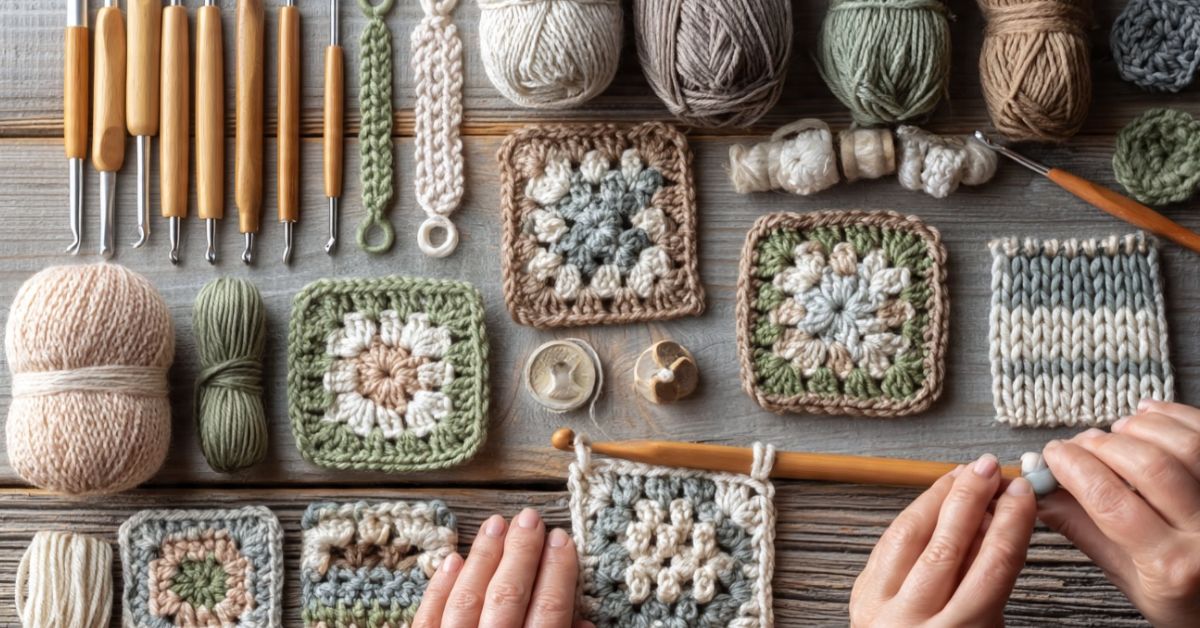
There is something utterly magical about taking a simple ball of yarn and a single hook and transforming it into something beautiful, functional, and deeply personal. Whether you are picking up a crochet hook for the very first time, looking to master the foundations, or simply wanting a relaxing project to wind down with after a busy day, you are in exactly the right place. Crochet is more than just a craft; it is a rhythmic, meditative practice that allows us to slow down and create something tangible in a world that often feels too fast.
Starting your journey into the world of fiber arts can feel a bit overwhelming, but I want to reassure you: if you can tie a knot, you can crochet. This guide is designed to walk you through the essential techniques of 101 crochet, covering everything from the basic stitches to the little finishing touches that make a handmade item look truly professional. Today, we are putting these skills to work by creating a cozy, textured “Everyday Essentials Market Bag.” This simple yet elegant project is the perfect way to practice your tension, master your stitch counts, and end up with a versatile companion for farmers’ markets, library trips, or organizing your craft room. Let’s grab our hooks and get started!
Quick Project Overview
This Everyday Essentials Market Bag is designed for accessibility and style. It leans on the sturdy texture of the single crochet stitch combined with open, airy spaces that give it that classic “market” look.
- Skill Level: Beginner-Friendly.
- Estimated Time: 4 to 6 hours.
- Finished Size: Approximately 12 inches wide by 14 inches tall (not including handles).
- Best Use: Perfect for carrying fresh produce, books, or as a thoughtful, handmade DIY gift for a friend.
- Why You’ll Love It: It works up quickly, uses only basic stitches, and is incredibly durable even when filled with heavy items.
Materials Needed
To create this bag, you will need the following supplies. I always recommend natural fibers for market bags as they tend to hold their shape better and are washable.
- Yarn: 2 skeins (approx. 200–250 yards) of Worsted Weight (Category 4) Cotton Yarn. Cotton is ideal because it has very little “stretch” compared to acrylic.
- Crochet Hook: Size H/8 (5.0 mm).
- Tapestry Needle: For weaving in your ends.
- Scissors: Any sharp pair will do.
- Stitch Marker: Extremely helpful for keeping track of your rounds.
Stitches and Abbreviations
We will use standard U.S. crochet terminology. Familiarize yourself with these abbreviations before you begin:
- ch (chain): Wrap yarn over the hook and pull through the loop on your hook.
- sc (single crochet): Insert hook into the next stitch, yarn over, pull up a loop, yarn over, and pull through both loops on the hook.
- dc (double crochet): Yarn over, insert hook into the stitch, yarn over, pull up a loop, yarn over, pull through two loops, yarn over, pull through remaining two loops.
- sl st (slip stitch): Insert hook into the stitch, yarn over, and pull through both the stitch and the loop on your hook.
- st(s) (stitch(es)): The individual loops of crochet.
- yo (yarn over): Moving the yarn from back to front over the hook.
Pattern Notes Before You Start
Crocheting is all about consistency. Your “tension” refers to how tightly or loosely you hold the yarn. If your stitches are too tight, your bag will be stiff and difficult to work; if they are too loose, the holes will be too large. Aim for a comfortable, even rhythm.
- The “Starting Chain” Tip: If you find your starting chain base is too tight, go up one hook size just for the foundation chain, then switch back to your recommended hook size for the rest of the project.
- Joining Rounds: In this pattern, we will be working in continuous rounds for the base and joined rounds for the body to ensure a clean appearance.
- Gauge: Don’t obsess over gauge for a market bag! As long as your stitches are consistent and you like the look of the fabric, you are doing perfectly.
Full Crochet Pattern
Part 1: The Base
We will begin at the center and work in a flat circle to create the bottom of the bag.
Round 1: Create a magic ring (or ch 4 and sl st into the first chain to form a ring). Ch 1, work 8 sc into the center of the ring. Sl st to the first sc to join. (8 sts)
Round 2: Ch 1, 2 sc in each st around. Sl st to join. (16 sts)
Round 3: Ch 1, 1 sc in the next st, 2 sc in the next st, repeat from to around. Sl st to join. (24 sts)
Round 4: Ch 1, 1 sc in each of the next 2 sts, 2 sc in the next st, repeat from to around. Sl st to join. (32 sts)
Round 5: Ch 1, 1 sc in each of the next 3 sts, 2 sc in the next st, repeat from to around. Sl st to join. (40 sts)
Round 6: Ch 1, 1 sc in each of the next 4 sts, 2 sc in the next st, repeat from to around. Sl st to join. (48 sts)
Part 2: The Body
Now we will build the height of the bag by working an open “mesh” stitch pattern.
Round 7: Ch 4 (counts as 1 dc and 1 ch), skip next st, 1 dc in next st, ch 1, skip next st. Repeat from to around. Join with a sl st to the 3rd chain of the beginning ch-4.
Rounds 8–25: Repeat Round 7. This creates the netted, mesh look that allows the bag to stretch comfortably when filled.
Part 3: The Border and Handles
To give the bag structure, we finish the top with a sturdy border and two handles.
Round 26: Ch 1, work 1 sc in every dc and every ch-space around. Sl st to join. (48 sts)
Round 27: Ch 1, 1 sc in each st around. Sl st to join.
Handles:
Mark the top edge to identify where you want your handles. You want two identical spacings on opposite sides.
Ch 1, sc in the next 8 sts, ch 40 (this forms your handle), skip 12 sts, sc in the next 12 sts, ch 40, skip 12 sts, sc in the remaining 4 sts. Sl st to join.
Round 28 (Edge Strengthening): Ch 1, work sc in every stitch around, including 40 sc into each of the handle chains. This reinforces the handles so they don’t stretch excessively under weight. Fasten off and weave in ends.
Step-by-Step Tutorial Explanation
When you start your bag, visualize the base as a flat disc. As you move into the mesh pattern of the body, you will see the bag naturally start to “cup” and grow outward. This is completely intended! The mesh pattern is essentially a series of “double crochet” stitches separated by a little “chain” space. If you notice a hole that looks too big, check to make sure you didn’t accidentally skip two stitches instead of one. The most satisfying part of this project is watching the bag gain height quickly—it’s a wonderful boost for your confidence as a new crafter.
Common Mistakes to Avoid
- The “Twisted” Starting Chain: If you ever work a project that starts with a long foundation chain and joins in a ring, be very careful to lay it flat on a table to ensure it isn’t twisted before you join it.
- Miscounting Stitches: It is the most common error in crochet! Use your stitch marker to mark the first stitch of every round. It saves so much time spent counting over and over.
- Uneven Edges: This usually happens when we forget to work into the very first or very last stitch of a row. Always check your work after a completed round to make sure your stitch count matches your pattern instructions.
- Tight Tension: If your hook feels like it’s “fighting” the yarn, stop, take a breath, and consciously relax your hand. Your stitches will be much easier to manage if you hold the yarn loosely.
Pro Tips for a More Beautiful Result
- Weaving in Ends: Don’t just cut your yarn and leave a tail! Use a tapestry needle to weave your end back and forth through the back of your stitches in at least three different directions. This creates a secure knot that won’t unravel in the wash.
- Blocking: For a professional finish, you can “block” your finished market bag. Simply dampen it with a spray bottle, reshape it into a perfect circle/rectangle symmetry, and let it dry overnight. You will be amazed at how much neater your stitches look.
- Styling: Because this bag is neutral, it looks beautiful with wooden beads added to the handles or even a small silk ribbon tied around the base of the strap for a feminine touch.
Variations and Personalization Ideas
The beauty of a simple pattern is that it is a canvas for your creativity.
- Color Blocking: You could work the base in one color and the mesh body in another.
- Handle Length: If you prefer a shoulder bag, simply increase the chain count for the handles.
- Decor: Add a button closure or a simple crochet flower in a contrasting color to the front of the bag for a custom, cottage-core aesthetic.
Care Instructions
Cotton yarn is fantastic because it is durable. You can machine wash this bag in a mesh laundry bag on a gentle cycle. Always lay it flat to dry; hanging a heavy cotton bag while wet can cause the fibers to stretch out of shape permanently.
FAQ
How do I know if my hook size is correct?
Check the label on your yarn. It usually suggests the ideal hook size. If your fabric is too holey, go down a size; if it is too stiff, go up a size.
Why does my work look like a hat?
If your bag is curving inward too quickly, you may be missing stitches. If it is ruffling like a skirt, you likely added too many extra stitches by accident.
Can I use acrylic yarn instead of cotton?
You certainly can! Acrylic is very soft and comes in many bright colors. However, please note that acrylic stretches much more than cotton, so your bag may become quite long after it is filled with heavy items.
What is a “magic ring” and why should I learn it?
A magic ring allows you to start a project without an unsightly hole in the center. It has a slight learning curve, but once you master it,8 your circular projects will look much cleaner.
Is it normal to have dropped stitches?
We have all been there! If you lose a stitch, it is okay to unravel your work back to the mistake. It is not “wasting time”—it is part of the learning process that makes you a better crocheter.
Conclusion
I hope this journey into 101 crochet techniques has left you feeling inspired and capable. Remember, every master crafter was once a beginner who decided to pick up a hook and give it a try. This Everyday Essentials Market Bag is just the beginning of what you can create. As you practice these stitches, they will slowly become muscle memory, and you will find yourself moving toward more complex, beautiful projects with ease.
Take your time, enjoy the process, and don’t worry about being perfect. Crochet is meant to be a joyful endeavor. When you finish your bag, take a moment to appreciate those handmade stitches—they are a reflection of your patience and your creative spirit. I encourage you to keep your hook nearby, save this tutorial for your next rainy afternoon, and keep exploring the wonderful, cozy world of crochet. Happy crafting!