
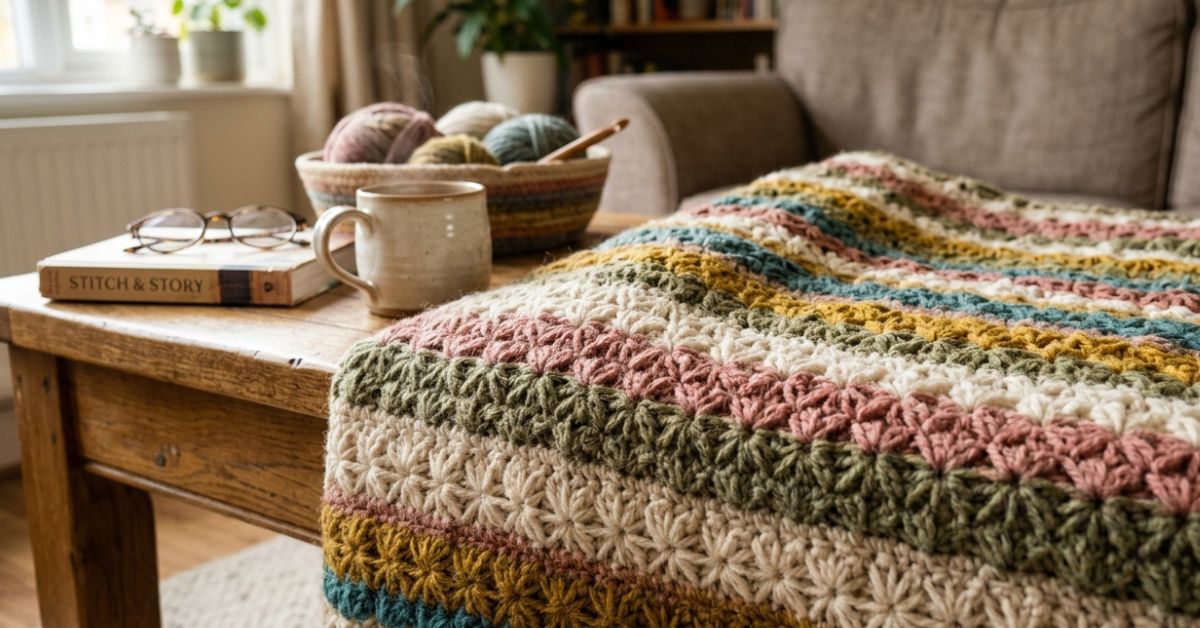
There is something undeniably magical about the star stitch. It carries an air of vintage elegance, reminiscent of heirloom blankets tucked away in cedar chests or delicate handmade shawls passed down through generations. When you look closely at the texture, you see a collection of little blossoms, each one perfectly formed and radiating outward. It is one of those classic crochet techniques that looks significantly more complicated than it actually is, making it the perfect choice for anyone wanting to add a touch of sophisticated, cozy charm to their handmade collection.
Whether you are looking to create a thoughtful baby shower gift, an elegant accessory for your own home, or simply want to master a new texture to expand your creative repertoire, this tutorial is designed with you in mind. We will break down every movement, ensuring that you feel confident and supported from your very first chain to the final woven-in end. Grab a cup of tea, pull up your favorite comfortable chair, and let’s explore the timeless grace of the crochet star stitch together.
Quick Project Overview
- Skill Level: Intermediate (or an ambitious advanced beginner).
- Estimated Time: 4 to 6 hours for a decorative lap blanket or cowl.
- Finished Size: Customizable (instructions are provided for a classic rectangular swatch/scarf format).
- Best Use: This stitch is wonderful for blankets, warm winter scarves, textured cushion covers, and sophisticated baby cocoons.
- Why You Will Love It: The star stitch creates a dense, luxurious, and squishy fabric. It is incredibly insulating, making it a dream for cold-weather projects.
Materials Needed
- Yarn: A medium weight (worsted weight, category 4) yarn is ideal for learning. Choose a solid color or a subtle tonal dyed yarn to best showcase the stitch definition; variegated yarns can sometimes hide the beauty of the star pattern.
- Crochet Hook: A size H/8 (5.0 mm) hook is standard for worsted weight yarn, but feel free to go up a half-size if you tend to crochet tightly.
- Yarn Needle: A large-eye blunt metal or plastic needle for weaving in ends.
- Scissors: Any sharp pair will do.
- Stitch Markers: Extremely useful for keeping track of the start and end of rows until you feel comfortable with the repeat.
Stitches and Abbreviations
- Ch (Chain): Yarn over and pull through the loop on your hook.
- Sc (Single Crochet): Insert hook, yarn over, pull up a loop, yarn over, and pull through both loops on your hook.
- Hdc (Half Double Crochet): Yarn over, insert hook, yarn over, pull up a loop, yarn over, and pull through all three loops on your hook.
- Star Stitch (Special Stitch): Worked by pulling up loops through five distinct points and closing them with a chain to create the star shape.
Pattern Notes Before You Start
The star stitch is worked over an odd number of chains. It is important to note that the “star” is actually created over two rows: the first row forms the base and the loops of the star, and the second row expands those stitches to close the star and prepare the fabric for the next set.
Tension Advice: This is the most crucial part of this pattern. If you pull your loops too tightly, you will struggle to get your hook through in the following row. Aim for a relaxed, even tension. Think of “feeding” the yarn through your fingers rather than pulling it tight.
Gauge: Because this is a dense, textured stitch, gauge is flexible unless you are making a garment. If you are making a garment, always swatch first to ensure your dimensions match the intended fit.
Full Crochet Pattern
This pattern creates a beautiful, thick fabric ideal for a winter scarf or a small decorative project.
Part 1: The Foundation
Start by chaining an odd number of stitches (e.g., 21 or 23 for a sample swatch).
Row 1 (The Star Formation)
- Ch 3. (Note: These count as the first loop).
- Insert hook into the 2nd ch from the hook, pull up a loop.
- Insert hook into the 3rd ch from the hook, pull up a loop.
- Insert hook into the next 3 chains (the stitch you started in and the next two foundations), pulling up a loop in each. You should now have 6 loops on your hook.
- Yarn over and pull through all 6 loops.
- Ch 1 to close the star. (This ch 1 creates the “eye” of your star).
- To create the next star: Insert hook into the eye of the previous star, pull up a loop. Insert hook into the side of the last loop of the previous star, pull up a loop. Insert hook into the same foundation stitch as the last loop of the previous star, pull up a loop. Insert hook into each of the next 2 foundation chains, pulling up a loop in each. (6 loops on hook again).
- Yarn over, pull through all 6 loops, ch 1.
- Repeat from * across the row. Finish by working 1 hdc into the very last foundation chain. Turn.
Part 2: The Closing Row
- Ch 2.
- Work 2 hdc into the “eye” of each star across the row.
- Finish with 1 hdc in the top of the turning chain from the previous row.
Part 3: The Repeat
You now simply repeat Row 1 and Row 2. When starting your Row 1 again, you work into the stitches created by the hdc row below, rather than foundation chains.
Step-by-Step Tutorial Explanation
To make this stitch easier, visualize your hook as a “gathering tool.” In the formation row, you are essentially picking up yarn from the landscape you just created. By the time you have six loops on your hook, it feels substantial. Do not be intimidated by the number of loops; the key is simply keeping them all on the hook long enough to pull the final yarn-over through.
When you work Row 2 (the closing row), you are effectively “unlocking” the stars you just made. The hdc stitches provide structure and height. By placing two hdc in every eye, you are widening the fabric and creating the space needed to work the next row of stars neatly.
Common Mistakes to Avoid
- Tangled Loops: If you find you are losing a loop, slow down. Ensure you are counting your six loops every time before you pull through.
- The Chain-3 Tightness: Beginners often make their starting chain too tight. Use a hook one size larger for your foundation chain to ensure your edges aren’t puckered.
- Skipping the Eye: If you forget to chain 1 after pulling through your 6 loops in the star stitch row, the star will look flattened. That little chain is the “heart” of the star.
Pro Tips for a More Beautiful Result
- Stitch Placement: When beginning the next star, look for the “eye” of the star. It is the hole created by the ch 1. If your crochet feels uneven, this is usually because you are missing the correct anchor point for your hook.
- Blocking: Because the star stitch is so textured, it benefits greatly from a light steam block if using wool, or a wet block if using cotton. This relaxes the stitches and makes the stars pop noticeably more.
- Color Selections: Try working the star rows in a cream color and the closing rows in a deep, contrasting blue or charcoal. This makes the star shapes stand out in a geometric, modern way.
Variations and Personalization Ideas
- The Scarf Version: Create a long, thin rectangle using this stitch. It creates a “bulletproof” warm fabric that is thicker than almost any other crochet stitch.
- Baby Blanket: Use a soft, baby-safe acrylic or bamboo blend. The density of the star stitch makes for a very warm blanket that is lovely and comforting for a bassinet.
- Edging: After finishing your project, add a simple shell stitch border to soften the straight edges of the star stitch, blending the geometric texture with a feminine finish.
Care Instructions
For items made with natural fibers like wool, hand wash in cool water using a gentle wool wash and lay flat to dry on a towel. For acrylic blends, you can usually machine wash on a delicate cycle, but always place the item in a mesh laundry bag first to prevent snagging on other items in the wash. Always avoid high-heat drying, as it can cause the fiber to lose its stitch definition and “felt” over time.
FAQ
Is the star stitch difficult for beginners?
It is a step above beginner stitches like SC or DC. However, once you complete the first row, you will find the rhythm. It is a very rhythmic, meditative stitch that becomes second nature after a few inches.
Why are my star edges uneven?
This is almost always due to tension. If you work your turning chains tightly, the edges will pull in. Try to make your turning chains slightly loose, and ensure your final hdc into the end of the row is worked firmly to keep the edge vertical.
Can I use cotton yarn for this stitch?
Absolutely! Cotton creates a stunning, defined star because it has less “fuzz” than wool. Just be aware that cotton is heavier, so your project will weigh more and have less “squish.”
How do I join new yarn in the middle of a row?
With the star stitch, it is best to join a new color at the very beginning of a row. If you must join mid-row, use the “Russian Join” or invisible knot method so you don’t have bulky knots hidden within the delicate star clusters.
Is this stitch suitable for clothing?
Yes, but keep in mind that it is quite heavy! It is perfect for structured cardigans or heavy winter skirts, but perhaps slightly too thick for a drapey summer top.
Conclusion
Mastering the crochet star stitch is a rite of passage for any maker who loves texture. By following this guide, you have not only learned a technical skill but also opened the door to a library of beautiful, vintage-inspired projects. Whether you choose to make a small, cozy coaster to practice or a full-sized heirloom blanket, remember that the beauty of crochet lies in the time and care you put into every single stitch.
Take your time, enjoy the process, and don’t be afraid to pull back your work if a star looks a little wonky—that is all part of the journey to becoming a confident crocheter. We hope you feel inspired to pick up your hook today and create something that brings warmth and beauty into your world. Happy crafting!