
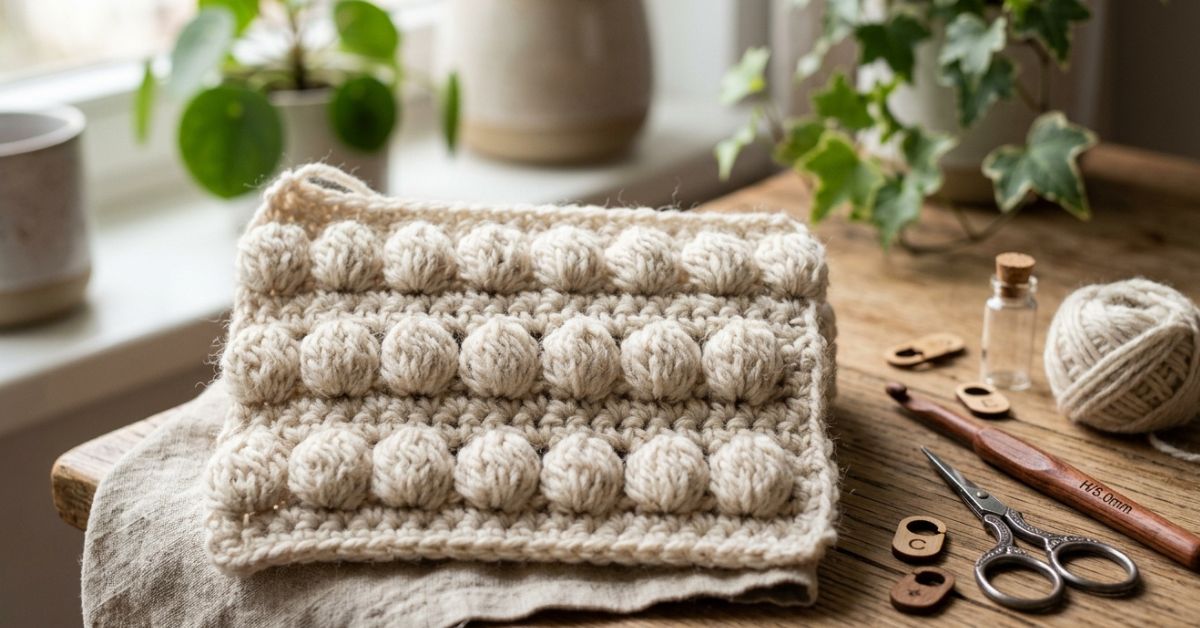
There is something undeniably magical about the bobble stitch. The moment those little rounded pillows of yarn pop out from the surface of your work, your project transforms from a simple flat square into a tactile, cozy masterpiece. Whether you are adding a subtle decorative detail to a baby blanket or creating a full-on, high-texture sweater, the bobble stitch is a foundational skill that elevates your crochet game instantly. It feels like a little secret—a bit of structured chaos that creates a professional, boutique-quality finish with just a few extra loops on your hook.
If you have ever felt intimidated by bobbles, please take a deep breath and relax. Many crocheters fear that their bobbles will look lopsided or that their tension will suffer, but I am here to tell you that with a few simple adjustments to your technique, you can create perfectly uniform 3D puffs every single time. This article will guide you through the process, providing a beautiful pattern to practice on and all the pro-tips you need to feel confident and inspired. Grab your favorite hook and a cup of tea; let’s turn some yarn into something truly special.
Quick Project Overview
To help you master this technique, we are going to make a “Cozy Bobble Potholder.” It is the perfect project because it is small, functional, and provides enough repetition for your hands to memorize the rhythm of the stitch.
- Skill Level: Beginner-Friendly Intermediate
- Estimated Time: 1–2 hours
- Finished Size: Approximately 8 inches by 8 inches
- Best Use: A practical kitchen staple or a thoughtful, quick handmade gift for a housewarming party.
- Why You’ll Love It: This project works up quickly, uses only a small amount of yarn, and teaches you how to manage your tension for a beautiful, symmetrical 3D effect.
Materials Needed
- Yarn: Worsted weight (Size 4) 100% cotton yarn. Cotton is essential for potholders because of its heat resistance.
- Crochet Hook: Size H/8 (5.0 mm). Adjust your hook size if your tension is naturally very tight.
- Tapestry Needle: For weaving in your ends.
- Scissors: A sharp pair of snips.
- Optional: A stitch marker to keep track of your first row.
Stitches and Abbreviations
- ch: Chain
- st(s): Stitch(es)
- sc: Single crochet
- dc: Double crochet
- bobble (5-dc bobble): Yarn over, insert hook into next st, pull up a loop, yarn over, pull through two loops (2 loops remain on hook). Repeat this 4 more times in the same stitch. You will have 6 loops on your hook. Yarn over and pull through all 6 loops at once. Note: Usually, we treat the bobble as a stitch that pushes forward; tighten it by pushing the bobble away from you.
- sk: Skip
- yo: Yarn over
Pattern Notes Before You Start
The most important aspect of a perfect bobble is “consistency.” Try to keep your yarn tension even as you pull up those five loops. If you find your bobbles feel a bit limp, give your working yarn a gentle tug immediately after completing the stitch to lock it in place. We will be working our bobbles on the Right Side (RS) of the fabric so that all the puffs pop out on the same side.
Full Crochet Pattern
Part 1: The Foundation
Chain 26.
Row 1: Single crochet in the second chain from the hook and each chain across. (25 sc). Turn.
Part 2: The Texture Rows
Row 2: Ch 1, sc in the first 2 sts. Bobble in the next st, sc in the next 3 sts. Repeat from to across until you reach the last 3 sts. Bobble in the next st, sc in the last 2 sts. (Total of 6 bobbles). Turn.
Row 3: Ch 1, sc in each stitch across. Make sure you are working into the “top” of the bobble stitch—it can sometimes hide. You should have 25 sc. Turn.
Row 4: Ch 1, sc in the first 4 sts. Bobble in the next st, sc in the next 3 sts. Repeat from to across until you reach the last 5 sts. Bobble in the next st, sc in the last 4 sts. (Total of 5 bobbles). Turn.
Row 5: Repeat Row 3.
Part 3: The Repeat
Repeat Rows 2 through 5 until your piece is a perfect square (approx. 20–25 rows depending on your personal tension).
Part 4: The Border
When you reach your desired height, don’t fasten off. Ch 1 and work a round of sc all the way around the perimeter of the square, placing 3 sc in each corner to keep the work flat. Join with a slip stitch to the first sc and fasten off.
Part 5: Finishing
Use your tapestry needle to weave in your starting and ending yarn tails securely. Because this is a cotton potholder, ensure you weave your ends back and forth in different directions to ensure they won’t unravel after a trip through the washing machine.
Step-by-Step Tutorial Explanation
When you start your bobble, you are essentially creating a cluster of double crochet stitches that are left unfinished until the very last pull-through. This is why the bobble occupies so much vertical space. As you work through the pattern, you will notice that the sc rows act as the “anchor” for your bobbles. Without those sturdy anchor rows, your fabric would collapse. If you are a beginner, look at your work after every bobble row. You should see the bumps protruding clearly. If they seem to be leaning, it usually means your tension on the “pull-through” segment of the stitch is too loose. Practice pulling that final loop through all six stitches firmly—it makes all the difference.
Common Mistakes to Avoid
- The “Loose” Bobble: If your bobbles look saggy, you aren’t pulling the final loop tight enough. After you draw your hook through all 6 loops, do not immediately chain. Simply snug the stitch up by pulling your working yarn, then move to the next stitch.
- Skipping the Top of the Bobble: Many beginners accidentally skip the stitch immediately following a bobble on the return row. Take a moment to count your stitches after every Row 3 or 5 to ensure you still have 25 total.
- Twisted Fabric: When starting, make sure your foundation chain isn’t twisted before you join or begin your first row.
- The “Wrong Side” Pop: Sometimes, a bobble will want to pop to the back of the work. If this happens, use your thumb to simply nudge it through to the front. They will naturally want to lay flat after a light steam or wash.
Pro Tips for a More Beautiful Result
- Yarn Choice: Stick with natural fibers like cotton for home decor. Acrylic is beautiful but can melt if it touches a hot pan.
- Blocking: People often skip blocking, but for texture-heavy projects, it is a game-changer. Once your potholder is done, soak it in cool water, gently squeeze out the excess (no wringing!), and lay it flat to dry, shaping it into a perfect square. This sets your stitches and makes the bobbles look intentional rather than accidental.
- Tension Control: If you find your hand cramping, take a break! The bobble stitch requires slightly more hand motion than a standard dc stitch. Keep your grip loose.
Variations and Personalization Ideas
- The Color Pop: Try working the sc rows in a neutral cream and the bobble rows in a bright pop of color like sage green or mustard yellow.
- The “Bobble Garden”: You don’t have to space them evenly. You can cluster bobbles to create shapes, like a heart or a star, by just drawing the design on graph paper beforehand.
- Gift-Ready: Add a leather label or a ribbon loop to the corner of your potholder to make it look like a high-end boutique gift.
Care Instructions
Since this is made of cotton, it is relatively easy to care for. Machine wash your project on a gentle cycle in a mesh laundry bag to prevent the bobbles from snagging on other items. Lay it flat to dry. If it gets a little stiff, you can fluff it by hand once it is dry, or give it a light steam with an iron (keeping the iron just above the fabric) to relax the fibers.
FAQ
How do I make my bobbles stand out more?
You can create a “puffed” look by adding an extra yarn-over to each stitch within the bobble, essentially making it a 6-dc or 7-dc bobble instead of a 5-dc one. This makes the puff larger and more pronounced.
Why are my stitches uneven?
This is almost always a tension issue. Try to maintain the same “pull” on your yarn for every single loop you draw up. If you are left-handed or have a different holding style, focus more on the rhythm of the stitch than the speed.
Can I use this stitch for a baby blanket?
Absolutely! The bobble stitch creates a wonderful tactile surface that babies love. Just be sure that all your ends are woven in very securely so there is no risk of small fingers getting snagged on a loose yarn tail.
How do I know if I have the right hook size?
Your fabric should be dense enough that it doesn’t look like lace (unless that is your goal). If you can see huge gaps in your single crochet anchor rows, go down a hook size.
Is the bobble stitch hard for beginners?
Not at all. It is just a series of stitches worked into one place. If you can perform a basic double crochet, you already have the skills to make a bobble. It is just about mastering that final “pull-through.”
Conclusion
Creating a piece with the bobble stitch is such a rewarding way to spend an afternoon. You start with a simple length of yarn, and within a few rows, you have created something with actual dimension and personality. Remember, crochet is a journey—don’t worry if your first few bobbles aren’t perfectly aligned. Each one is a practice run for the next, and with time, your hands will find that beautiful, rhythmic flow.
I hope this tutorial has helped you unlock the secret to perfect 3D puffs. Whether you’re making this for your own kitchen or as a gift for a loved one, your hard work and care will shine through in every stitch. If you enjoyed this project, I encourage you to browse our other tutorials—there is always something new to learn and another cozy project waiting for your hook. Happy crocheting!