
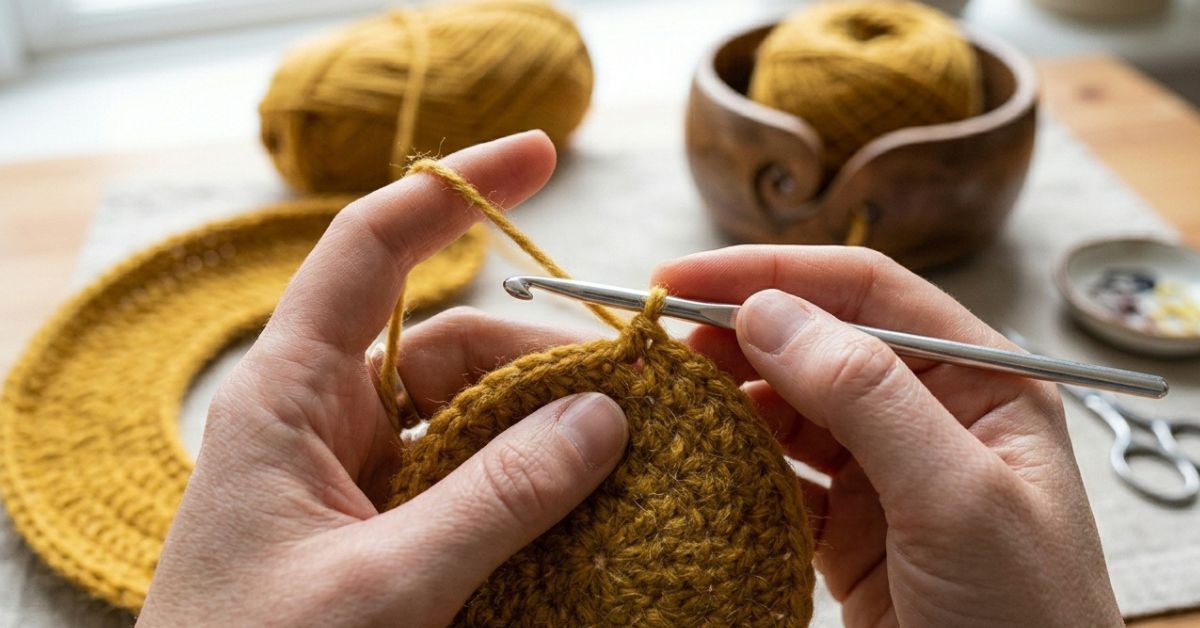
There is something truly magical about the moment a simple length of yarn transforms into something tangible and beautiful through the rhythm of a crochet hook. Whether you are a brand-new maker just learning how to hold your yarn or a seasoned crafter looking to refine your technique, the slip stitch is an essential building block in your crochet toolkit. Often relegated to the background, the humble slip stitch is actually the secret weapon behind professional-looking results. It is the invisible thread that joins your rounds perfectly, creates sturdy seams, and adds the most elegant, polished edges to everything from cozy blankets to delicate garments.
In this guide, we are focusing on the beauty of the “invisible join” and the art of the slip stitch edge. We will walk through a lovely project—a classic, textured circular coaster or mini-tapestry—that requires precise joining techniques. By the time you finish this tutorial, you will feel confident in your ability to start and end rounds with total precision, helping you avoid those unsightly “stair-step” gaps that so often frustrate beginners. Let’s sit in a comfortable chair, settle in with some soft yarn, and elevate your crochet craft together.
Quick Project Overview
You are going to love this project. It is designed to be a meditative, quick win that teaches you the mechanics of the slip stitch join while resulting in a stylish, useful piece of home decor.
- Skill Level: Beginner-Friendly Intermediate
- Estimated Time: 30–45 minutes
- Finished Size: Approximately 5 inches in diameter
- Best Use: Use these as individual drink coasters, or crochet several to sew together into a stunning trivet or a piece of wall art.
- Why You’ll Love It: This project provides the perfect practice ground for mastering the slip stitch without the pressure of a large, time-consuming garment.
Materials Needed
To achieve the best results, consistency is your best friend.
- Yarn: Worsted weight (Size 4) cotton yarn. Cotton is preferred for coasters because it is absorbent and holds its shape well.
- Crochet Hook: Size H/8 (5.0 mm).
- Notions: A bent-tip yarn needle (essential for weaving in ends), a pair of sharp scissors, and an optional locking stitch marker to keep track of your first stitch.
Stitches and Abbreviations
Using standard U.S. crochet terminology:
- ch: Chain
- sc: Single crochet
- dc: Double crochet
- sl st: Slip stitch (Insert hook, yarn over, pull through both the stitch and the loop on your hook)
- st(s): Stitch(es)
- yo: Yarn over
- rnd: Round
Pattern Notes Before You Start
- Tension: Because we are focusing on the slip stitch join, try to keep your tension consistent. If your slip stitches are too tight, your subsequent round will be difficult to work into; if they are too loose, the join will look like an extra, unwanted stitch.
- Working in the Round: In this pattern, we will be joining with a slip stitch at the end of every round. We will also chain up, but we will count that chain as a stitch only where noted.
- The Join: When you reach the end of a round, you will be inserting your hook into the top of the very first stitch of that round to close the circle.
Full Crochet Pattern
This pattern creates a “Star-burst” circle, which is a classic design for mastering round-based crochet.
Part 1: The Foundation
Start with a magic ring.
Rnd 1: Ch 2 (does not count as st here), 12 dc into the ring. Join with a sl st to the first dc. (12 sts)
Part 2: Working the Rounds
Rnd 2: Ch 2, 2 dc in each st around. Join with a sl st to the first dc. (24 sts)
Rnd 3: Ch 2, 1 dc in next st, 2 dc in next st; repeat from around. Join with a sl st to the first dc. (36 sts)
Part 3: The Finishing Edge
Rnd 4: Ch 1, sc in next st, skip 1 st, 5 dc in next st, skip 1 st; repeat from around. Join with a sl st to the first sc.
Fasten off, leaving a 6-inch tail for weaving.
Finishing
Using your yarn needle, weave the tail firmly through the back loops of the last round to secure it. If you want a perfectly flat finish, lightly steam block the coaster by pinning it down and holding a steam iron about an inch above the surface for a few seconds.
Step-by-Step Tutorial Explanation
When you finish that final stitch of a round, it can be confusing to know exactly where to put your hook. For this pattern, always look for the “V” shape of the very first stitch you made in that round. Insert your hook under both loops of that V. Yarn over, pull the loop through the stitch, and then immediately pull it through the loop already on your hook. This is the act of “slipping”—it secures the round without adding height.
Once joined, you will notice a tiny, tight knot. To make your next round, you chain up (usually ch 2 for double crochet). The trick here is to pull that chain slightly taut so it doesn’t look like a dangling loop, and then work your first stitch of the new round into the same space where you joined. This maintains a clean, straight edge that doesn’t spiral.
Common Mistakes to Avoid
- Counting the Slip Stitch as a Stitch: A common mistake is to work a stitch into the slip stitch join. This will accidentally increase your stitch count by one every round, resulting in a wavy, ruffle-like edge. Always count your stitches carefully before joining.
- The “Twisted” Start: When starting your foundation, ensure your chain or magic ring isn’t twisted before you join it.
- Tension Fatigue: If your hands get tired, take a break. Tight tension often happens unconsciously when we are frustrated or trying too hard. If you find your work is curling aggressively, you might be crocheting too tightly; try moving up a hook size.
- Ignoring the “V”: Many beginners insert the hook under only one loop of the stitch. Unless the pattern specifies “back loop only,” always aim for both strands of that top “V.”
Pro Tips for a More Beautiful Result
The difference between a “handmade” look and a “hand-crafted” one is all in the finishing.
- The Invisible Join: For advanced projects, instead of a standard slip stitch, try the method where you pull the yarn through the final loop, thread it onto a needle, and “fake” the top loop of the first stitch. This makes the join truly invisible.
- Yarn Choice: Stick to smooth, plied cotton or high-quality acrylic for these types of projects. Fuzzy mohair or novelty yarns make it very difficult to see the stitches, which can be discouraging when you are trying to master a join.
- Blocking: Never underestimate the power of blocking. It relaxes the fibers of your yarn and allows the slip stitches to settle into a uniform line. It truly changes the look of your work from “home-project” to “boutique-style.”
Variations and Personalization Ideas
- Seasonal Colors: Use reds and greens for Christmas, or soft pastels for a baby project.
- Color Blocking: Join a new color at the start of a round by slip stitching the new yarn onto your hook instead of the old one. It creates a crisp color transition.
- Size Versatility: Want a bigger piece? Simply keep adding rounds to the pattern by increasing by 12 stitches each time (following the math of a flat circle formula).
Care Instructions
Since this project is intended for daily use, keeping it clean is easy. If you used cotton, you can simply toss it into the washing machine on a gentle cycle, though hand-washing in cool water with a mild soap is always safer. Lay it flat to dry on a clean towel. Avoid the dryer, as the heat can cause cotton to shrink or slightly alter the shape of your stitches.
FAQ
Why do my rounds look like they have a staircase?
This usually happens because you are chaining up and counting that chain as a stitch. Try “standing stitches” for a more professional look, or ensure your slip stitch join is pulled very tight to keep the foundation of the next round close to the base.
What should I do if my circle is starting to ruffle?
A ruffle is a sign of too many stitches. You might have accidentally increased too many times or worked into the slip stitch join. Check your stitch count at the end of every round to ensure you haven’t added extras.
How do I hide the tail from the slip stitch join?
Always weave your tail in the direction the stitches were worked. If you go back and forth in a zig-zag pattern through the back of the work, the tail will be virtually invisible and, more importantly, will not come undone.
Is the slip stitch the same as a single crochet?
No! A single crochet adds height to the work, while a slip stitch is essentially flat. The slip stitch is strictly for joining, surface embroidery, or creating a very tight, decorative edge.
Can I join rounds with a chain instead?
While some patterns use a chain-join, it is rarely as clean as a slip stitch join. The slip stitch is the industry standard for a reason—it creates the tightest possible seam.
Conclusion
Mastering the slip stitch and the art of joining rounds is a rite of passage for the dedicated crocheter. It takes time, patience, and a little bit of practice, but the payoff is a wardrobe or home filled with pieces that look neat, intentional, and beautifully crafted. Remember, every master was once a beginner who just decided not to quit. Take your time with these stitches, enjoy the tactile joy of the yarn moving through your hands, and don’t be afraid to pull it out and try again if the first join isn’t quite perfect. You are creating something special, and that counts for everything. Happy hooking!