
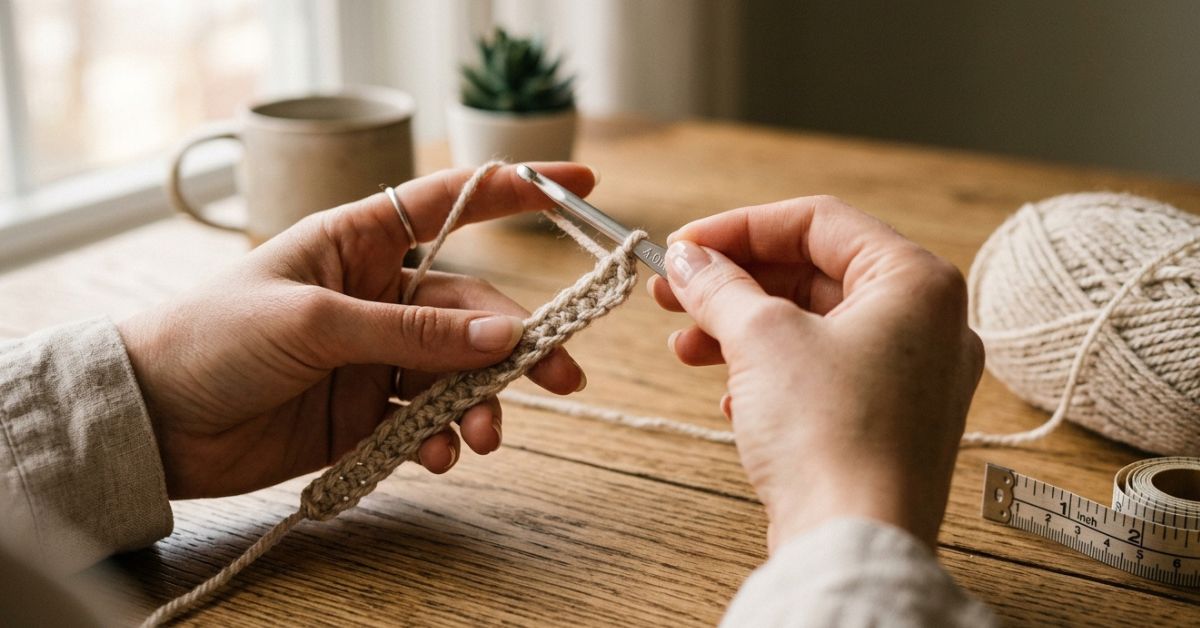
There is something inherently magical about those first few loops on your hook. Whether you are picking up your yarn for the very first time or returning to a beloved hobby after a long hiatus, the foundation chain is where every dream takes shape. It is the literal heartbeat of your project—the quiet beginning that dictates the structure, the drape, and the overall final look of your handmade piece. I know that for many, counting those stitches can feel like a chore, and getting them to look perfectly consistent feels like an elusive goal. But today, we are going to change that.
We are going to demystify the foundation chain and walk through a beautiful, beginner-friendly “Cozy Home” cotton coaster set. This project is the perfect way to master your base stitches while creating something genuinely useful for your coffee table or nightstand. By the time we finish, you will not only have a sweet set of coasters, but you will also have the confidence to approach any pattern, knowing that your foundation is rock-solid and beautifully uniform. Let’s sit down, grab a cup of tea, and get those hooks moving.
Quick Project Overview
- Skill Level: Beginner-Friendly
- Estimated Time: 1 to 2 hours for a set of four
- Finished Size: Approximately 4.5 inches by 4.5 inches
- Best Use: A perfect “everyday” home decor project, or a thoughtful handmade gift for friends, housewarmings, or holidays.
- Why You’ll Love It: It teaches you the vital art of counting your chain and maintaining steady tension, resulting in professional-looking square edges that don’t pull or pucker.
Materials Needed
- Yarn: Worsted weight (Size 4) 100% cotton yarn. Cotton is preferred for coasters because it is absorbent and holds its shape well.
- Crochet Hook: Size H/8 (5.0 mm). If your stitches tend to be very tight, feel free to size up to an I/9 (5.5 mm).
- Tools: A yarn needle for weaving in ends and a pair of sharp embroidery scissors.
- Optional: A set of locking stitch markers to help track your counts.
Stitches and Abbreviations
- ch (chain): Yarn over (YO), pull through the loop on your hook.
- sc (single crochet): Insert hook into the next stitch, YO, pull up a loop, YO, pull through both loops on your hook.
- hdc (half double crochet): YO, insert hook into next stitch, YO, pull up a loop, YO, pull through all three loops on your hook.
- sl st (slip stitch): Insert hook, YO, pull through both the stitch and the loop on your hook.
- st(s) (stitch/stitches): The individual loops of your work.
Pattern Notes Before You Start
The most important part of this pattern is the tension of your foundation chain. Many beginners experience “curling” because the starting chain is worked much tighter than the subsequent rows. To combat this, try to purposefully keep your foundation stitches a little “roomier.” If you find your chain is naturally very tight, go up one hook size just for the starting chain, then switch back to your normal size for the rest of the rows. Consistency is far more important than speed. Remember, it is perfectly fine to stop and recount your stitches at the end of every row.
Full Crochet Pattern
Part 1: The Foundation Chain
Start with a slip knot on your hook.
Row 1: Chain 18. Count them slowly—1, 2, 3… until you reach 18. Lay your chain flat on the table. It should look like a miniature braid. Check that none of the chains are twisted or looped around each other.
Part 2: The First Row
Insert your hook into the second chain from the hook. Work one single crochet (sc) in that stitch and in every chain across. You should end with 17 stitches. Chain 1 and turn your work.
Part 3: Main Body
Row 2: Work one half double crochet (hdc) in the first stitch and in each stitch across. Chain 1 and turn. (17 sts)
Row 3-12: Repeat Row 2. By working in hdc, you get a beautiful, slightly textured fabric that is perfect for protecting surfaces from glasses or mugs.
Part 4: Finishing the Square
Once you have worked 12 rows, or until your coaster looks like a perfect square, fasten off your yarn, leaving a 6-inch tail. Pull the tail through the final loop on your hook to secure it.
Part 5: Bordering
To give your coaster a professional finish, join your yarn in any corner with a slip stitch. Work one round of single crochet evenly around the entire perimeter, putting 3 single crochets in each corner stitch to help the coaster lay flat. Slip stitch to the first sc to join, then fasten off and weave in your ends securely using your yarn needle.
Step-by-Step Tutorial Explanation
When you start your chain, hold your yarn with a comfortable, light grip. If you hold it too tightly, your hands will cramp, and your foundation will be restrictive. As you work into that foundation for the first row, you are looking for the “back hump” of each chain stitch. Working into that back hump—the small bump on the reverse side of the braided chain—results in a cleaner, more finished-looking edge that mimics the top of a stitch.
When transitioning from the first row to the second, notice how the turning chain (the ch 1) acts as a step up to the next row. It doesn’t count as a stitch here, so you begin your first hdc in the very first gap you see. At the end of every row, count your stitches. If you started with 17, make sure you have 17 at the end. It takes only a few extra seconds but saves you from the frustration of a “leaning” project later on.
Common Mistakes to Avoid
The most common culprit for an uneven project is the “tension trap.” When you are concentrating, it is natural to unconsciously grip the hook harder, which makes your stitches progressively tighter as the row continues. If you notice your coaster starting to look like a trapezoid rather than a square, your tension changed mid-row. Take a break, shake out your hands, and try to maintain a rhythmic, relaxed pace.
Another frequent issue is a twisted foundation chain. Before you make your very first stitch of Row 1, run your thumb and index finger along the length of your chain to ensure it is lying perfectly straight. Imagine it like a ribbon—if you twist it, that twist will be built into your project forever. If you find a twist, just undo those few chains and re-work them. It’s better to fix it now than to frog the whole thing later.
Pro Tips for a More Beautiful Result
- Use Stitch Markers: If you find yourself losing track of counts, place a marker in your first and last stitch of every row. This ensures your edges stay perfectly straight and you don’t accidentally skip the last stitch.
- The “Blocking” Secret: If your cotton coasters feel a little stiff or uneven after you finish, light steam blocking works wonders. Pin your square to a clean towel, spray it lightly with water, and let it dry. This “sets” the fibers and ensures those square corners stay sharp and neat.
- Color Play: Cotton yarn comes in a rainbow of shades. Using a variegated yarn for the body and a solid color for the border can make your coasters look like boutique-bought items.
- Weaving Ends: Don’t just clip your yarn ends. Use your needle to weave the tail back and forth through at least three different directions within the work. This ensures they won’t pop out after the coasters go through the wash.
Variations and Personalization Ideas
Once you have mastered the simple square, the world is your oyster! You can increase the number of foundation chains to make these into placemats or trivets. For a “scrappy” version, use up your leftover bits of cotton yarn by changing colors every two rows, creating a fun, striped pattern. If you want to make them seasonal, choose deep reds and greens for a Christmas set, or soft pastels for a lovely spring baby shower gift. For a truly professional touch, consider adding a little fabric tag to the corner once you are done—it’s the hallmark of a handmade heirloom.
Care Instructions
Since we are using 100% cotton, these coasters are easy to maintain. I recommend machine washing them in a garment bag on a gentle cycle with like colors. Avoid heavy bleach, as it can weaken the natural fibers. To dry, reshape them while damp and lay them flat on a towel. They should not be tumble-dried on high heat, as they can shrink. A quick press with a warm iron can restore their crisp, brand-new look whenever they start to look a little tired.
FAQ
How do I stop my crochet chain from being too tight?
Try using a hook that is one size larger just for the foundation chain. Alternatively, focus on purposefully pulling the yarn a bit higher with each loop you pull through, giving the chain some extra space to breathe.
Does the turning chain count as a stitch?
In this pattern, the turning chain does not count as a stitch. This is a common convention in many patterns, but always check the specific instructions at the beginning of any new piece you start.
Why does my coaster look like a triangle instead of a square?
This usually happens if you are accidentally skipping the very first or very last stitch of the row. Counting your stitches at the end of every single row is the best way to prevent this common issue.
Can I use acrylic yarn instead of cotton?
While you can, cotton is highly recommended for items like coasters because it is heat-resistant and absorbent. Acrylic yarn can melt if a very hot mug is placed directly on it, and it doesn’t soak up spills the same way cotton does.
How do I make the edges look perfectly straight?
Taking the time to insert your hook properly into the final stitch of the row—rather than into the gap created by the turn—results in a much cleaner, vertical edge that prevents the “wavy” look some beginners experience.
Conclusion
Mastering the foundation chain is like learning the alphabet; once you have these basics down, you unlock the ability to “read” and “write” any crochet project you desire. Never underestimate the beauty of a simple, well-made square. By focusing on your tension, counting your stitches, and taking your time with those early rows, you are setting the stage for a lifetime of beautiful, handmade creations.
I hope you found this walk-through helpful and, more importantly, calming. There is such a joy in slowing down and creating with your hands. If you enjoyed this project, why not try making a few more in different colors, or perhaps experimenting with a slightly larger size next time? Your progress is your own journey, and every stitch—even the ones that turn out imperfect—is a step toward becoming the master crafter you are meant to be. Happy hooking, and may your yarn always be tangle-free!