
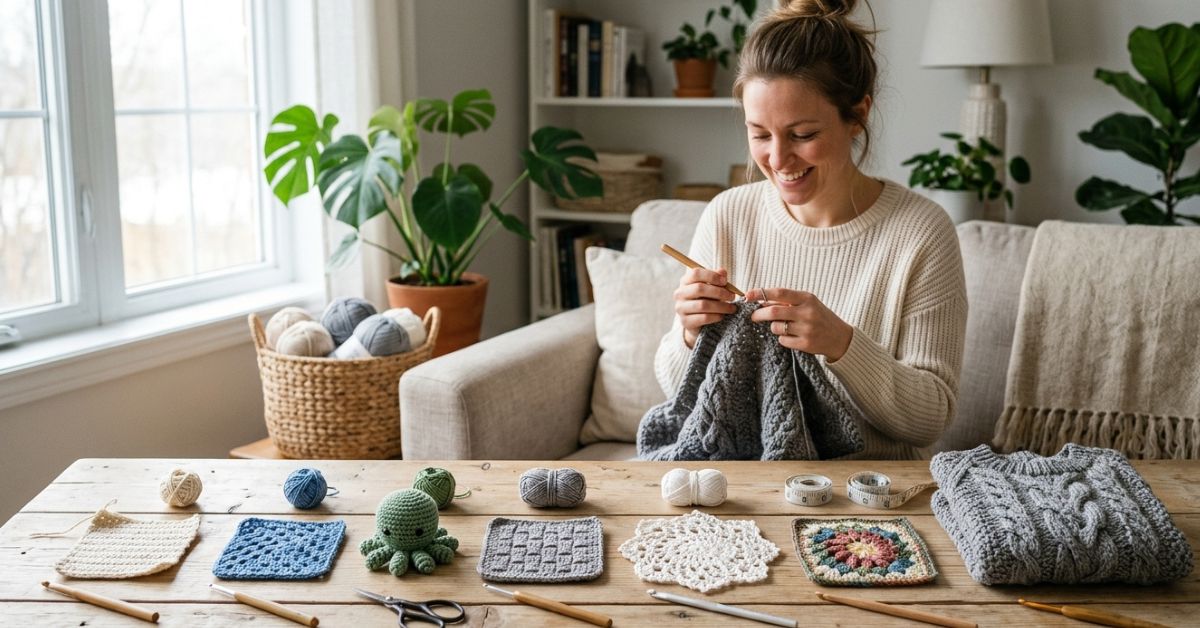
There is something truly magical about picking up a hook and a ball of yarn for the first time. Perhaps you have seen a cozy, handmade blanket on a friend’s sofa, or maybe you have spent hours pinning beautiful crochet garments to your dream boards. Many people worry that learning to crochet takes months or even years of strenuous practice, but that is simply not the case. Learning the foundational stitches—the building blocks of every intricate shawl, adorable plushie, and home decor piece you admire—is an achievable, rewarding journey that you can jump into right now.
In just a few days of consistent, intentional practice, you can transform a single strand of yarn into a tangible treasure. Crochet is a gentle craft; it is rhythmic, meditative, and incredibly satisfying. Whether you are looking for a creative outlet to soothe your mind after a long day or wanting to create heartfelt, handmade gifts for your loved ones, this craft is the perfect companion. In this guide, we will move past the intimidation factor and look at exactly how to master the basics. We have even included a lovely, beginner-friendly pattern—a classic textured dishcloth—that serves as the perfect “first project” to build your confidence and refine your technique. Pull up a comfortable chair, grab a cup of tea, and let’s begin your crochet journey together.
Quick Project Overview
This project is designed specifically for the complete beginner, though its elegant texture is something intermediate crocheters will appreciate as a quick, mindless project for a quiet evening.
- Skill Level: Absolute Beginner
- Estimated Time: 2 to 4 hours
- Finished Size: Approximately 8 x 8 inches
- Best Use: Kitchen essential, housewarming gift, or sustainable face cloth
- Why You’ll Love It: This project utilizes the “Moss Stitch,” a combination of single crochets and chains that creates a beautiful, squishy fabric. It is forgiving, easy to count, and incredibly satisfying to complete.
Materials Needed
- Yarn: One skein of Medium (4) weight 100% cotton yarn. Cotton is recommended because it is absorbent, durable, and holds its shape well.
- Crochet Hook: Size H/8 (5.0 mm). This size provides a nice balance of drape and structure for beginners.
- Tapestry Needle: For weaving in your yarn tails.
- Scissors: Any sharp pair will do.
- Optional: A small locking stitch marker to keep track of the first stitch of each row.
Stitches and Abbreviations
We use standard U.S. crochet terminology. Familiarizing yourself with these abbreviations will help you read any future pattern you encounter.
- Ch (Chain): Yarn over, pull the loop through the loop on your hook. This creates the foundation for your work.
- Sc (Single Crochet): Insert hook into the next stitch, yarn over, pull up a loop (two loops on hook), yarn over, and pull through both loops.
- Sk (Skip): Do not work into the designated stitch.
- St (Stitch): The individual loop or gap you work into.
- FO (Fasten Off): Cut the yarn and pull the tail through the final loop to secure it.
Pattern Notes Before You Start
When starting, your tension may feel inconsistent—this is completely normal. Think of your crochet journey as learning to play an instrument; your hands need to find their natural rhythm. Try to hold your yarn with a comfortable, consistent tension—not so tight that the hook struggles, and not so loose that the stitches look wonky. If you find your edges are curling, it usually means your foundation chain was too tight. A great tip for beginners is to use a hook that is one size larger than the yarn label recommends just for your starting chain to ensure it remains flexible.
Full Crochet Pattern
Part 1: The Foundation
To begin, make a slip knot and place it on your hook. Chain an even number. For this 8-inch square, chain 30. Ensure your chains are uniform in size.
Part 2: Starting the Pattern
Row 1: Single crochet in the 4th chain from the hook. Chain 1, skip 1 chain, single crochet in the next chain. Repeat from to until you reach the end of the row. You should end with a single crochet in the very last chain. Turn your work.
Row 2: Chain 2. Single crochet into the first “chain-1 space” (the gap created by the chain in the row below). Chain 1, skip the next single crochet, single crochet into the next chain-1 space. Repeat until you reach the end. Work your final single crochet into the turning chain space. Turn.
Part 3: Continuing the Work
Repeat Row 2 until the piece measures approximately 8 inches square. The beauty of this stitch pattern is that it is the same row over and over again, allowing you to settle into a meditative flow.
Part 4: Finishing and Weaving
Once your piece is the desired size, fasten off, leaving a 6-inch tail. Use your tapestry needle to weave the tail back and forth through the stitches on the back side of the work to secure it so it cannot unravel. Repeat this for the starting tail.
Step-by-Step Tutorial Explanation
If you are feeling a bit overwhelmed by the technical terms, visualize the process this way. Imagine you are building a small fence. Your foundation chain is the ground, and your single crochets are the fence posts. By chaining one and skipping a stitch, you are essentially leaving a “window” for your next row. When you come back to start the new row, your hook will dive right into those “windows” (the chain-1 spaces) rather than trying to find the tiny holes in the top of the previous stitches. This makes the work much easier to see and prevents the common mistake of missing stitches, which leads to your rectangular project accidentally becoming a triangle.
Common Mistakes to Avoid
Many beginners struggle with “dropped stitches,” which happens when you accidentally skip a stitch at the very end of your row. Always count your stitches at the end of each row. If you started with 30, ensure you still have 30 by the time you turn your work. Another common issue is tension variance. If your project starts to look wavy, try to focus on keeping the distance between your stitches uniform. If you find yourself needing to force the hook into the stitch, your tension is likely too tight—take a breath, loosen your grip on the yarn, and try again. Remember, crochet is meant to be relaxing, not a test of strength!
Pro Tips for a More Beautiful Result
For a polished finish, consider “blocking” your finished piece. This sounds technical, but it’s quite simple: lightly dampen your completed item with water, lay it flat on a towel, and gently stretch it into a perfect square or rectangle, pinning the edges if necessary. Let it dry completely. This relaxes the yarn fibers and makes your stitches look professional and even. Additionally, when choosing yarn, start with a light or medium pastel color. It is much easier to see your individual stitches in bright, light colors than with dark navy or black yarn, which can hide your stitch definition and make learning more frustrating than it needs to be.
Variations and Personalization Ideas
Once you have mastered the basic dishcloth, the possibilities are endless. You can hold two strands of thinner yarn together to create a chunky, textured coaster set. You can change colors every four rows to create a beautiful striped look—just be sure to carry the yarn up the side so you don’t have a million ends to weave in! For a more advanced version, try this same stitch sequence using a soft, wool-blend yarn to turn it into a delicate, cozy washcloth for a spa-themed gift bag. Adding a store-bought ribbon or a sprig of dried lavender to your finished project makes it feel like a boutique item.
Care Instructions
Because we used cotton yarn for this project, your item can be easily maintained. For the best longevity, machine wash on a delicate cycle in a mesh garment bag and tumble dry on low, or lay flat to air dry. If the piece becomes slightly out of shape after many uses, simply dampen it and reshape it to restore its original look.
FAQ
Is crochet expensive to start?
Not at all. A basic set of crochet hooks can be found for a very low price, and a single ball of high-quality cotton yarn is very affordable. Compared to many other hobbies, the barrier to entry is quite low.
Why does my work look like a triangle?
This is caused by missing stitches at the end of every row. Use a stitch marker to mark the first stitch of each row so you always know where to place the last stitch when you return to that side.
How do I stop my yarn from tangling?
Removing the yarn band and finding the “center pull” end is a great habit. Keeping your yarn in a dedicated bag or a ceramic bowl while you work will also prevent it from rolling onto the floor.
How long does it really take to get “good”?
Within a week of 30-minute daily practice sessions, you will be able to complete basic squares and rectangles. Mastery of complex patterns usually follows within a few months of consistent work.
Are left-handed crocheters at a disadvantage?
Absolutely not. You can find “mirror” versions of most tutorials online. Once you learn the mechanics of how the hook pulls the loop through, it becomes second nature regardless of which hand is dominant.
Conclusion
You have just taken the first step toward a lifetime of creativity. Learning to crochet is not just about producing an object; it is about reclaiming the power to make things with your own two hands. Do not worry if your first few rows aren’t perfect—most experienced crocheters keep their first practice pieces as a reminder of how far they have come. Save this guide as a reference, keep your hook in your bag, and don’t be afraid to pull out your work and start over if you make a mistake. Every stitch is progress. Enjoy the process, celebrate your first finished project, and get ready for your next beautiful creation. Happy hooking!