
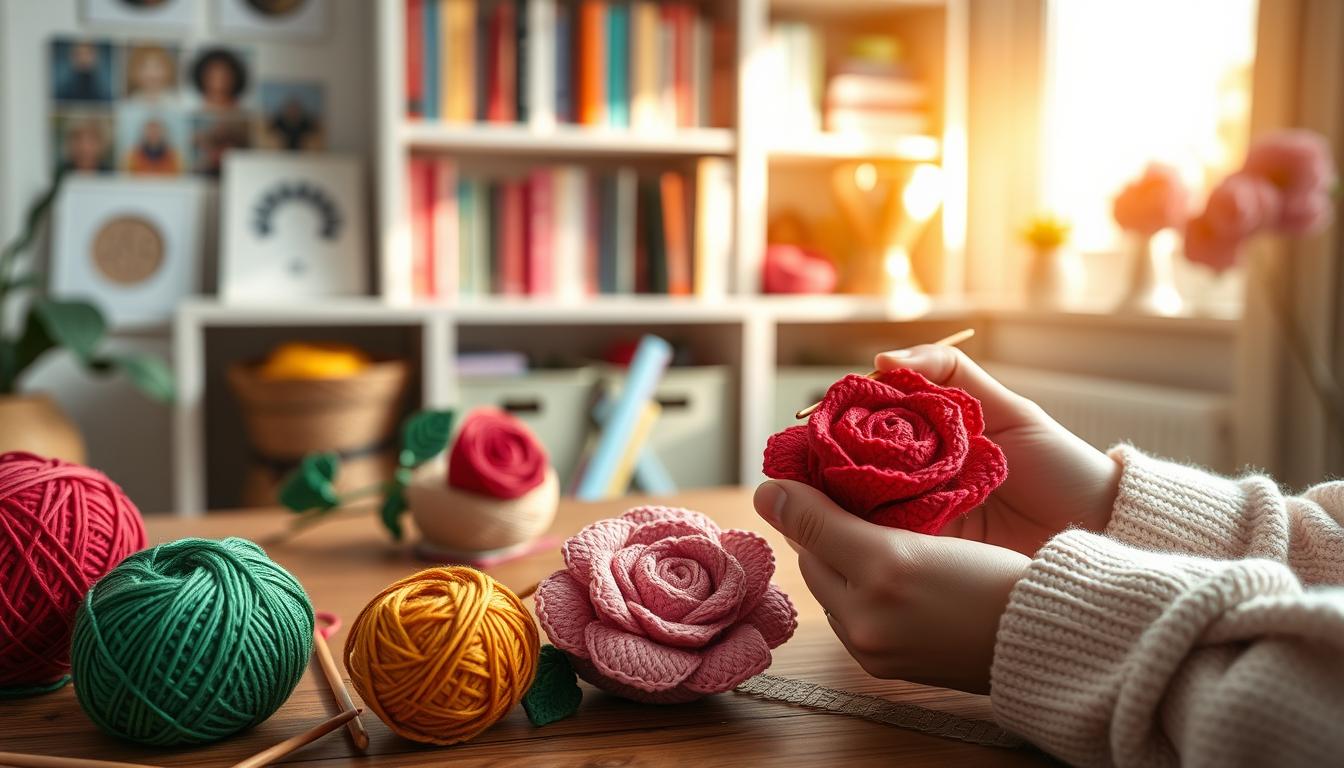
This easy crochet rose tutorial welcomes new makers with clear steps and real materials. You will find beginner crochet flower options and a practical crochet rose pattern. The pattern guides you from a tiny mini bloom to a multi-head arrangement.
The instructions use US crochet terms and include tips on yarn choice, hooks, and simple assembly. This helps you learn how to crochet a rose with confidence.
Patterns range from a quick mini rose worked from a short chain to an intermediate multi-head small rose. This uses three yarn colors (dark and light pink, green), a 2.5mm or 3.0mm hook depending on yarn, and basic tools like scissors and a tapestry needle.
Video support is available for visual learners; subtitles must be enabled manually in some videos. You’ll also see how the same techniques scale up for a large plush rose using bulky chenille yarn and dowel stems.
Throughout this series you’ll learn how to make petals and add sepals. You will thread wire or rods for stems and secure blooms with hot-melt adhesive or sewing.
Whether you want a tiny accent for a hat or a fuller bloom for a bouquet, this guide shows how to crochet a rose step by step. You can also adapt the pattern to your supplies and skill level.
Key Takeaways
- The tutorials use US crochet terms and suit beginners with video help.
- Materials cover small to bulky yarns, hooks from 2.5mm to 6.5mm, wire or dowels, and basic tools.
- Mini and small roses form quickly from simple chains and rolling techniques.
- Multi-head and large plush roses need staged petals, sewing, and glue for secure assembly.
- Adjust size by changing yarn weight and hook size; leave long tails for sewing and shaping.
crochet rose tutorial: materials, stitches, and preparation for beginners
Start by gathering a concise crochet materials list for a smooth session. Pick yarn that fits your goal: DK / light worsted (#3) is good for small roses. Use bulky chenille like Cygnet Jellybaby Chunky for large plush blooms.
Choose colors such as light and dark pinks, reds, greens, or bright yellows and oranges to add depth to your roses. Save scraps from other projects for practice and tiny roses.
Essential crochet tools make a big difference. Include hooks ranging from 2.5mm to 6.5mm, stitch markers, tapestry needle, sharp scissors, and a hot glue gun. Keep floral wire supplies like 0.5mm wire, a 40cm x 2mm flower rod or wooden dowel for stems, and tape or yarn for wrapping.
A craft mat protects surfaces during hot glue steps. These tools help create neat and secure crochet roses.
Learn common crochet abbreviations before you start. Patterns use ch, sc, hdc, dc, ss, sk, and sometimes trc for larger petals. All instructions follow US crochet terms so you won’t need to convert stitch names.
The V-stitch is written as (1 dc, ch2, 1 dc) in the same stitch. Shell stitch rows often use clusters, like six dc in a ch2 space.
Practice basic stitches in short swatches to confirm your tension. Use stitch markers to mark the start of rounds and key increases or decreases. Pay attention to turning chains when working rows versus rounds.
Leave long tails for sewing petals and fastening off securely when patterns ask for it.
Assess crochet difficulty honestly before starting a pattern. Small and mini roses rate as basic to intermediate, fitting many beginner projects. Multi-head or layered roses are intermediate, while large plush roses need confident handling of rounds, consistent stitch counts, and mixed techniques like glue and wire shaping.
Check crochet gauge early to achieve your desired finished size. A small rose can finish near 2″ (5 cm) with DK yarn and a 3mm hook. A mini rose may be around 3/4″ (2 cm).
A bulky chenille bloom can reach about 6.5″ wide with a 6–6.5mm hook. Adjust yarn and hook size to scale your roses up or down.
Prep your workspace before assembly. Clear a surface and lay out crochet tools and floral wire pieces. Pre-cut wire lengths and enable subtitles for any video tutorial you follow.
Practice with scrap yarn to test stitch tension and finished size. This gives better results when working with your chosen yarn for crochet roses.
step-by-step crochet rose tutorial and assembly techniques
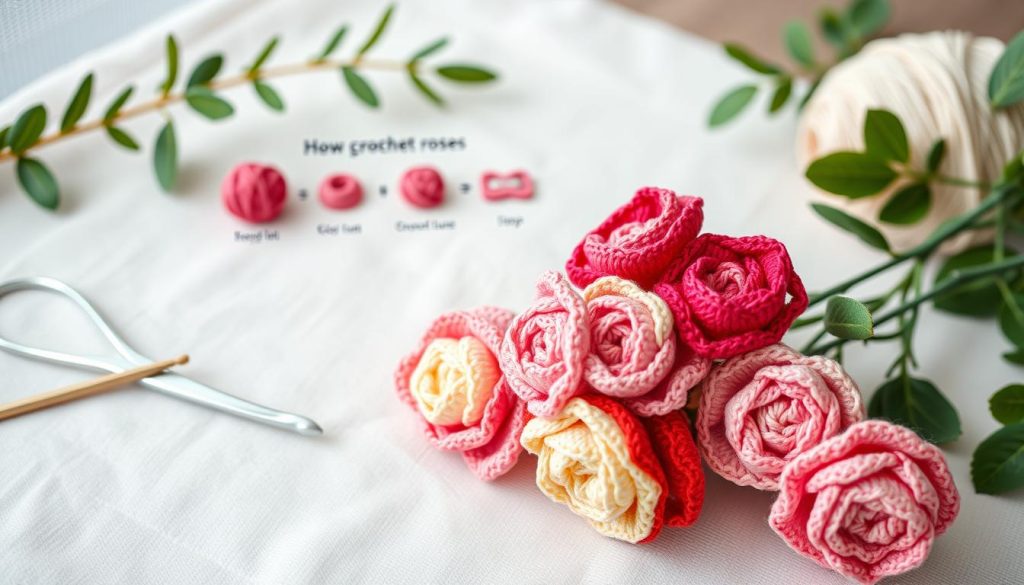
Start with clear steps so each rose looks neat and stays consistent. For beginners, try the mini crochet rose pattern.
Use leftover #3/DK yarn and a 3.0mm hook. Chain 6, work 1 hdc in the 2nd chain from the hook. Then repeat 3 hdc across to make about 15 hdc total.
Cut the yarn leaving a long tail. Let the strip curl, roll it tightly, and sew the underside to secure. This makes a 3/4″ bloom perfect for embellishments.
For a larger rose, chain 25 for the base. Work the V-stitch repeat across to make 11 V-stitches.
In the next row, make shell petals by working 6 dc in each ch-2 space. Place single crochets between shells.
Leave a 6–8″ tail. Roll from the end of the petal row and stitch the base. Using 23 chains creates a slightly different petal shape with seven fuller petals.
How to roll crochet rose matters for the look and strength. Start at the outer edge for a loose bloom or at the tip for a tight bud.
Use stitch markers to mark the last stitch of your petal row to know where to start rolling. Secure with some tapestry-needle stitches through the base.
Add sepal pieces around the bottom and hide stitches with hot glue if needed.
Intermediate makers can try making several small roses for a multi-head approach. Mount these on one stem to create a bouquet.
Wrap each wired or glued base around a 40cm wooden dowel or floral rod. Stagger placement to form a multi-head crochet rose bouquet.
Use hot-melt adhesive to attach to the rod and then wrap the finished stem with green yarn to cover wires and seams.
Layered rose patterns create realistic depth. First build a center core. Then add small, middle, and large petals in order.
For plush blooms, follow a chenille rose tutorial using chunky yarn like Cygnet Jellybaby. This gives a large, soft flower.
Insert iron wire into petal bases where shaping is needed. Glue petal bases to the core to hold them firmly.
Large crochet rose starts with a magic ring. Then work rounds of double crochet increases for the center.
Make three petal sizes: small, middle, and large. Keep stitch counts even so shaping stays balanced.
Add wired leaves or a sepal worked in rounds. Slide the dowel through the sepal center and glue it to hold placement.
For assembly, attach the flower core first. Then add small petals, middle petals, and outer petals last.
Fan the petals to the openness you want. Secure each layer with glue or needle stitches.
Add wired leaves and wrap stems to assemble a bouquet. Use finished roses as embellishments on hats, blankets, or brooches.
Durability tips: weave in tails neatly and cover exposed wire with yarn. Reinforce glue joints on frequently handled stems.
For a plush look, follow the chenille rose tutorial for larger blooms. Test petal placement before final gluing.
These steps yield crochet rose projects that look professional and last well with daily use.
Conclusion
This crochet rose tutorial summary shows a clear path from easy practice pieces to polished blooms. Start with the mini rose using a chain 6 quick pattern. This helps you master curling and rolling.
Next, try the small rose with a chain 25 foundation, V-stitch, and shell row to refine petal shaping. Then, tackle multi-head or plush chenille roses. These teach assembly, wiring, and hot-glue techniques.
Keep key tips in mind while learning. Use US crochet terminology, and pick yarn and hook sizes to control the final rose size. For example, DK/#3 yarn with a 3mm hook makes a 2″ small rose. Chunky chenille with a 6–6.5mm hook creates blooms up to 6.5″.
Leave long tails for sewing and use stitch markers for rounds. Turn on subtitles in videos if they are available for extra clarity.
For presentation, stagger petals to create a natural shape. Secure sepals with stitching or hot glue. Cover wires or dowels with green yarn for tidy stems.
Fan petals to set the openness you want. These final tips help your pieces look handmade and professional. They work well as gifts, bouquet accents, or items for sale.
Practice the three core builds—mini, small, and plush—to master rolling, sewing, and shaping. Experiment with colors and textures. Document your progress and share your blooms on social media or craft markets.
With steady practice, you will confidently create many types of roses. This will also help you expand your crochet skills.
FAQ
What is the title of this tutorial?
Easy Crochet Rose Tutorial for Beginners to Master
What materials and tools do I need to make small, mini, and large plush crochet roses?
For small and mini roses use leftover #3 light worsted/DK yarn and a 3.0mm (C) hook or a 2.5mm hook for finer work.
For large plush roses use bulky/12‑ply chenille such as Cygnet Jellybaby Chunky Chenille with a US 10–10½ / 6–6.5mm hook.
Supporting tools include stitch markers, tapestry/darning needle, scissors, hot‑melt glue or a hot glue gun, floral or iron wire, flower rod or wooden dowel (example: 40cm x 2mm), kebab sticks for cores, and tape or yarn for wrapping stems.
Keep a craft mat for gluing and pre‑cut wires for leaves.
What stitches, abbreviations, and special stitches will I use? (US terms)
Patterns use US crochet terms: ch (chain), sc (single crochet), hdc (half double crochet), dc (double crochet), tr (treble), ss (slip stitch), sk (skip).
Special stitches include V‑stitch (1 dc, ch2, 1 dc in one stitch) and shell stitches (for example 6 dc in a ch2 space).
Tutorials may use rounds and rows—watch for turning chains and use stitch markers to mark round starts or key stitches.
What skill levels do the patterns target and how should I prepare?
Mini and small roses are rated Beginner/Basic (Craft Yarn Council). They are great first projects.
Multi‑head bouquets and large plush roses are intermediate. They require working rounds, keeping stitch counts, shaping, wiring, and hot‑glue assembly.
Prep by gathering all materials, enabling subtitles on tutorial videos if available, and practicing with scrap yarn to test size.
Leave long tails for sewing and assembly.
How do the mini and small rose patterns differ and what are their finished sizes?
The mini rose is a quick curl‑and‑roll pattern (Ch6, hdc repeat). It finishes about 3/4″ (2cm) using DK yarn and a 3.0mm hook.
The small rose uses a longer foundation (Ch25) to create a V‑stitch row and a shell row, or an alternative small pattern from the multi‑petal method. It finishes around 2″ (5cm) with DK yarn and a 3.0mm hook.
Leave a long tail for rolling and sewing the base.
What is the step‑by‑step assembly for a small or mini rose?
Work the foundation and petal rows as instructed. Cut yarn leaving a 6–8″ tail, then roll the piece into a spiral from the starting edge. Secure the underside with a few tapestry needle stitches.
Add a crocheted or worked sepal around the base and glue or sew it in place.
For wired roses insert thin wire into the base and cover it with yarn when attaching to a stem.
How do I make a multi‑head or layered rose bouquet?
Make several small rose units. Add iron wire or long tails to bases.
Attach each flower to a central flower rod or wooden dowel (example: 40cm x 2mm), stagger flowers down the rod, and secure each base with hot‑melt adhesive and wrapping yarn.
Cover the rod with green yarn and add wired leaves as you go. Staggering each bloom creates a natural multi‑head bouquet.
How are large plush roses constructed and finished?
Large roses use bulky chenille yarn and are made in pieces: a center, small petals (two), medium petals, large petals, sepals, and leaves.
Work rounds with precise stitch counts. Glue petals halfway down and stagger each petal by about 50%.
Push the dowel through the sepal and glue, then wrap it with green yarn. Add wired leaves and secure all joins with hot glue.
Fan petals to adjust openness and weave in ends for a neat finish.
What leaf patterns and wiring methods are recommended?
Leaf patterns range from Ch8 small leaves to Ch13 larger leaves. They include symmetrical sc, hdc, and dc sequences.
Insert 0.5mm florist wire along the leaf center before finishing so you can shape it.
After attaching to the stem, cover exposed wire with yarn and secure with glue or wrapping to hide joins.
Which yarn and hook combinations change finished size and texture?
Use DK/#3 yarn with 2.5–3.0mm hooks for delicate small roses (~2″ or smaller).
Use bulky/12‑ply chenille with 6–6.5mm hooks for plush roses up to ~6.5″ wide.
Thicker yarn and larger hooks increase size; thinner yarn and smaller hooks decrease size.
Color choice—mixing light and dark pinks, reds, or bright tones—affects depth and realism.
What assembly glue and safety tips should I follow?
Use a hot‑melt glue gun for fast, strong joins. Work on a craft mat and keep a safe distance from skin.
Apply glue sparingly to petal bases and stem joins. Reinforce with stitching where possible.
Cover exposed wire with yarn to avoid sharp edges and secure glued seams if flowers will be handled or sold.
How do I shape petals and adjust bloom openness?
Shape petals by adding wire to bases or inserting wire inside petal seams as directed.
For more open blooms, fan and stagger outer petals during assembly and glue them slightly farther from the center.
For a closed look, overlap petals tightly and glue closer to the core.
Chenille and bulky yarn create fuller, plush petals while DK curls tighter when rolled.
How should I finish and present my crochet roses for gifting or sale?
Weave in and trim tails. Cover stems and wires with green yarn. Fan petals into the desired shape and add wired leaves.
Photograph pieces on a neutral background, tag pattern sources when sharing, and package bouquets carefully.
Reinforce glued joins for durability if pieces will be handled frequently or shipped.
What are practical starter projects and a recommended learning path?
Start with the mini rose (Ch6 quick pattern) to practice curling and rolling.
Next, try the small rose (Ch25 foundation with V‑stitch and shell row) to learn petal shaping.
Advance to multi‑head bouquets and large plush chenille roses to practice wiring, hot‑glue assembly, and layering petals.
Save scraps for practice and experiment with color blends for depth.
Are video tutorials or subtitles available for these patterns?
Many patterns include video tutorials. If subtitles are provided they usually must be enabled manually—check the video player settings.
Videos help with assembly, rolling, and petal shaping.
Can I reuse leftover yarn and which brands are suggested?
Yes—leftover DK/#3 yarn is perfect for mini and small roses. Use scrap yarn to test size and tension.
For plush large roses, chenille such as Cygnet Jellybaby Chunky Chenille is recommended.
The first source mentions access to 86 cotton colors for varied projects.
How do I secure petals and sepals to last through use and washing?
Secure petals by stitching into the base with a tapestry needle and finishing with a dab of hot glue if desired.
Sew the sepal in place and reinforce with glue where it meets the stem.
For washable items, avoid excessive glue on wearable parts and reinforce purely with stitching when possible.
What decorating uses work best for these crochet roses?
Use mini and small roses as appliqués on hats, blankets, baby booties, and brooches.
Multi‑head bouquets and large plush roses work well for wedding bouquets, home decor, market items, and gift arrangements.
Experiment with color and texture to suit seasons—bright yellows and oranges for sunny looks, pinks and reds for classic roses.