
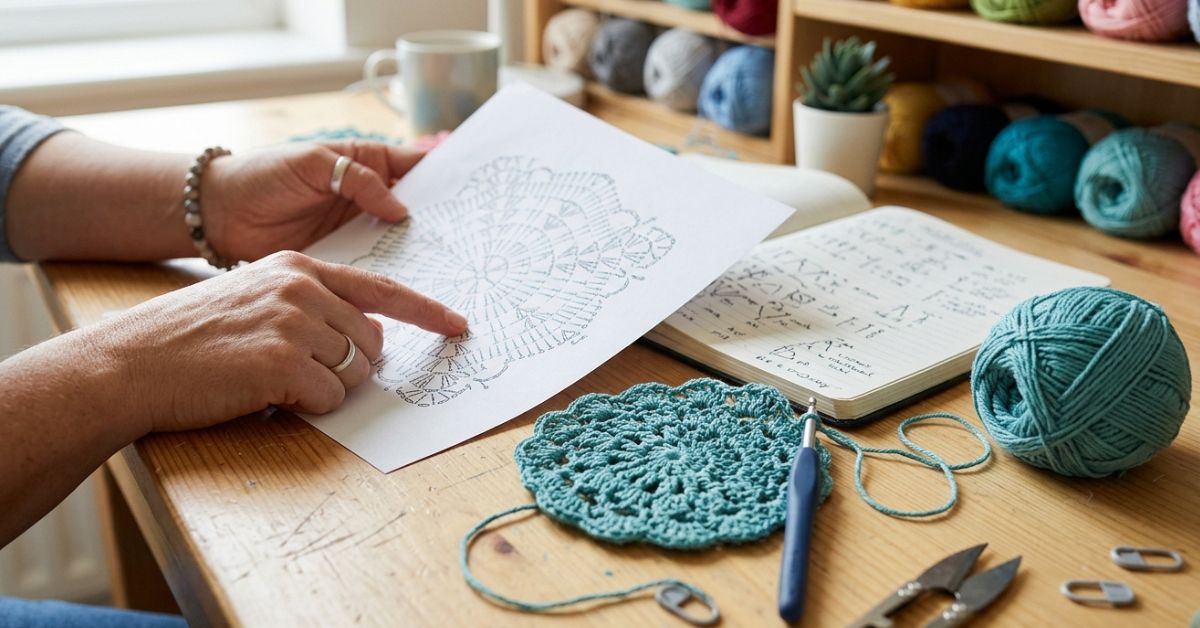
Decoding the Language of Crochet: A Beginner’s Guide to Charts
There is a unique kind of magic that happens when you pick up a crochet hook for the first time. You start with a single ball of yarn and a loop, and suddenly, you are crafting fabric with your own two hands. As you progress, you will likely encounter patterns that look more like artistic blueprints than traditional written instructions. These are crochet charts—or symbol diagrams—and while they might look intimidating at first, they are actually one of the most beautiful and logical tools in an artisan’s toolkit.
If you have ever felt overwhelmed by a page filled with circles, crosses, and branching shapes, take a deep breath. You are in the right place. Learning to read these visual maps is like learning a new language that transcends borders. Whether you are a total beginner who just learned your first chain stitch or an intermediate crocheter looking to expand your capabilities, understanding these symbols will open up a world of global patterns. This guide is designed to take the mystery out of the chart, helping you move from “where do I start?” to “I can build anything I see.”
What to Expect from This Guide
In this guide, we are focusing on the educational art of interpreting crochet diagrams. You will learn the universal alphabet of crochet symbols, how to navigate the flow of a chart, and the best practices for verifying your work as you go. This information is designed for anyone who wants to become a more independent and confident crafter. By the end, you will not only be able to read standard diagrams, but you will also understand how to bridge the gap between a written pattern and a visual one, making your future projects significantly easier to tackle.
Essential Tools for Reading Charts
You don’t need a heavy toolbox to master crochet charts. In fact, most of what you need is likely already sitting in your craft bag. To get the most out of your learning experience, keep these items handy:
- A dedicated “stitch key” or pattern legend: Every well-designed pattern will provide a legend that maps the symbols to the specific stitches used.
- A highlighter or a magnetic chart keeper: These are lifelike savers when you are keeping track of your current row or round.
- Stitch markers: Even if a pattern doesn’t call for them, using a locking stitch marker to mark your starting chain or a specific repeating point in a chart can prevent unnecessary frustration.
- A physical copy of the chart: While digital patterns are wonderful, having a printed version allows you to scribble notes or check off completed rows with a pencil.
The Anatomy of a Crochet Symbol
Crochet symbols are essentially shorthand for stitches. Instead of reading “single crochet,” you are looking for a small symbol that represents the action. Once you internalize these few core shapes, they become second nature.
The most common symbols follow a logical visual representation of the stitch itself. A “chain” is almost always a small circle or an oval, mirroring the look of a loop. A “single crochet” is usually a small plus sign or an “x,” which mimics the crossing of yarn in the stitch. A “double crochet” is represented by a vertical line with a small horizontal dash through it—the dash represents the “yarn over” you perform to create the extra height. If you see multiple dashes, that simply indicates a taller stitch, like a treble crochet, with more yarn overs.
How to Read a Crochet Chart
Navigating a chart correctly is all about understanding the direction of your work. The chart tells you exactly where to go, but you have to know how to follow the path.
Reading Flat Rows (Back and Forth)
When you are working a flat project, like a scarf or a blanket, you work row by row. Usually, the chart will indicate the sequence by placing numbers at the beginning of each row. You will read the first row from right to left, then the second row from left to right, and so on. Many charts include arrows at the end of the rows to remind you which way to proceed.
Reading Rounds (In the Round)
If you are making a hat, a granny square, or amigurumi, you will be working in rounds. The chart will usually start at the very center, typically shown as a small circle or a central starting chain. You will work in a counter-clockwise direction, spiraling outward. If the pattern is not worked in a continuous spiral, the chart will indicate where to slip stitch to join and how to chain up to start the next round.
The Importance of the Starting Chain
The starting chain in a chart is the foundation. Pay close attention to how the first row of symbols interacts with that chain. Sometimes, a stitch will be worked into the same space as the chain, while other times it might skip a chain or jump into the next. The chart is your visual map for these specific placements.
Beginner-Friendly Tips for Success
The transition from text to charts can feel a bit rocky, but there are simple ways to keep your rhythm.
- Start with simple patterns: Don’t dive into a complex lace shawl immediately. Look for a simple motif, like a basic coaster or a square, to get comfortable with the symbols.
- Match symbols to your known stitches: As you look at the chart, point to a symbol and say the stitch name out loud. This helps bridge the gap between the image and the physical movement of the hook.
- Use a “row tracker”: Even a simple sticky note placed at the bottom of the line you are currently working on makes a massive difference in preventing “lost-in-the-pattern” syndrome.
- Trust the legend: Never assume. Even if you think you recognize a symbol, double-check the legend provided in your specific pattern. Designers occasionally use variations or symbols for specialized stitches that are unique to that particular project.
Common Mistakes to Avoid
The most common hurdle for crocheters learning to read diagrams is losing their place in the sequence. It’s easy to get distracted by the beautiful design and lose track of the count.
One frequent error is overlooking the “turning chain” symbols. In written patterns, they are often described as “ch 3, count as dc.” In a chart, those turning chains appear as a stack of little circles at the end or start of a row. If you skip over them, your piece will immediately start to lean or lose its rectangular shape because you missed the necessary height-building stitches.
Another common mistake is neglecting the “join” symbols. If you are working in rounds, there is almost always a small loop or a tiny curved line indicating a slip stitch to connect the end of a round to the beginning. If you ignore the slip stitch, you create a spiral where you intended to have a flat join, which changes the entire aesthetic of the piece.
Pro Tips for Intermediate Crocheters
Once you are comfortable with the basics, use charts to level up your finishing work. If you are working on a complex lace project, a chart is actually superior to written text because it allows you to see the “big picture” of how the stitches interact, branch, and decrease.
Try “drawing” your own adjustments. If you want to modify a pattern, sketch out your changes on graph paper using the same symbols you see in the original, but create a new shape or stitch sequence. Visualization is a key skill for professional-level designers, and practicing with a pencil and paper will deepen your understanding of how crochet fabric is constructed.
Variations and Customization
Charts are incredible for customization. If you have a chart for a blanket square, you don’t have to stick to the pattern exactly. You can change the yarn weight, which will change the finished size of your motif. You can add a border by simply adding additional rows of “chain” or “single crochet” symbols around the perimeter of your chart. Because the chart gives you a bird’s-eye view of the motif’s structure, it’s much easier to visualize where to add extra rounds or where to increase the frequency of your stitches to make a piece larger or more decorative.
Next Steps for Your Practice
Now that you understand the logic behind these diagrams, your next step is to put that knowledge to work. Find a simple, one-page pattern that includes both written instructions and a chart. Start by reading the written instructions, then pause and look at the chart. See if you can identify the “x” for every single crochet you just made. See if you can spot the “o” for every chain.
When you see a line of symbols that looks like a “v,” identify it as an increase (usually two stitches into one space). The more you cross-reference, the faster your brain will stop needing the text entirely. Soon, you will find yourself glancing at a chart and “seeing” the stitches before you even pick up your hook.
FAQ
Why do some patterns have a chart and others don’t?
Some designers prefer the clarity of visual diagrams, especially for intricate stitches like lace or cables, while others prefer the step-by-step guidance of written instructions. Often, high-quality patterns include both to ensure everyone has a method they feel comfortable using.
What should I do if a symbol in a pattern isn’t in my legend?
This is rare but happens with custom or “special” stitches. In this case, always check the “special stitches” section of the main pattern document, which should describe the stitch in detail, or look at the designer’s website for an errata page or video tutorial to clarify the symbol.
Is reading charts easier than reading written patterns?
For many people, yes. Charts eliminate the “wall of text” that can be overwhelming. They show relationships between stitches—like how three stitches might share a single base—much more clearly than words ever could. It is simply a different way to process the same information.
Do I have to read the written pattern if I have a chart?
Generally, no. A good chart should contain all the information you need, including row numbers and stitch counts. However, for a beginner, keeping the written instructions open as a safety net while you learn to trust the chart is a very helpful way to build confidence.
Can I use the same chart for different yarn weights?
Absolutely! Since charts are “stitch-based” rather than “measurement-based,” they are universal. A square made from a chart using cotton thread will be significantly smaller than the same square made with bulky wool, but the structure remains the same.
Conclusion
Learning to read crochet charts is a milestone in any crafter’s journey. It moves you from being a follower of instructions to being an interpreter of art. By breaking down those complex diagrams into simple, recognizable symbols, you have gained a new sense of freedom in your craft. You are no longer tethered to a narrator; you are the navigator of your own creative process.
Take your time, be patient with your eyes and your hands, and enjoy the process of unraveling these symbols. Whether you are working on a cozy winter scarf or a delicate decorative doily, the next time you see a chart, look for the shapes, count the symbols, and trust your intuition. You have everything you need to create something beautiful. Happy crocheting!