
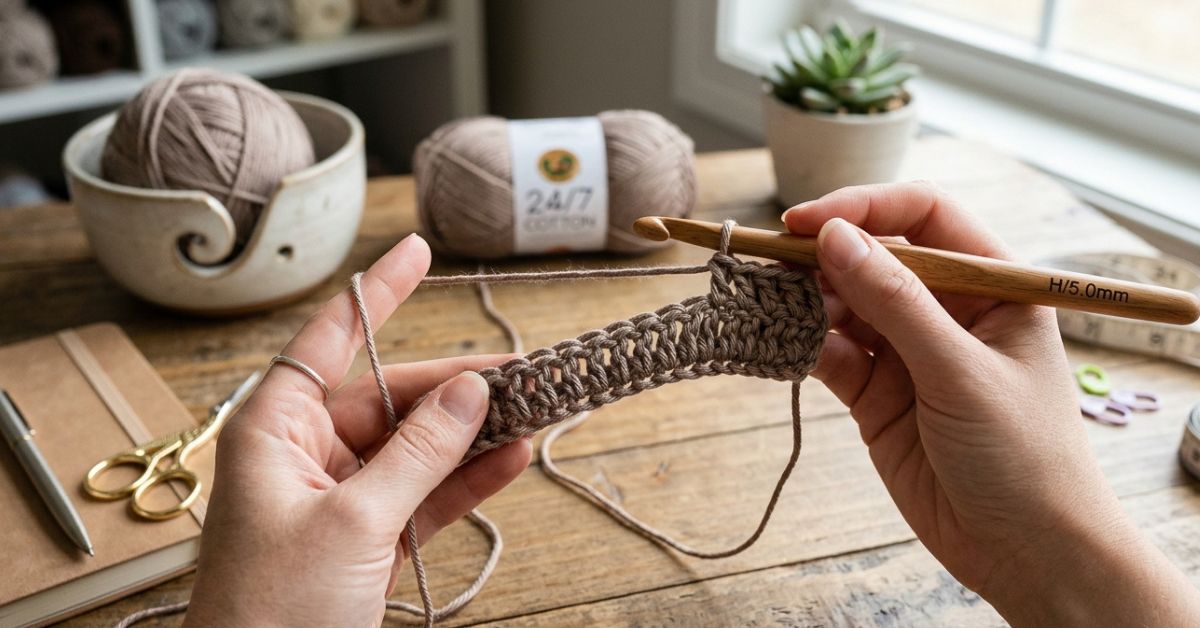
There is something undeniably satisfying about starting a new crochet project. We often spend our first few minutes fussing over a long, restrictive foundation chain, worrying that it might be too tight, too loose, or—heaven forbid—twisted by the time we reach the end of our first row. If you have ever felt that twinge of frustration while working those endless chains, I have wonderful news for you. The solution is a technique that changes the game entirely: the foundation half double crochet.
The foundation half double crochet (often abbreviated as FHDC) allows you to create your foundation row and your first row of stitches simultaneously. Not only does this save time, but it also creates a remarkably flexible, stretchy edge that mimics the natural movement of your yarn. Whether you are crafting a cozy blanket, a fitted garment, or a simple accessory, this technique offers a professional touch that elevates your work instantly. This guide is designed to walk you through every loop and yarn-over, ensuring you feel confident and capable, whether you have been crocheting for decades or picked up your first hook just this week. Let’s create something beautiful together.
Quick Project Overview
To help you master this technique, we will be creating the “Everyday Softness Scarf.” This project is the perfect vessel for learning the foundation half double crochet because it allows you to practice the stitch over a manageable length before committing to a larger project.
- Skill Level: Beginner-friendly.
- Estimated Time: 1–2 hours for a completed scarf.
- Finished Size: Approximately 6 inches wide and 60 inches long.
- Best Use: A perfect accessory for brisk autumn days or chilly spring mornings.
- Why You Will Love It: You will master a sophisticated technique while making a piece that is truly wearable. It eliminates the “tight chain” issue, ensuring your scarf drapes beautifully around your neck.
Materials Needed
For this project, you will need a few simple supplies that are easily found at any craft store or in your existing personal stash:
- Yarn: Approximately 300 yards of worsted-weight (category 4) yarn. A wool-blend or a high-quality acrylic works beautifully.
- Crochet Hook: Size H/8 (5.0 mm) or the size recommended by your yarn label.
- Tapestry Needle: For weaving in your yarn ends securely.
- Scissors: Any sharp pair will do.
- Stitch Markers (Optional): Helpful if you are working a very long foundation row to keep your count accurate.
Stitches and Abbreviations
- Ch (Chain): Yarn over and pull through the loop on your hook.
- FHDC (Foundation Half Double Crochet): The star of our show. It combines the chain and the stitch into one.
- HDC (Half Double Crochet): Yarn over, insert hook into stitch, yarn over, pull up a loop, yarn over, and pull through all three loops on your hook.
- St(s) (Stitch/Stitches): The individual loops we work into.
Pattern Notes Before You Start
Success in crochet is often 50% technique and 50% preparation. Before you begin your first foundation half double crochet, take a moment to consider your tension. Because the FHDC naturally has more “give” than a chain row, it is easy to accidentally make your stitches too loose if you are not accustomed to the technique. Aim for a consistent, steady pull on your yarn. Ensure that your chain-stitch bridge at the base of each FHDC is uniform in height.
This project is worked in rows. You will start with the FHDC for your first row, and every row thereafter will consist of standard half double crochets for a clean, uniform look.
Full Crochet Pattern
Part 1: The Foundation Row
We will begin by creating the base of the scarf using the foundation half double crochet.
- Ch 3.
- Yarn over, insert your hook into the 3rd chain from the hook.
- Yarn over and pull up a loop (3 loops on your hook).
- Yarn over and pull through the first loop only (this creates the “chain” base).
- You still have 3 loops on your hook. Yarn over and pull through all 3 loops (this completes the “half double crochet” part).
- To make the next stitch: Yarn over, insert your hook into the base chain you just created in step 4.
- Yarn over and pull up a loop.
- Yarn over and pull through the first loop only.
- Yarn over and pull through all 3 loops.
- Repeat steps 6–9 until you have 25 stitches total.
Part 2: Working the Scarf Body
Now that our foundation is set, the rest of the scarf follows a simple, meditative rhythm.
- Ch 2, turn your work. (This chain does not count as a stitch).
- Work 1 HDC into each stitch across the row. You should end with 25 stitches.
- Repeat step 2 until the scarf reaches your desired length or you run out of yarn.
Part 3: Finishing
Once your scarf has reached the desired length:
- Fasten off your yarn, leaving a tail of about 6 inches.
- Pull the tail through the final loop to secure it.
- Using your tapestry needle, weave the tail back and forth through the stitches at the end of the work. Trim any excess, ensuring you do not cut into your knots.
- Repeat this process for your starting tail.
Step-by-Step Tutorial Explanation
When you first try the foundation half double crochet, it may feel a bit like you are trying to pat your head and rub your belly at the same time. This is completely normal! Focus on the “chain” portion first. When you insert your hook into that base loop, imagine you are simply creating a new chain stitch followed immediately by an HDC. If you find your foundation row looks slightly uneven, do not worry; with just a little practice, your hands will develop the muscle memory required to keep each base loop consistent. By the time you finish the first five stitches, the rhythm will start to feel intuitive.
Common Mistakes to Avoid
- The “Twist”: When working your foundation row, pay close attention to ensure your chain base isn’t twisting. If it does, you will find it difficult to identify the base loops for the next stitch.
- The Tight-Tension Trap: Beginners often crochet tightly. Since the FHDC is designed to be flexible, if your tension is too tight, the natural stretch will be defeated. Keep your stitches relaxed.
- Miscounting: The most common error is missing the very last stitch of the row. Use a stitch marker in the first stitch of every row to help you identify where to place that final “turn” stitch.
- Yarn Splitting: Because you are working into a chain base, be careful not to split your yarn strands. Use a slightly larger hook than you think you need if you find you are struggling with this.
Pro Tips for a More Beautiful Result
A beautiful finished project comes down to the finishing touches. Blocking your scarf is one of the most important things you can do. Once finished, soak your scarf in cool water with a drop of gentle soap, squeeze (do not wring!) the water out in a towel, and lay it flat to dry. This relaxes the fibers and makes the FHDC edge look perfectly uniform. For yarn choice, opt for a smooth, plied wool or cotton blend to really highlight the structure of the stitch. Avoid highly textured or “eyelash” yarns for your first attempt at the foundation stitch, as they make it much harder to see the base loops.
Variations and Personalization Ideas
- Color Blocking: Use the FHDC to transition between colors. Because the edge is so neat, starting a new color on the foundation row looks incredibly clean.
- The Snood Version: Instead of working a long flat scarf, turn your foundation row into a circle by joining your first and last stitches with a slip stitch, then continue working in rounds.
- Texture Play: Try using this foundation technique for other projects, such as the cuffs of a sweater or the brim of a hat. The added stretch is a game-changer for items that need to fit snugly over hands or heads.
Care Instructions
To keep your handmade scarf looking its best, always check your yarn label for specific care instructions. Generally, hand washing in cool water is the safest bet for any handmade wool project. Lay the item flat on a clean towel in the shade to dry, avoiding direct heat sources like radiators, which can make natural fibers brittle. If you used a machine-washable acrylic, you can usually tumble dry on low, but air drying is always the best way to extend the lifespan of your stitches.
FAQ
Is the foundation half double crochet harder than a standard chain?
It is slightly more complex, but it is not “hard.” It requires a bit more focus initially, but once you practice it for a few minutes, most crocheters find it much faster and more enjoyable than working chains.
Can I use this for any stitch?
Yes! There are versions for single crochet (FSC), half double (FHDC), and double crochet (FDC). Once you learn the rhythm of this one, you can easily adapt the technique for others.
Why does my edge look wavy?
Sometimes, a wavy edge is caused by starting your foundation stitches too loosely. If it bothers you, try going down a half-size with your crochet hook for the foundation row only, then switch back to your regular hook for the rest of the project.
Can I use this for sweaters?
Absolutely. Using this for the bottom hem of a sweater or the beginning of a sleeve creates a wonderfully elastic edge that prevents the “tight cast-on” problem common in many patterns.
How do I know if I have the right number of stitches?
Since you are working the chain and the stitch at once, count the “V” shapes along the top of your work. That is the most accurate way to ensure you have the correct stitch count for your pattern.
Conclusion
Mastering the foundation half double crochet is a significant milestone in any crocheter’s journey. It moves you past the basic “chain and skip” limitations and opens up a world of professional-looking, durable, and comfortable edges. You have done the hard work of learning a new skill, and the scarf you hold in your hands—or the one you are about to start—is the perfect proof of your dedication.
Remember, crochet is meant to be a joyful, relaxing practice. If a stitch feels tricky or a row doesn’t look quite right, give yourself the grace to unravel and try again. Each loop is a lesson, and every project brings you one step closer to becoming the artisan you envision. Keep your hook handy, your yarn cozy, and keep creating. You are doing something truly special.