
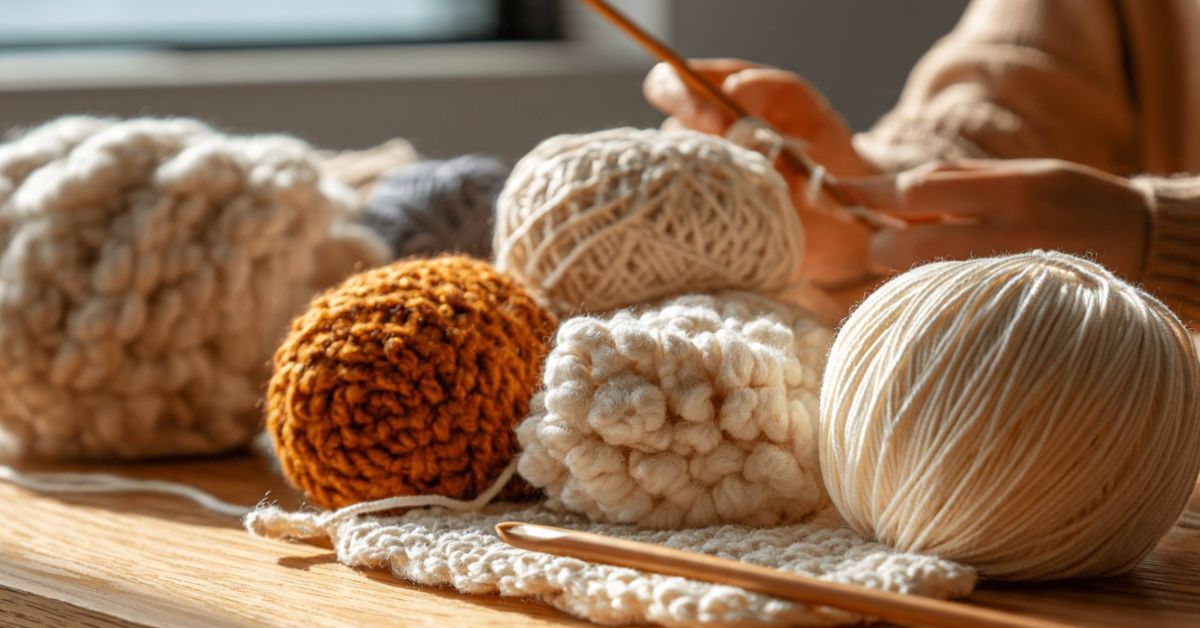
Walking into the yarn aisle can feel like stepping into a candy store, but for a new crocheter, it can also be a little overwhelming. You see vibrant skeins, soft textures, and shimmering fibers, and you wonder: will this be easy to work with? Choosing the right yarn is truly the secret ingredient to a successful crochet project. When you pick a yarn that matches your skill level and your project’s purpose, the process changes from a frustrating struggle to a soothing, rhythmic meditation. That is exactly where my heart is today—guiding you toward your next favorite project while demystifying the world of yarn selection.
Whether you are dreaming of a soft, chunky blanket for cozy movie nights or a sweet, handcrafted gift for a new baby, the fiber you choose determines how your stitches breathe and sit. Today, we are going to dive into the “easiest” fibers to work with, focusing on smooth, medium-weight yarns that allow you to see your stitches clearly. To put this knowledge to work, I have designed a charming, beginner-friendly Textured Keepsake Basket. It is a functional piece of home decor that uses simple stitches and a forgiving yarn weight, making it the perfect “first-basket” project. Let’s grab our hooks and find our creative flow together.
Quick Project Overview
- Skill Level: Beginner-friendly.
- Estimated Time: 2 to 3 hours.
- Finished Size: Approximately 6 inches in diameter and 5 inches deep.
- Best Use: Organizing craft supplies, holding keys on an entryway table, or as a thoughtful handmade gift filled with treats.
- Why You Will Love It: It works up quickly, requires very little yarn, and is a fantastic way to practice your tension in the round.
Materials Needed
- Yarn: One skein of worsted weight (Category 4) medium-smooth cotton or a cotton-acrylic blend. These fibers are durable and have great stitch definition, making it easy to see where to place your hook. Avoid dark colors for your first try; stick to light neutrals like cream, sage, or soft grey.
- Crochet Hook: Size H/8 (5.0 mm).
- Stitch Marker: Essential for keeping track of the start of your round.
- Yarn Needle: A large-eye blunt metal needle for weaving in those ends.
- Scissors: Any sharp pair will do.
Stitches and Abbreviations
- ch (chain): Bring yarn over the hook and pull through the loop on your hook.
- sc (single crochet): Insert hook into the next stitch, yarn over, pull up a loop, yarn over, and pull through both loops on the hook.
- inc (increase): Work two single crochet stitches into the same stitch.
- sl st (slip stitch): Insert hook into the stitch, yarn over, and pull through both the stitch and the loop on your hook.
- st(s) (stitch/stitches): The loops of your fabric.
Pattern Notes Before You Start
Crocheting in the round can sometimes be intimidating, but I promise it is simpler than it looks! The most important note here is to pay attention to your tension. If your stitches are too tight, you will have a hard time inserting your hook; if they are too loose, the basket won’t be able to hold its shape. Since this is a home decor item, a slightly tighter tension is actually better because it makes the basket sturdy. If you find your hand cramping, take a break—crochet is supposed to be relaxing! Always remember to count your stitches at the end of each round to ensure you haven’t accidentally missed an increase.
Full Crochet Pattern
Part 1: The Base
We start by creating a flat circle that will serve as the bottom of your basket.
- Round 1: Create a magic ring (or ch 4 and join with a sl st to form a loop). Ch 1, work 8 sc into the ring. Mark your first stitch. (8 sts)
- Round 2: 2 sc in each st around. (16 sts)
- Round 3: 1 sc in the next st, 2 sc in the next st. Repeat from to around. (24 sts)
- Round 4: 1 sc in each of the next 2 sts, 2 sc in the next st. Repeat from to around. (32 sts)
- Round 5: 1 sc in each of the next 3 sts, 2 sc in the next st. Repeat from to around. (40 sts)
Part 2: The Basket Walls
Now that our base is complete, we need to build the sides.
- Round 6: Working only in the “back loops” of your stitches from Round 5 (this creates a natural ridge or fold), sc in every stitch around. Do not increase. (40 sts)
- Rounds 7–14: Sc in every stitch around. Continue until the basket reaches your desired height. (40 sts)
Part 3: Finishing and Edging
Once you reach the desired height, we finish with a clean, decorative edge.
- Round 15: Sc in every stitch, but try to keep your tension consistent. Fasten off, leaving a 6-inch tail.
- Weaving in ends: Using your yarn needle, weave the tail firmly through the inside stitches of the top rim to secure it, then trim the excess.
Step-by-Step Tutorial Explanation
When you start your basket, the magic ring might feel a bit fiddly. If you struggle with it, do not worry—you can always just chain 4 and join with a slip stitch into the first chain to create a center hole to work into. As you progress through the increases (the rounds where we add more stitches), the circle will naturally grow. If it starts to ruffle, it’s a sign you are adding too many stitches; if it starts to cup like a bowl before you’re ready, you might need to add more increases. Getting to Round 6 is the moment of truth! By working into the back loops only, you create a distinct “corner” that helps your basket sit flat and rise vertically. From there, it is just a repetitive, peaceful round of single crochet until you hit your height.
Common Mistakes to Avoid
The most common trap for beginners is miscounting. Even experienced crafters lose track sometimes, so using a stitch marker at the beginning of each round is a non-negotiable habit. Another frequent issue is “dropping” stitches, which happens if you accidentally skip the tiny stitch hidden right next to your join. Always look closely at the top of your last stitch to ensure you didn’t leave a gap. Finally, don’t worry if your stitches are not perfectly identical; that variation is precisely what gives handmade items their soul and “human” character.
Pro Tips for a More Beautiful Result
If you want your basket to stand up perfectly straight, consider using a slightly smaller hook than the yarn label recommends. This keeps the stitches tight and dense, which provides natural structure. When weaving in your ends, always go in at least two different directions; this prevents the yarn from working its way out over time. If your completed basket looks a little rumpled, you can lightly steam it or reshape it with your hands while it is slightly damp. Blocking isn’t just for lace shawls—it works wonders for home decor, too!
Variations and Personalization Ideas
You can easily adapt this basket to suit your home. Use two strands of yarn held together with a larger hook (around a size J/10 or 6.0 mm) for a “chunky” look that works up in minutes. For a decorative flair, consider changing colors every four rows to create stripes, or weave a contrasting ribbon or spare yarn through the second-to-last round to create a handle effect. If you are making this as a gift, why not fill it with a matching handmade washcloth or a small succulent for a complete, thoughtful present?
Care Instructions
Since this basket is likely made with cotton or a sturdy blend, it is quite durable. If it gets dusty, simply shake it out or use a lint roller. If you accidentally spill something on it, you can spot-clean it with a damp cloth and a drop of gentle soap. Avoid putting it through a harsh washing machine cycle, as this can cause the shape to distort. If it loses its crispness over time, a light spray of starch can help bring back that “fresh off the hook” stiffness.
FAQ
How do I know if the yarn weight is right for my project?
Always look at the back of your yarn label. It will have a small symbol of a ball of yarn with a number (1 through 7) inside. For beginners, a Category 4 (Worsted/Medium) is the gold standard because it is thick enough to hold firmly but thin enough to glide easily over the hook.
Why does my circle have wavy edges?
Wavy edges usually indicate that you are adding too many stitches per round. If your circle doesn’t lay flat, try loosening your tension slightly or double-check that you aren’t accidentally performing an extra increase stitch.
What is the best yarn material for a beginner?
I highly recommend cotton or a smooth-spun acrylic. Avoid textured or “fuzzy” yarns like mohair or boucle for your first few projects. They look beautiful, but they make it very difficult to see your stitch anatomy, which is essential when you are still learning the basics of counting and placement.
How do I stop my stitches from getting tighter as I go?
Tension drift is very common! It happens when we get excited or stressed. Every time you pick up your project after a break, take a moment to consciously relax your shoulders and hands before you start your next stitch.
Can I use a larger hook than recommended?
Absolutely! If you use a larger hook, your fabric will become more “draped” and airy. This is great for scarves or blankets, but for baskets and toys, stick to the hook size recommended on the label or one size smaller to keep the stitches nice and tight.
Conclusion
I hope this guide has given you the confidence to pick up your materials and start your crochet journey with joy. Remember, every master was once a beginner who just refused to give up. The beauty of crochet isn’t reaching the final round in record time; it is in the quiet moments of the process—the feel of the yarn, the click of the hooks, and the satisfaction of seeing your vision come to life in your hands.
Do not be afraid to make mistakes—they are simply proof that you are learning something new. If you enjoyed this tutorial, I invite you to keep this page bookmarked for when you need a quick, reliable pattern or a little bit of inspiration. Please explore our other tutorials to build your skills further. Happy stitching, and may your basket hold nothing but wonderful, handmade memories!