
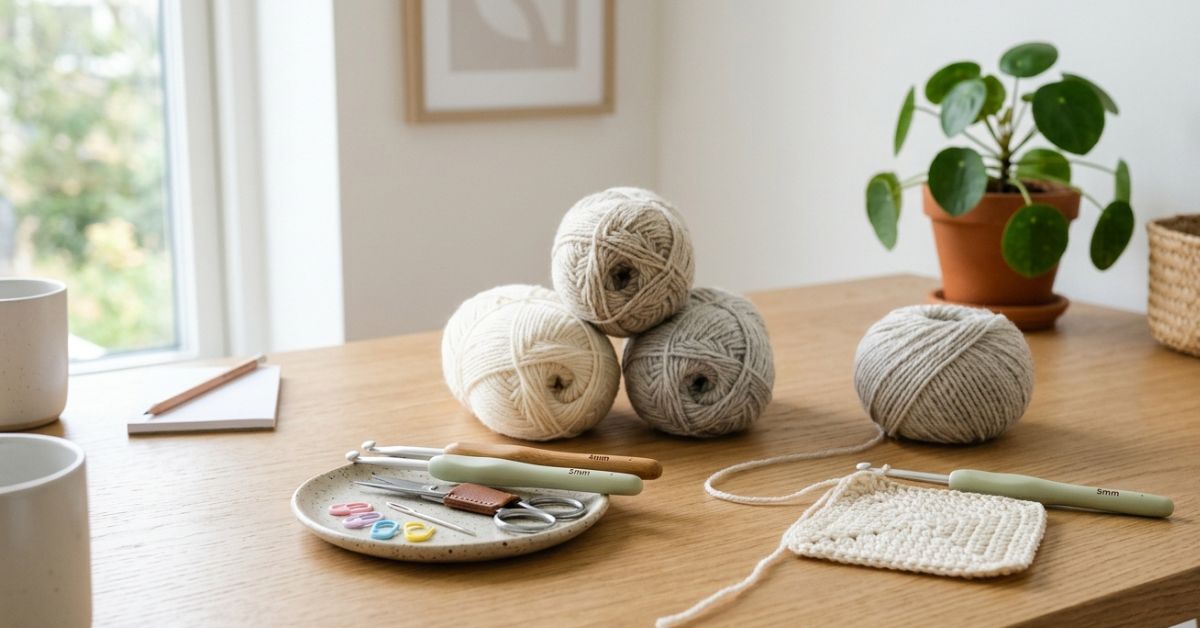
There is something truly magical about turning a simple ball of yarn and a single hook into a cozy, handmade treasure. If you have been admiring crochet projects on your feed—those soft blankets draped over nursery chairs, the intricate lace of a handmade scarf, or the sweet, tiny faces of amigurumi toys—you are likely feeling that familiar tug to pick up a hook and start creating. You might be wondering, “Do I really need all those expensive supplies to get started?” The answer is a resounding no. Starting your crochet journey is surprisingly affordable and incredibly rewarding, as long as you have the right foundational tools.
This guide is designed to walk you through the essential tools you actually need before you make your first purchase. Whether you are a total beginner looking for your first project or an intermediate crocheter fine-tuning your craft, understanding the mechanics of your materials is the secret to success. We will explore those basics and then dive into a delightful beginner-friendly project: the “Everyday Essential Textured Washcloth.” This project is the perfect way to practice your tension, master basic stitches, and create something functional and beautiful for your home. Grab a cup of tea, settle into your favorite chair, and let’s get ready to create something wonderful together.
Quick Project Overview
This project is the “Everyday Essential Textured Washcloth,” a versatile piece that serves as a canvas for learning core techniques. It’s perfect for beginners because it uses repetitive, rhythmic stitches that yield a sophisticated, high-end look.
- Skill Level: Beginner-friendly
- Estimated Time: 1–1.5 hours
- Finished Size: Approximately 8” x 8”
- Occasion: Everyday use, handmade housewarming gifts, or a quick “me-time” project.
- Why You’ll Love It: This washcloth teaches you the fundamental difference between building height in stitches and creating texture. The result is a thick, thirsty fabric that feels luxurious and stands the test of time.
Materials Needed
To start crocheting, you want to focus on quality rather than quantity. You don’t need a huge kit, just a few reliable items.
- Yarn: For this project, choose a 100% cotton yarn in a Worsted Weight (Category 4). Cotton is absorbent, durable, and holds its shape well after washing. Avoid dark-colored yarns for your first try; lighter colors make it much easier to see your stitches.
- Crochet Hook: A size H/8 (5.0 mm) hook is the gold standard for beginners. It is comfortable to hold and works beautifully with worsted weight yarn. You may choose aluminum or ergonomic-handled hooks; both are excellent choices.
- Yarn Needle: Also known as a darning or tapestry needle. You will need one with a dull tip and a large eye for hiding your yarn tails neatly.
- Scissors: Any sharp pair will do, but ensure they are dedicated to fiber arts to keep the blades sharp.
- Optional: A small measuring tape and a few stitch markers (or even simple safety pins) to keep track of your row ends.
Stitches and Abbreviations
Using standard U.S. terminology, here are the stitches we will use to build our washcloth:
- Ch (Chain): The foundation of most crochet. Yarn over and pull through the loop on your hook.
- Sc (Single Crochet): Insert hook into the stitch, yarn over, pull up a loop, yarn over, and pull through both loops on the hook.
- Dc (Double Crochet): Yarn over, insert hook, yarn over, pull up a loop (three loops on hook), yarn over, pull through two loops, yarn over, pull through remaining two loops.
- Sl St (Slip Stitch): Insert hook, yarn over, pull through the stitch and the loop on your hook immediately.
- St/Sts (Stitch/Stitches): The individual loops you work into.
Pattern Notes Before You Start
Before you begin, remember that tension is the hidden language of crochet. If you feel your hands gripping the hook tightly, stop, take a breath, and loosen your grip. A relaxed hand leads to even, beautiful stitches.
Gauge is not critical for a washcloth, but if you tend to crochet very loosely, consider going down one hook size. We are working this pattern in rows. At the beginning of each row, we will chain a certain number to reach the height of the next stitch; this is called a “turning chain.” In this pattern, the turning chains do not count as a stitch, which helps keep your edges straight and professional-looking.
Full Crochet Pattern
Part 1: The Foundation
Chain 30. This creates a generous width for your washcloth. If you want to customize the width, simply chain any even number.
Part 2: Working the Rows
Row 1: Sc in the 2nd chain from your hook and in each ch across. Ch 1, turn. (29 sts)
Row 2: Dc in the first st, sc in the next st, dc in the next st; repeat from across. The row should end with a dc in the final stitch. Ch 1, turn. (29 sts)
Row 3: Sc in the first st, dc in the next st, sc in the next st; repeat from across. The row should end with a sc in the final stitch. Ch 1, turn. (29 sts)
Repeating these two rows creates a beautiful “lemon peel” texture that is soft on the skin and incredibly durable for kitchen or bath use. Repeat Rows 2 and 3 until your piece measures roughly 8 inches from the starting edge.
Finishing
Once you have reached your desired length, do not fasten off immediately. Work one final round of single crochet stitches evenly around the perimeter of the cloth, placing 3 single crochet stitches into each corner to help it lay flat. Join with a slip stitch to the first single crochet. Fasten off, leaving a 6-inch yarn tail.
Weaving in Ends
Using your yarn needle, weave the tail back and forth through the back of your stitching until it is secure. Trim the excess yarn close to the fabric, being careful not to cut the yarn of the washcloth itself.
Step-by-Step Tutorial Explanation
When you start, look at your chain carefully. Each “V” represents a stitch. As you work your single crochet row, make sure you are inserting your hook under both legs of that “V.”
In Row 2, when you alternate the dc and sc, you are creating height differences. The double crochet will naturally “pop” out, while the single crochet creates a recessed area. Don’t worry if it looks a little messy at first; the pattern will naturally settle into a uniform, pebbled texture after the first few rows. If you find your edges are curling, it usually means your tension is too tight. Practice relaxing your yarn tension as you pull the yarn through the loops.
Common Mistakes to Avoid
- Forgetting the Turning Chain: Beginners often skip the ch 1 at the end of a row. If you skip this, your work will gradually shrink in width, turning your square into a triangle!
- Tight Tension: If you find it hard to push your hook through the stitches of the next row, you are likely pulling your yarn too tight. Consciously try to keep your stitches loose enough to slide the hook through easily.
- Twisted Chains: When you start your foundation chain, make sure the “V”s are all facing the same direction before you work your first row. A twist in the chain will spiral through the entire project.
- Miscounting Stitches: It is incredibly easy to accidentally add or drop a stitch at the very end of a row. Counting your stitches every few rows is a wonderful habit to build early on.
Pro Tips for a More Beautiful Result
The difference between a “hand-knit look” and a “homemade” look is often in the finishing details.
- Blocking: Once your washcloth is finished, soak it in cool water with a tiny drop of gentle soap. Press it flat on a towel into a perfect square, pinning the corners if necessary, and let it air dry completely. This step “sets” the stitches and makes your project look professionally finished.
- Yarn Choice: Stick to cotton or a cotton-linen blend for utility items. Acrylic is great for blankets and hats, but it does not absorb water, making it a poor choice for a washcloth.
- Consistent Hooking: If you are finding it hard to keep your tension, try holding your yarn differently. There are two main ways to hold yarn: the “pencil” hold and the “knife” hold. Experiment to see which one keeps your yarn flowing smoothly from the skein.
Variations and Personalization Ideas
Once you have mastered the lemon peel stitch, you can personalize your projects quite easily.
- Color Blocking: Create stripes by switching to a new color every four rows. Simply pull the new color through on your last pull-through of the final stitch of the row.
- Size Customization: Make a set of matching washcloths, or increase the starting count of your chain to turn this pattern into a luxurious spa-style bath mat.
- Border Accents: Use a contrasting color for your final border round to frame the piece and make those colors pop.
Care Instructions
Because this is made with 100% cotton, it is fully machine washable. For the best longevity, wash in a mesh laundry bag to prevent the fringe or edges from snagging on other items. Tumble dry on low or, better yet, lay flat to dry to maintain the crisp, clean shape of your stitches. Avoid using harsh fabric softeners, as they can build up on the fibers and reduce the natural absorbency of the cotton.
FAQ
How do I know if I have the right yarn and hook?
Check the label on your yarn. It will display a “weight” icon (usually a number inside a yarn skein symbol). A #4 or “Medium/Worsted” weight is ideal for beginners. The label will also suggest a hook size—usually a G or H hook—which is a great starting point for your project.
Why does my crochet project look like a triangle?
This happens when you accidentally miss the very last stitch of a row or forget to chain at the turn. Always count your stitches at the end of each row to ensure you have the same number you started with.
Is it cheaper to crochet than to buy store-bought items?
It depends! While you spend a little more upfront for quality tools (which last a lifetime), a single skein of yarn can often produce two or three washcloths. The true value lies in the higher quality materials you choose and the joy of creating something by hand.
How much yarn do I need?
For a standard washcloth, one 50-gram ball of cotton yarn (roughly 80–100 yards) is more than enough.
Can I fix a mistake without unraveling the whole thing?
You can use a technique called “tinking” (the word “knit” spelled backward). Simply remove your hook and gently pull on your working yarn to unravel the stitches one by one until you reach the mistake. It’s a standard part of the crochet process—even for the experts!
Conclusion
Starting your crochet journey is about more than just making “stuff.” It is about finding a quiet, contemplative space in your day to create with your hands. You now have the knowledge to pick up your first set of tools with confidence. Remember, every master was once a beginner who refused to quit. Your first washcloth might have a wonky edge or a dropped stitch, and that is perfectly okay; those are the marks of a human hand creating beauty from scratch.
Take your time, enjoy the rhythmic motion of the hook and yarn, and celebrate every finished row. Once you finish this washcloth, you will have the confidence to move on to scarves, small bags, or even blankets. There is a whole world of cozy textures and colors waiting for you. Keep exploring, stay curious, and most importantly, keep on crocheting—you are doing something truly wonderful for yourself.