
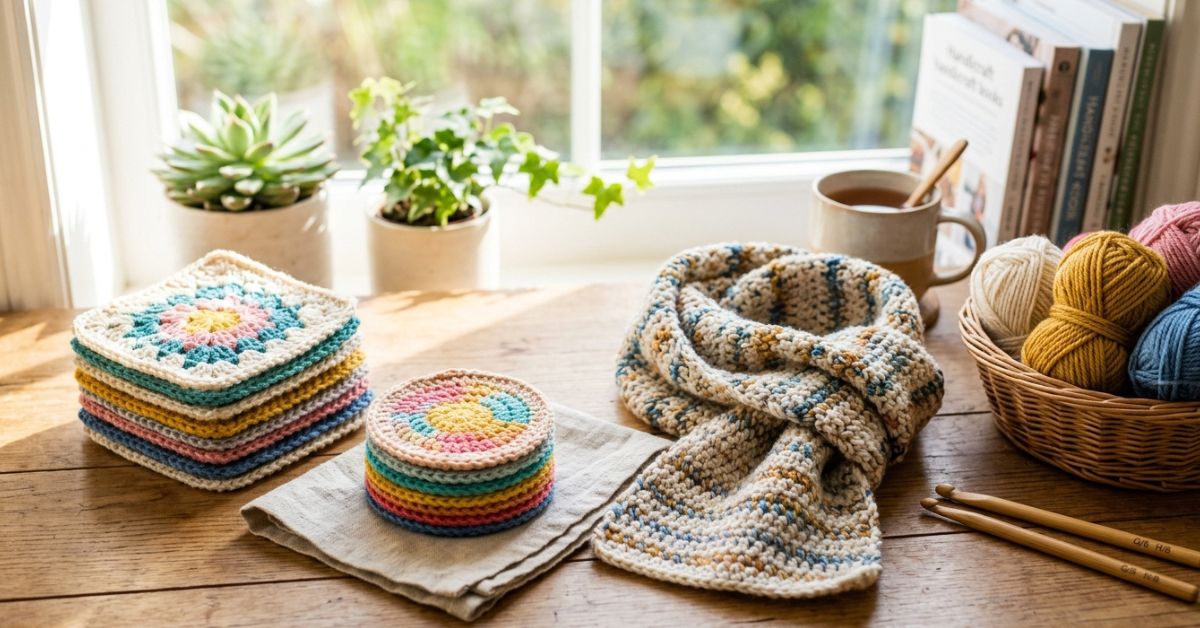
There is something truly magical about picking up a crochet hook and a soft skein of yarn for the first time. If you have been admiring cozy, handmade goods on social media or in decor magazines and wondering if you have the patience to create them yourself, I have wonderful news: you absolutely do. Crocheting is a rhythmic, meditative craft that rewards you with tangible beauty, and the best way to start is by choosing a project that balances simplicity with immediate, satisfying results.
Many beginners feel intimidated by complex diagrams or patterns that require changing colors and stitch types every few rows. This guide is designed to remove that overwhelm. We are going to focus on the classic, ultra-versatile textured washcloth—or, if you prefer, a beautiful, simple coaster set. It might sound modest, but mastering the basics on a smaller piece is the secret to building the confidence you need for larger blankets and garments later on. You will learn the foundational stitches that form the backbone of nearly every crochet project, all while creating a practical item that feels luxurious in your hands. Let’s set aside some time for yourself, find a cozy chair, and start this creative journey together.
Quick Project Overview
You are going to love this project because it is forgiving, fast, and incredibly functional. It teaches you how to maintain consistent tension, how to turn your work, and how to create clean, straight edges.
- Skill Level: Absolute Beginner
- Estimated Time: 1–2 hours
- Finished Size: Approximately 8 inches by 8 inches
- Best Use: Kitchen essential, spa-inspired gift, or a quick meditative practice session.
- Why You Will Love It: There is no heavy shaping or complex counting involved. It is the purest way to experience the rhythm of the craft.
Materials Needed
To ensure your first project is a joy to work on, yarn selection is key.
- Yarn: One skein of medium (worsted) weight cotton yarn. Cotton is preferred for washcloths because it is absorbent, durable, and holds its shape beautifully. Avoid dark colors for your first project; opting for cream, light sage, or soft yellow makes it much easier to see your stitches.
- Crochet Hook: Size H/8 (5.0 mm). This is the “Goldilocks” of hooks—it is large enough to handle easily but small enough to create a nice, tight fabric.
- Tapestry Needle: Used for weaving in your ends.
- Scissors: Any sharp pair will do.
Stitches and Abbreviations
We will be using U.S. crochet terminology. Here are the building blocks you will need to know:
- ch (Chain): The foundation of most crochet projects.
- sc (Single Crochet): The most essential stitch. It creates a dense, sturdy fabric.
- hdc (Half Double Crochet): A slightly taller, softer stitch that adds lovely texture.
- st(s) (Stitch/Stitches): The individual loops you work into.
- turn: Flipping your work to begin the next row.
Pattern Notes Before You Start
Success in crochet is 90% about tension—how tightly or loosely you hold the yarn. Try to keep your movements relaxed. If your hands feel cramped, take a break! Your gauge (the number of stitches per inch) does not need to be perfect for this project, but try to keep your stitches consistent throughout. If you notice your edges are getting “wavy,” you may be accidentally adding or skipping stitches. Always count your stitches at the end of every row to ensure you have the same number you started with.
Full Crochet Pattern
This pattern creates a lovely, textured piece using the half double crochet stitch, which works up much faster than single crochet but remains structured.
Part 1: The Foundation
Start by making a slip knot and placing it on your hook. Chain 26. This starting chain should be loose enough that you can move your hook easily through the loops.
Part 2: Working the Rows
Row 1: Half double crochet (hdc) in the third chain from the hook and in every chain across. You should have 24 stitches in total. Chain 2 and turn your work.
Row 2-20: Hdc in the first stitch and in every stitch across, ending with an hdc in the last stitch of the row. Chain 2 and turn.
Assembly and Finishing
Once you have completed 20 rows, or until your square reaches your desired size, fasten off your yarn by cutting the tail (leaving about 6 inches) and pulling the yarn all the way through the final loop. Use your tapestry needle to weave the remaining tail through the back of your stitches. Repeat this for the starting tail.
Step-by-Step Tutorial Explanation
When you start that first row, remember that the “V” shape at the top of your stitch is where your hook goes. As you work to the end of the row, look for the very last stitch—it can sometimes hide near the turning chain. If you feel like your edges look a little jagged, it is likely because you are skipping the last stitch of the row. Use a stitch marker (or even a small scrap of contrasting yarn) to mark the first stitch of every row until you get the hang of spotting it. By the time you reach the fifth row, you will notice your muscle memory taking over, and you won’t even have to look at your hands as much. That is the moment the “crochet trance” kicks in!
Common Mistakes to Avoid
Even experienced crocheters make mistakes, so do not get discouraged if you have to “frog” (unravel) your work.
- The Tight-Tension Trap: Beginners often pull their yarn too tight, making it impossible to insert the hook into the next row. If you find yourself fighting the yarn, intentionally relax your grip.
- Twisted Starting Chain: When you join your beginning chain or start your first row, ensure the “V”s of the chain are all facing the same direction. A twisted foundation will cause a spiral effect.
- Dropped Stitches: This happens when we aren’t counting. If your rectangle starts looking like a triangle, you are accidentally dropping stitches at the end of your rows. Count at the end of each pass until it becomes second nature.
- Weaving Ends Poorly: If you barely tuck in your yarn tail, it will unravel in the washing machine. Always weave your end back and forth in at least three different directions to securely lock the yarn in place.
Pro Tips for a More Beautiful Result
To take your crochet from “homemade” to “handmade professional,” try these finishing techniques.
- Blocking: Once you finish, soak your piece in cool water, gently squeeze out the excess, and lay it flat on a clean towel. Use pins to stretch it into a perfect square. Let it dry completely. This relaxes the stitches and makes your edges look crisp and uniform.
- Varying Texture: Once you master the half double crochet, try alternating rows of single crochet and double crochet. You will see how different stitches change the drape and feel of the fabric.
- Color Transitions: If you want to use two colors, simply drop the old color at the end of a row and pull through the new color before you chain up to start the next row.
Variations and Personalization Ideas
While a simple square is a classic, you can easily adapt this pattern for other projects. Add a loop of extra chain stitches to the corner to make it a hanging dishcloth. If you want a coaster, simply reduce the starting chain to 12 stitches and work for 10 rows. For a seasonal touch, crochet a large square and use a contrast color to embroider a simple initial or a small heart in the corner. Cotton yarn comes in a rainbow of shades; you can create a “collection” for your kitchen that changes colors with the seasons—think soft pastels for spring and deep, rustic tones for autumn.
Care Instructions
Since we used cotton yarn, this item is designed to be well-loved. You can machine wash it on a gentle cycle, but I personally prefer hand-washing with a tiny bit of mild detergent to keep the stitches looking pristine. Lay it flat to dry. Avoid using intense heat from a dryer, as it can cause the cotton fibers to shrink or become stiff over time. With proper care, your handmade creation will get softer and more absorbent with every single use.
FAQ
How do I know if my tension is too tight?
If your hook feels like it is stuck inside the stitches or if you have to force the yarn through, your tension is likely too tight. Your stitches should move freely on the hook. Try holding your yarn with a bit more “slack”—you might be surprised how much easier it becomes.
Why does my work have holes in it?
If you see large gaps, you are likely using a hook that is too large for your yarn weight, or you are accidentally adding extra loops, such as “yarn overs.” Stick to a medium-weight yarn with the recommended hook size to keep your stitches compact.
How do I fix a mistake without starting over?
If you spot a mistake in the current row, simply pull the yarn carefully to “undo” your stitches until you reach the error. It is much easier to fix it now than it is to worry about it later. Don’t be afraid to pull it back; it’s just part of the process!
How do I keep my edges straight?
The secret to straight edges is to count your stitches at the end of every row. Also, ensure you are starting your first stitch of the new row in the correct spot. If you aren’t sure, place a stitch marker in the first stitch you make so you always know where your row begins and ends.
Can I change the size of my project?
Absolutely! The number of chains you start with determines the width. If you want a wider piece, just chain more. If you want it smaller, chain less. The pattern works with any odd or even number, so you have complete creative freedom.
Conclusion
You have just embarked on a wonderful journey into the world of fiber arts. Whether this washcloth ends up in your kitchen, becomes a gift for a dear friend, or simply sits on your side table as a reminder of what you can accomplish with your own two hands, I hope you feel a sense of pride. Crocheting is more than just making things—it is a way to slow down, practice patience, and create something beautiful in a fast-paced world.
Don’t worry if your first few stitches aren’t perfect; each loop you create brings you closer to mastery. The more you practice, the more intuitive the motions will become until, one day, you won’t even need to look at a pattern. Keep your hook and yarn handy, save this guide for your next session, and most importantly, enjoy the process. There is a whole community of makers waiting to welcome you—happy crocheting!