
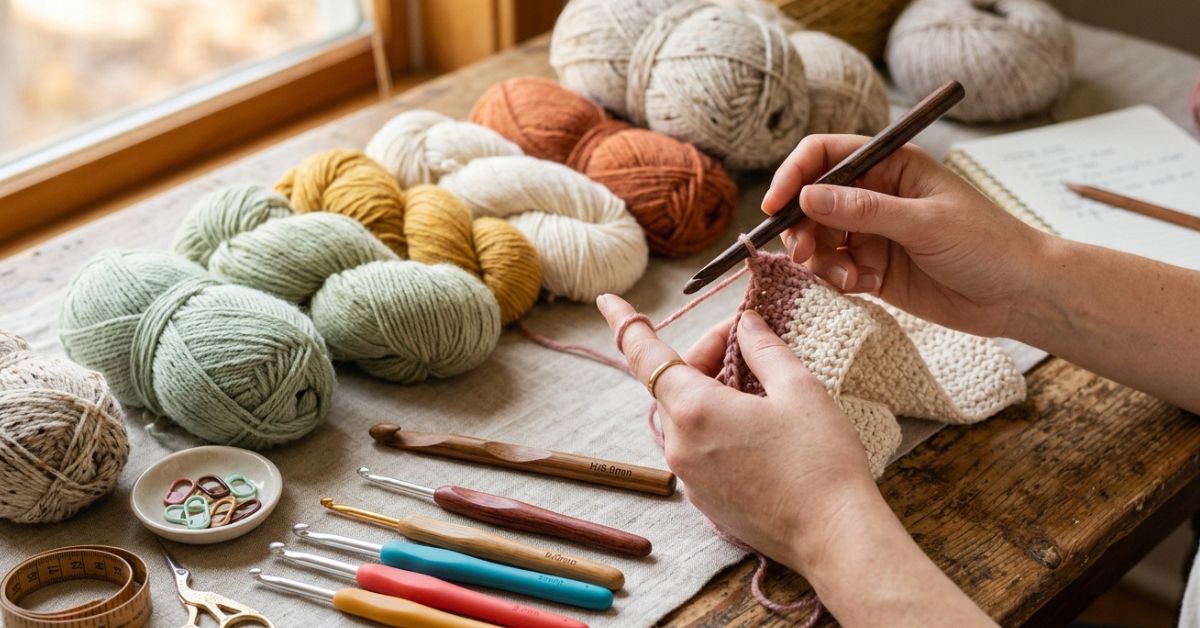
There is something truly magical about picking up a crochet hook and a ball of soft yarn, knowing that with just a few rhythmic loops, you are about to create something beautiful from scratch. Whether you are seeking a quiet moment of mindfulness after a long day or looking to craft a thoughtful, handmade gift for someone special, crochet is a hobby that warms the heart as much as it fills your home with cozy, handcrafted charm. If you have ever felt overwhelmed by the dizzying array of hooks and yarn labels in your local craft aisle, you are certainly not alone. Understanding the relationship between your tools and your materials is the absolute best way to ensure your project turns out exactly how you envisioned.
In this guide, we are looking at the essentials of choosing the right supplies, followed by a delightful project that is perfect for those who want to practice their skills while creating something functional and sweet: the “Everyday Essentials” Textured Spa Washcloth. This project is designed to be accessible for beginners while offering enough textural interest to keep intermediate crocheters engaged. It is the perfect introductory piece to master tension, stitch height, and clean finishing techniques. Let’s prepare to embark on your next creative journey with confidence and joy.
Quick Project Overview
This project is designed with the modern home in mind. It is a practical, quick-to-complete, and highly decorative item that serves as an excellent “gateway” project if you are new to fiber arts.
- Skill Level: Beginner-friendly.
- Estimated Time: 1 to 2 hours.
- Finished Size: Approximately 8 x 8 inches.
- Best Use: Use as a luxurious face cloth, a sweet bathroom accessory, or tie it with a ribbon as a thoughtful handmade housewarming gift.
- Why You’ll Love It: You will master the fundamentals of the single crochet and half double crochet stitches while learning how to keep your edges straight—a skill that will serve you in every future project you tackle.
Materials Needed
To create a professional-looking washcloth, the choice of fiber is paramount. You want a material that is absorbent, soft, and durable enough to withstand repeated washing.
- Yarn: Approximately 70 yards of medium (worsted) weight cotton yarn. Cotton is preferred over acrylic for washcloths because it is absorbent.
- Hook: Size H/8 (5.0 mm) crochet hook.
- Additional Supplies: A tapestry needle (with a blunt tip for weaving in ends) and a pair of sharp embroidery scissors.
Stitches and Abbreviations
We will be using standard American crochet terminology throughout this pattern. Familiarizing yourself with these abbreviations will make reading future patterns much easier:
- ch (chain): Yarn over, pull the yarn through the loop on your hook.
- st (stitch): The space or loop created by the hook.
- sc (single crochet): Insert hook into stitch, yarn over, pull up a loop, yarn over, pull through both loops on the hook.
- hdc (half double crochet): Yarn over, insert hook into stitch, yarn over, pull up a loop, yarn over, pull through all three loops on the hook.
- sl st (slip stitch): Insert hook into stitch, yarn over, pull through the stitch and the loop on your hook simultaneously.
Pattern Notes Before You Start
Success in crochet often comes down to tension—how tightly or loosely you hold your working yarn. When working with cotton, your stitches may feel slightly stiffer than they would with wool or acrylic. Aim for a relaxed grip; if your hands feel cramped, take a mindful breath and loosen your hold. Gauge is not strictly critical for this washcloth since it is not a fitted garment, but keep an eye on your edges to ensure you aren’t accidentally missing the first or last stitch of a row, which is the most common cause of “triangular” washcloths.
Full Crochet Pattern
Part 1: The Foundation
Start by making a slip knot and placing it on your hook. Chain 30. This ensures a nice, square base.
Row 1: Starting in the second chain from the hook, work one sc in each chain across. You should have 29 stitches in total. Chain 1 and turn your work.
Part 2: Working the Pattern Rows
The beauty of this design lies in its texture. We will alternate rows to create a balanced fabric.
Row 2: Work 1 hdc into each sc from the previous row. (29 stitches). Chain 1 and turn.
Row 3: Work 1 sc into each hdc from the previous row. (29 stitches). Chain 1 and turn.
Repeat rows 2 and 3 until your piece measures 8 inches long, ending on a row 3.
Part 3: Finishing the Edges
To give your project a polished, boutique-store look, we will add a simple slip stitch border. After your final row, do not fasten off. Chain 1, and work 1 sl st into each stitch along the top edge. When you reach the corner, work 3 sl st into the corner stitch to help it turn smoothly. Continue working a slip stitch evenly along all four sides of the washcloth. When you return to the start, join with a slip stitch to the first stitch made and fasten off.
Step-by-Step Tutorial Explanation
When you begin, focus on the “v” shapes that form the top of your stitches. In Row 1, you are searching for those little bumps on the bottom of the chain. By the time you reach the middle of the washcloth, you will notice the rhythm—the alternating height of the single crochet and the half double crochet mimics a subtle, woven texture. Don’t worry if the edges look a little uneven at first; that is exactly what the slip stitch border is for. Think of the final round of slip stitches as the “frame” for your beautiful work.
Common Mistakes to Avoid
The most common hurdle for new crocheters is the disappearing stitch. It is very easy to forget the last stitch in a row because it often slants downward and hides. Always count your stitches at the end of every row. If you started with 29, you should end with 29. If you find your work is becoming a triangle, you are likely skipping the last stitch or failing to chain at the turn. Another mistake is working too tightly. If your hook feels like it’s struggling to enter the stitch, you need to lift your working yarn slightly to give the stitch room to breathe.
Pro Tips for a More Beautiful Result
- Uniformity: To make your work look professional, keep your yarn hand in the same position throughout. Tension changes are most obvious when we switch from working in the morning to working in the evening, so try to finish a full section in one sitting if possible.
- Blocking: Once you finish your washcloth, it might look a little scrunchy. This is normal for cotton! Soak it in lukewarm water, gently squeeze out the excess (do not wring it), and pin it flat on a towel until it is completely dry. This “blocks” the fabric and sets the stitches, making everything look perfectly uniform.
- Weaving Ends: Never just cut your yarn close to the knot. Weave your remaining tail back and forth through the stitches at least three times in different directions to ensure it never unravels in the wash.
Variations and Personalization Ideas
Once you have mastered this basic pattern, the sky is the limit. You can use this same stitch count to create a “set” by alternating colors—perhaps a soft sage green for one and a creamy white for another. If you want to make it a spa gift set, try crocheting a matching soap cozy by working in the round. If you feel adventurous, you can experiment with varying sizes; simply increase your starting chain for a larger kitchen dishcloth or decrease it for a smaller, facial cleansing pad.
Care Instructions
Since you have used cotton yarn, these washcloths are incredibly resilient. They can be machine-washed in a garment bag on a gentle cycle, though hand-washing is always the kindest choice for handmade items. Lay them flat to air dry if you want to keep them looking brand new, or toss them in the dryer on a low setting for a softer, slightly more “lived-in” feel.
FAQ
How do I stop my crochet fabric from curling?
Curling often happens when your starting chain or your tension is too tight. Ensure your chains are loose and use a hook size that corresponds to your yarn weight. If it still curls, the process of blocking described above will usually resolve the issue completely.
Which crochet hook material is best for beginners?
Bamboo or wooden hooks are often recommended for beginners because they are slightly “grippier” than metal. This prevents the yarn from sliding off the hook too easily while you are still learning to manage your tension.
How do I know if I am using the right yarn weight?
Look at the yarn label for a little symbol of a ball of yarn with a number inside. For beginners, a number 4 (medium/worsted weight) is the easiest to see and handle. This size is large enough to build confidence but fine enough to show good stitch definition.
Can I change colors mid-project?
Absolutely! To change colors, work your last stitch until you have two loops left on the hook, then pull the new color through to complete the stitch. Carry your yarn up the side if you are doing short stripes, or cut and weave in your ends for a cleaner look.
How do I fix a mistake without undoing the whole project?
If you make a mistake, gently remove your hook and slowly pull on the working yarn to “frog” (rip back) your work stitch-by-stitch until you reach the error. We call it “frogging” because you “rip it, rip it.” It is a normal part of the process for even the most experienced designers.
Conclusion
Congratulations on taking those first, exciting steps into the world of crochet! By understanding the importance of your tools and committing to practicing your tension with a project like this textured washcloth, you are building a foundation that will last a lifetime. Crochet is a creative outlet that rewards patience and practice, and with every stitch, you are becoming a more confident crafter. Remember, every master was once a beginner who refused to put down their hook.
I encourage you to embrace the imperfections in your early rows—they are the hallmarks of a handmade piece made specifically by you. Once you finish your washcloth, I’d love to hear how it turned out! Keep your hook handy, keep your yarn stash growing, and most importantly, remember to enjoy every single loop. There is always a new pattern to explore, a new stitch to master, and a new cozy handmade treasure waiting right at the end of your yarn. Happy hooking!