
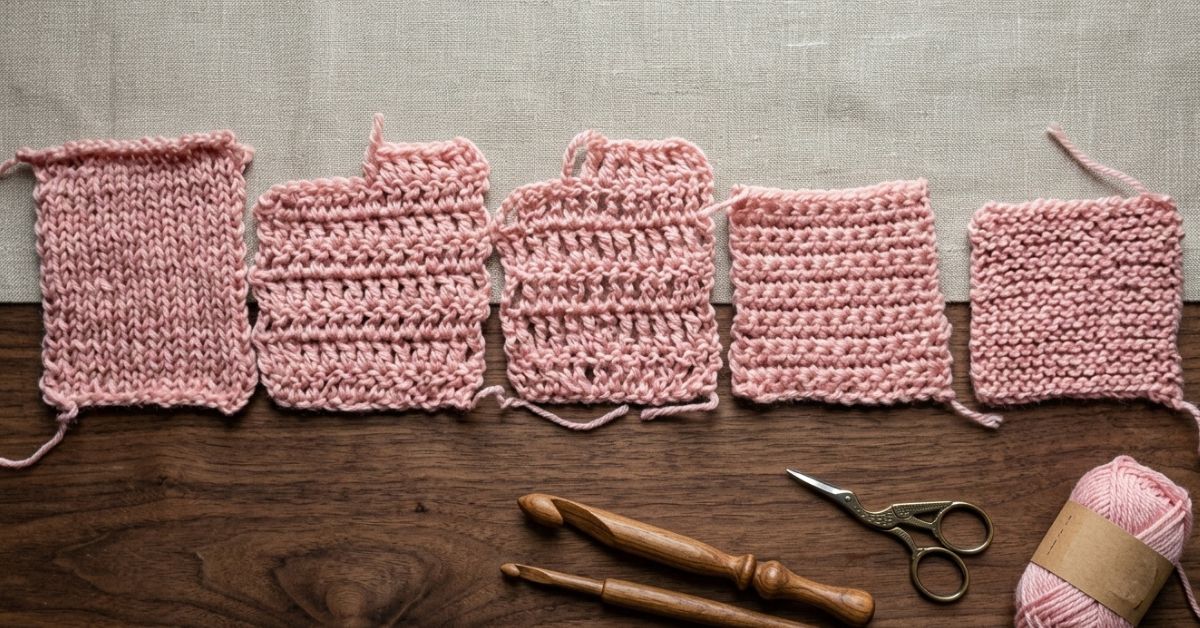
The record for yarn efficiency depends entirely on the specific stitch you choose, but in a controlled comparison, the common belief that crochet uses significantly more yarn is largely unsupported; while stockinette knitting is the most efficient, double crochet and triple crochet actually use less yarn than the common garter stitch.
For decades, crafters have operated under the assumption that crochet is a “yarn eater” that requires twice the yardage of its needle-bound counterpart. To settle this debate once and for all, we conducted a rigorous test involving 4-inch by 4-inch swatches to see exactly how much fabric each craft produces from a fixed length of yarn.
Materials Used for the Yarn Experiment
To replicate this study or use the results for your next project, these specific tools were utilized:
- Vanna’s Choice Yarn (Lion Brand medium weight)
- 5.5 mm Crochet Hook (Size I-9)
- 5.0 mm Knitting Needles (Size US 8)
- Measuring Tape (For precise swatch dimensions)
- Digital Scale (To weigh remaining yarn scraps)
- Blocking Mats (To ensure fabric consistency)
The Myth of the “Yarn Eater”
If you are planning a large blanket or a sweater, the choice between knitting and crocheting can mean the difference between buying five skeins or ten. However, the density of the stitch is the true culprit. When we compared single crochet to stockinette stitch, the knitting did indeed go further, covering about 0.31 inches more than a double crochet swatch using the same length of yarn.
But here is where it gets interesting: garter stitch, which is knitting every row, actually used more yarn than double crochet and triple crochet. This means that if you are a knitter who loves the squish of garter, you are actually being less efficient than a crocheter working in taller, airier stitches.
Breaking Down the Results
Our experiment ranked the stitches from most efficient (uses the least yarn) to least efficient (uses the most yarn):
- Stockinette Knit: The clear winner for yardage efficiency.
- Double Crochet / Triple Crochet: Tied for second, surprisingly beating out traditional knit textures.
- Single Crochet: The 4×4 control swatch that sets the baseline for “average” usage.
- Garter Stitch: The most yarn-heavy stitch in the group.
Why Stitch Height Matters
The reason double crochet performs so well against knitting is the height-to-width ratio. A taller stitch creates more surface area with fewer “wraps” of the yarn around the hook. When you create a triple crochet, you are essentially building a lattice. This lattice covers more physical space than the dense, interlocked loops of a stockinette or garter knit fabric.
Tension and Fabric Characteristics
While the math might favor certain stitches, we must consider the drape and density of the final product. A knitted stockinette fabric is thin and fluid, making it ideal for garments. A double crochet fabric of the same weight will be thicker and more structured. If you are looking to save money on yarn, you can choose a larger hook size to increase the “lacy” quality of your crochet, which further reduces the amount of yarn used per square inch.
How to Calculate Your Own Yarn Needs
Don’t let myths dictate your hobby. To find out exactly how much yarn your specific project will use, follow the Swatch and Weigh method:
- Create a 4×4 inch square using your chosen stitch and yarn.
- Unravel the square and measure the total length of the yarn used.
- Divide the total area of your planned project by 16 (the area of your swatch).
- Multiply that number by the yarn length of your swatch to get your total yardage requirement.
This simple calculation ensures you never run out of yarn halfway through a row—a nightmare every crafter knows too well.
Conclusion: Should You Switch Crafts?
Ultimately, the difference in yarn usage between knitting and crocheting is not enough to abandon the craft you love. However, if you are working with a limited amount of luxury hand-dyed wool, choosing stockinette knitting or a tall crochet stitch like the triple crochet will help you stretch your dollar further. The “yarn eater” reputation of crochet is only true if you stick strictly to dense, short stitches like the single crochet or the moss stitch.