
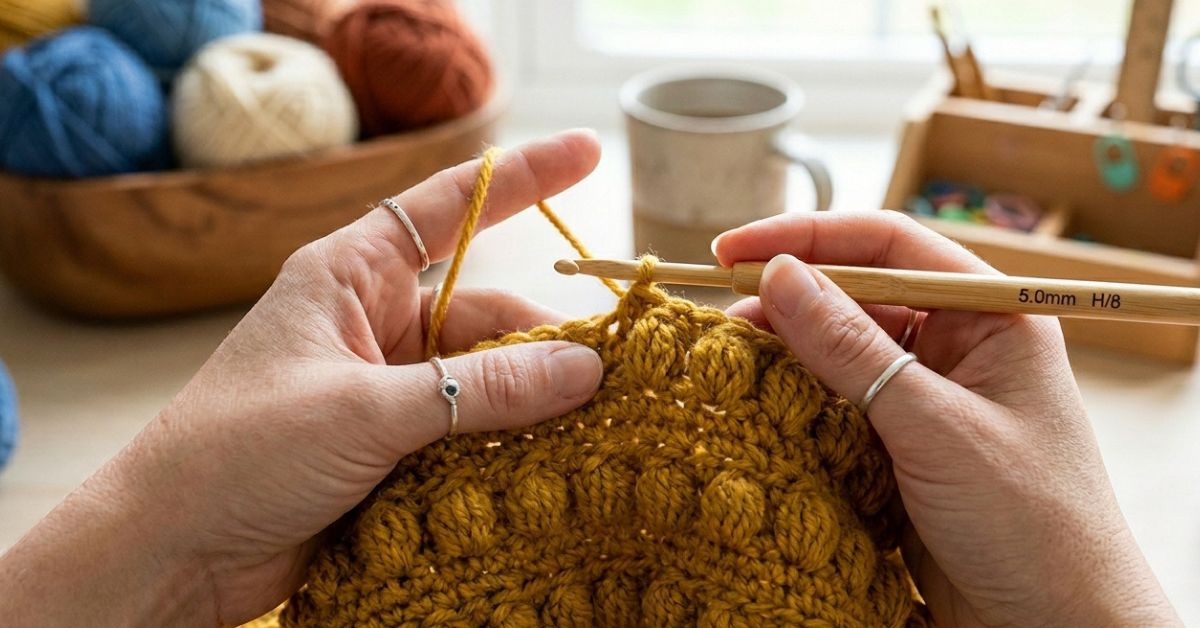
There is something uniquely magical about adding texture to a crochet project. When you first learn to crochet, you start with the basics—the flat, rhythmic beauty of single and double crochet stitches. But once you discover the bobble stitch, your crochet world opens up to a realm of tactile, three-dimensional possibilities. The bobble is essentially a little “puff” of yarn that sits on the surface of your work, creating a cozy, sophisticated look that transforms a simple blanket, cushion, or sweater into a work of art.
If you have ever looked at a beautifully textured throw pillow or a chunky, boutique-style baby blanket and wondered how to achieve that raised, bubbly effect, you are in the right place. Today, we are going to dive deep into the world of the bobble stitch. Whether you are a brand-new crocheter feeling a little nervous about moving beyond the basics or an experienced maker looking to refine your technique for perfectly uniform, plump stitches, this guide is designed for you. We will go over everything from the essential anatomy of a bobble to the professional secrets that keep your work looking polished, elegant, and perfectly consistent every time.
Quick Project Overview
- Skill Level: Beginner-Friendly Intermediate
- Project Type: Decorative Home Decor Piece (Textured Throw)
- Estimated Time: 4 to 6 hours for a decorative pillow cover
- Finished Size: 18″ x 18″
- Best Use: Adding a cozy, boutique aesthetic to your living room or nursery.
- Why You’ll Love It: The bobble stitch is immensely meditative, and the result is a high-end, store-bought look that feels incredibly professional—all for the price of a few skeins of yarn.
Materials Needed
- Yarn: Worsted weight (Size 4) acrylic or cotton-blend yarn. I recommend a medium-weight yarn (approx. 300–400 yards total).
- Crochet Hook: Size H/8 (5.0 mm) or the size recommended on your yarn label. You may want to size down by 0.5 mm to ensure the bobbles are firm and round.
- Tapestry Needle: For weaving in your ends.
- Scissors: Sharp ones are best to keep your yarn fibers neat.
- Measuring Tape: To ensure your project stays square.
- Stitch Markers: Very helpful for keeping track of your bobble placements.
Stitches and Abbreviations
- Ch: Chain
- St(s): Stitch(es)
- SC: Single Crochet
- DC: Double Crochet
- Bobble: A specialized cluster stitch (see explanation below).
- Yo: Yarn Over
Pattern Notes Before You Start
The bobble stitch is created by working several double crochets (usually 4 or 5) into the same stitch, but leaving the final loop of each stitch on your hook. You then pull the yarn through all loops at once, effectively “popping” the stitches forward to create that signature bump.
- Tension is Key: The most common issue with bobbles is “dull” or flat stitches. Keep your tension tight while pulling up the loops for your bobble.
- The Anatomy of a Bobble: We will be using a 5-DC Bobble for this project. This provides a plump, round shape that looks great from every angle.
- Work on the Right Side: For a classic bobble effect, crochet these on the “Right Side” (the front) of your work. The bobbles will naturally push themselves out toward you.
Full Crochet Pattern
This pattern creates a textured square perfect for a decorative cushion cover.
Foundation
Chain 60 (or any number divisible by 4, plus 2 for the turning chain).
Row 1 (Right Side)
SC in the second chain from the hook and each chain across. Turn. (59 SC).
Row 2 (Wrong Side)
Chain 1, SC in every stitch across. Turn.
Row 3 (The Bobble Row)
Chain 1, SC in the first 3 stitches. Work a 5-DC Bobble in the next stitch, SC in the next 3 stitches. Repeat from to until you reach the last 4 stitches of the row. Work a 5-DC Bobble in the next stitch, SC in the final 3 stitches. Turn.
Row 4
Chain 1, SC in every stitch across. Make sure to SC into the top of the bobble stitches firmly. Turn.
Row 5
Repeat Row 2 (Plain SC row).
Pattern Repeats
Repeat Rows 3 through 5 until you have reached your desired length for your cushion cover.
Finishing
Once your square is complete, fasten off, leaving a long tail for sewing. Block your work gently to ensure the bobbles sit evenly, then sew your piece onto a backing fabric or join two identical squares together to form a pillow cover.
Step-by-Step Tutorial Explanation
To create your 5-DC Bobble:
- Yarn Over and Insert: Yarn over, insert your hook into the designated stitch, and pull up a loop. You now have 3 loops on your hook.
- Partial DC: Yarn over, pull through the first 2 loops (as you would for a normal DC). Do not finish the stitch. You have 2 loops left on your hook.
- Repeat: Repeat this process 4 more times in the same stitch.
- Final Pull-Through: After your 5th partial DC, you will have 6 loops on your hook. Yarn over one last time and pull through all 6 loops at once.
- Secure: Immediately SC into the next stitch. The movement of the next SC “seals” the bobble and forces it to pop forward.
Common Mistakes to Avoid
- Loose Bobbles: If your bobbles look like long, spaghetti-like strings, you are being too gentle with your yarn. Pull your loops firmly to the same height before the final pull-through.
- Sinking Bobbles: If your bobbles are disappearing into the fabric, you might be overcrowding the row. Ensure you have flat SC rows in between your bobble rows to give the texture “room” to breathe.
- Incorrect Stitch Count: It is easy to skip the stitch immediately following a bobble. Remember that the bobble counts as one stitch, and the next stitch remains distinct. Always recount your stitches after a complex row.
- Twisted Fabric: When starting with a long chain, make sure your chain doesn’t twist before you join or start that very first row.
Pro Tips for a More Beautiful Result
- Color Blocking: Bobbles look incredible in a solid, neutral color, but they also pop beautifully if you use a variegated yarn for the entire piece.
- Blocking: Because bobbles create such dense fabric, the piece may naturally “draw in” or shrink slightly. Blocking—gently soaking your piece and pinning it into a perfect square while it dries—is the difference between a homemade item and a professional-grade home decor piece.
- The “Push” Factor: If your bobbles are coming out towards the back of your project, simply use your thumb to push them to the front. They are flexible; you can train your stitches to sit exactly where you want them.
- Yarn Choice: Look for a yarn with a slight “bounce” or elasticity, such as a wool blend. Pure cotton is beautiful but can be very heavy and prone to sagging once the weight of all those bobbles is added.
Variations and Personalization Ideas
- Size Variation: This stitch is easily customizable. You can use this pattern for a baby blanket by simply continuing the row repeats until you reach 36 or 40 inches.
- Gift Ideas: A smaller rectangular version of this pattern makes a gorgeous, thick potholder or a cover for a small journal.
- Color Changes: Try doing your SC rows in a cream color and your bobble rows in a contrasting color like sage green or dusty rose for a modern, Scandinavian-inspired look.
- The “Polka Dot” Effect: Instead of row-by-row, space your bobbles out by 5 or 7 stitches to create a “polka dot” texture rather than a solid row of bubbles.
Care Instructions
Handmade items deserve care, especially those with heavy texture.
- Washing: If you use acrylic yarn, a gentle machine cycle in a mesh laundry bag is usually fine. If you use wool or natural fibers, hand wash in cool water with a gentle wool wash.
- Drying: Never wring out your bobble projects, as this can distort the shape of the bubbles. Lay them flat on a towel, reshape them into a square, and let them air dry in the shade.
- Storage: Store flat. Hanging textured crochet pieces can cause them to stretch over time due to the weight of the yarn.
FAQ
How do I know if I am counting the stitches correctly after a bobble row?
Always look at the top of the bobble and the SC stitches that follow. Each bobble acts as a single stitch. If you started with 60 chains, you should always have 60 stitches at the end of every row, regardless of how many bobbles you made.
Can I make the bobbles larger?
Yes! Simply increase the number of partial double crochets you work into the stitch. A 7-DC bobble will be much larger and more prominent than a 3-DC bobble. Just be mindful that larger bobbles require more yarn.
Why does my project look like it’s curling at the edges?
Curling often happens if your tension is too tight or if you are using an incorrect hook size. Ensure your starting chain is slightly looser than your regular stitches; some crocheters even go up a full hook size just for the foundation chain to avoid this.
Is this stitch difficult for a beginner?
The bobble stitch is one of the most rewarding “beginner-intermediate” stitches. It is just a series of double crochets—something most beginners learn in their first week—performed in a specific way. If you can do a DC, you can do a bobble.
Can I iron my bobble project to make it look flatter?
I highly recommend avoiding the iron! The heat can “kill” the synthetic fibers of your yarn or flatten the beautiful, three-dimensional puff of the bobble itself. Stick to light steam blocking (without the iron touching the fabric) if you need to smooth out your edges.
The bobble stitch is a classic for a reason. It is tactile, playful, and offers a level of depth that flat crochet just cannot provide. As you work through your first few rows, remember to be patient with your hands. Your bobbles will get better and more uniform the more you practice. There is no joy quite like finishing that final row, fluffing up those stitches, and seeing the beautiful, bubbly texture you created with your own two hands. Happy hooking, and don’t forget to enjoy the rhythm of the process—that is where the real magic happens!